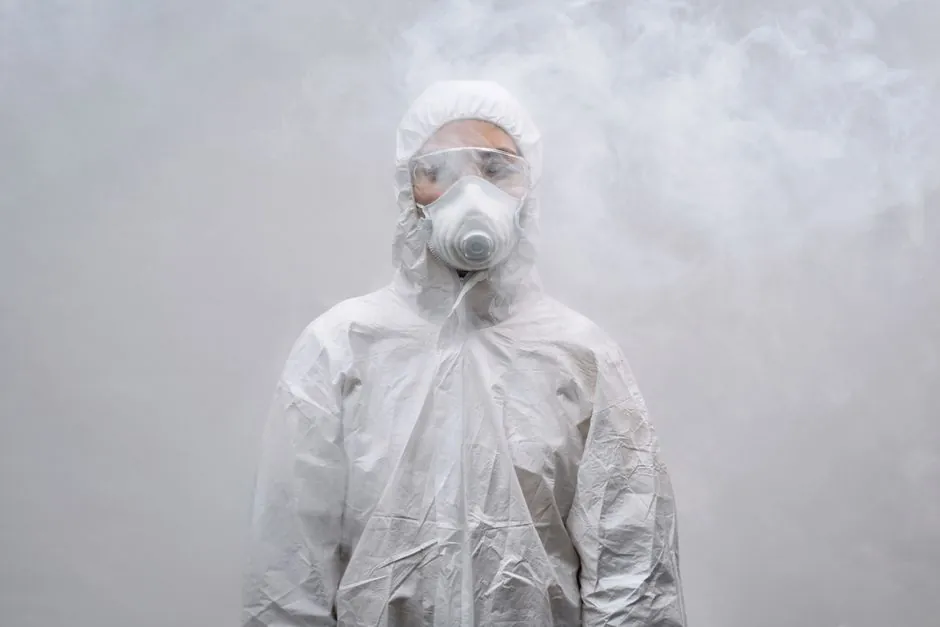
Respirator sizing starts with two facial dimensions, face length measured from the bridge of the nose to the tip of the chin, and mouth/lip width, then mapped to the manufacturer's size chart, because no universal standard across brands guarantees cross-compatibility [S1][S2].
For 3M's reusable half-face line, the practical size band is Small, Medium, and Large, with Medium sitting as the default fit for the majority of adult users and Large reserved for faces that exceed the Medium measurement window [S1]. The fit only becomes real, however, once a user seal check is run, and the OSHA 29 CFR 1910.134 framework treats that check as a mandatory gate before any tight-fitting respirator is used in a hazardous atmosphere.
Anthropometric Measurements That Drive the Size Decision
Face length, nose bridge to chin, is the primary discriminator, with a documented industry cutoff near 4.5 inches (approximately 114 mm) separating the smaller and larger size buckets in common 3M sizing tables [S3]. Mouth width (corner to corner) is the secondary discriminator and the one that most often tips a borderline face from Medium to Large; both dimensions are taken with a flexible tape while the subject stands relaxed [S2][S3].
Skull width and jawline circumference refine the call when the two primary measurements disagree, which is common in roughly the top and bottom deciles of the adult population [S1]. Anyone whose measurements fall outside the published chart should be treated as a special case and trialled against multiple sizes rather than forced into a default [S3]. For buyers sourcing a fleet respirator, the practical action is to stock a balanced ratio across S, M, and L, typically weighted toward M, rather than ordering a single SKU and hoping workers self-fit.
Half-Face vs Full-Face vs Disposable: Matching Respirator Class to Hazard
Half-face reusable elastomeric respirators, like the 3M 6000 Series with its bayonet cartridge interface, cover the nose and mouth, weigh less, and accept swappable P100 or combination cartridges; they are the right default for particulates and organic vapors at or below 10× the OSHA permissible exposure limit [S2]. Full-face respirators add a polycarbonate visor and seal across the forehead and chin, lifting the assigned protection factor to 100 and making them the correct class for higher-exposure atmospheres, gas/vapor IDLH conditions, or any task where eye irritation is a co-hazard [S2].
Disposable N95 / FFP2 / KN95 filtering facepiece respirators are the lowest-cost option and are appropriate for solid and liquid aerosol hazards in healthcare, dust, and light construction work, but they cannot be seal-checked and refit the way an elastomeric half-face can, and they have no cartridge upgrade path. A useful selection matrix:
Class, Typical APF, Best-fit hazards, Service life: Half-face elastomeric (e.g. 3M 6200/6300), APF 10, particulates, organic vapors, acid gases below IDLH, multi-week with cartridge swap [S2]. Full-face elastomeric, APF 100, higher-concentration dusts and vapors, splash or eye-irritation co-hazard, multi-month. Disposable FFR (N95/FFP2), APF 10 in the US framework for fit-tested wear, dust and bioaerosol, single shift or break-room disposal. Powered air-purifying respirator (PAPR), APF 25 to 1000 depending on hood/full-face, beard wearers, hot environments, sustained shift use with battery cycling. Choosing the wrong class is the most common spec error; a half-face on a full-face-class hazard gives workers a false sense of protection.
Filter and Cartridge Pairing: Particulate, Gas/Vapor, and Combination Logic

NIOSH approval letters classify filters by series and efficiency: N-series for non-oil, R-series for oil-resistant up to one shift, P-series for oil-proof; the 95/99/100 suffix sets the filtration efficiency at 95%, 99%, or 99.97% respectively against a 0.3 µm challenge aerosol [S2]. A P100 cartridge is therefore the conservative default for industrial painting, welding fume, and pharmaceutical powder, where oil aerosol is plausible and 99.97% efficiency is desired.
For gas and vapor hazards, 3M-style bayonet cartridges are color-coded: magenta for P100, black for organic vapor, white for acid gas, green for ammonia, yellow for mercury vapor, and olive for multi-gas; combinations (e.g. P100 + organic vapor) are stacked on the same bayonet port [S2]. Match the cartridge to the contaminant and the OSHA substance-specific standard, and never rely on the smell threshold for organic vapors, since olfactory fatigue routinely masks overexposure. For lead and asbestos work, a HEPA-grade (P100) particulate stage is mandatory, and a half-face piece must be combined with that P100 to reach the required APF. The earlier 3M 6000 Series reference confirms the bayonet interface as the swap mechanism, so a single facepiece can move between particulate-only and combination-cartridge duties without re-fitting the head harness [S2].
Fit Testing, Seal Checks, and Who Should NOT Wear a Half-Face
OSHA 29 CFR 191.134 requires qualitative fit testing (QLFT) or quantitative fit testing (QNFT) before first use, annually, and whenever a different model, size, or facial feature change occurs, and a passing fit factor is the only evidence that a size chart pick is actually protective. The user seal check, positive-pressure and negative-pressure, is performed every donning; if the wearer detects leak around the nose, chin, or straps, the respirator is re-seated, re-adjusted, or replaced, never forced into use. Per [S2], "any leakage could compromise protection" and the fit-test result, not the size label, is what legally clears a worker for a regulated atmosphere.
Half-face elastomerics are not appropriate for several worker populations: anyone with facial hair in the seal zone (beard, stubble, sideburns crossing the jawline) cannot pass a fit test on a tight-fitting half- or full-face piece, and OSHA 1910.134(g)(1)(i) bars tight-fitting respirators in that case, routing those users instead to a loose-fitting PAPR hood. Other exclusions include facial scarring across the seal path, significant weight change of roughly 10% or more of body weight, and dental work that alters lip or jaw contour; in each case, re-fit-test rather than assume continuity. Anyone who failed a fit test on a given size should be re-tested on an alternative size or, if all sizes fail, escalated to a powered air-purifying hood before being assigned a respirator-dependent task.
Selection Criteria Buyers Should Lock In Before Sourcing

A defensible respirator specification names seven items: NIOSH or EN 149 approval number; facepiece material (silicone, thermoplastic elastomer, or rubber, with silicone preferred for sweat and chemical resistance); available sizes and the corresponding face-length ranges in mm; cartridge interface type (bayonet, thread, or proprietary); assigned protection factor relative to OSHA 1910.134 Table 1; cleaning and storage method (wipe-down, bag, shelf life of elastomer); and the documented service life of the elastomer shell, typically 1 to 5 years depending on use and cleaning chemistry [S2].
Cost-per-wearer-hour, not sticker price, is the right comparison metric: a 6000-series reusable at roughly $25–$40 for the facepiece plus $8–$15 per cartridge pair, amortized over multi-week service, lands well below disposable FFRs once a worker passes roughly 30–40 shifts per year [S1][S2]. Inventory logic: stock Medium as 50–60% of fleet quantity, Small and Large at 15–25% each, and a small number of full-face pieces for tasks that exceed half-face APF. Pair the spec sheet with a written fit-test record and a cartridge-change-out schedule keyed to contaminant and breakthrough curves, not the calendar alone.
Standards, Records, and Where Sizing Data Lives
The governing documents are OSHA 29 CFR 1910.134 for US fit-testing, training, and medical evaluation; NIOSH 42 CFR Part 84 for respirator certification; and EN 149 (FFP1/2/3) plus EN 140 for the European side, with AS/NZS 1716 covering Australia/New Zealand [S2]. Manufacturer sizing charts are the binding source of numerical face-length-to-size mapping, and 3M publishes these per product family in its technical data sheets, with the 3M 6200/6300 reusable half-face and the 3M 7500 series as the common references [S1][S2].
For an in-depth look at the elastomeric respirator class and its filter-pairing logic, see the respirator reference page; broader PPE selection context sits in construction machinery and equipment for site-safety integration, and the lamps and light fittings page covers the auxiliary lighting spec that often pairs with respiratory PPE on low-visibility tasks. For a worked example of selection-criteria discipline on adjacent safety hardware, the paper-pulp helmet vs industrial safety helmet comparison and the fiber optic sensor sizing guide follow the same measure-map-decide structure applied here.
Track two signals on the next cycle: a fit-test pass-rate of at least 10 representative workers per size and per facepiece model, used to confirm the S/M/L stocking ratio is real, and a cartridge change-out log keyed to breakthrough, not the calendar, used to verify that the filter pairing actually matches the contaminant. Either number below expectations means the size chart and cartridge spec need a second look before the next respirator order ships.