
Respirator selection is governed by three non-negotiable inputs: identified airborne contaminant, measured concentration versus the occupational exposure limit (OEL), and the OSHA Assigned Protection Factor (APF) needed to bring exposure below the limit, per NIOSH guidance [S1][S2].
Two main families cover the field, air-purifying respirators (APRs) and atmosphere-supplying respirators (ASRs), and within APRs sit filtering facepieces, elastomeric half and full facepieces, and powered air-purifying respirators (PAPRs) [S1]. When oxygen drops below 19.5% or the atmosphere is unknown, only SCBA or a combination supplied-air/SCBA is permitted; air-purifying devices do not supply oxygen [S2][S4].
Hazard Identification and the 19.5% Oxygen Floor
The first selection gate is contaminant ID plus concentration versus the OEL, expressed as a hazard ratio (OEL divided by workplace air concentration) [S4]. Particulate hazards route through filters, gas and vapor hazards route through cartridges, and combined exposure requires combination cartridges [S2].
If the atmosphere contains less than 19.5% oxygen, is oxygen-deficient, or has unknown contaminants, the only legal choice is SCBA or combination supplied-air/SCBA, and this rule is repeated across NIOSH, 3M, and CCOHS sources [S1][S2][S4][S5]. CCOHS frames the same flow as four steps: identify hazard, decide whether respiratory protection is needed, determine the protection level required, then pick the device [S5].
For a comparison of the main respirator families against decision criteria, the table-style rundown below lines up the four common duty profiles buyers actually face.
APF Comparison: Filtering Facepiece vs Elastomeric vs PAPR vs SCBA
Assigned Protection Factor is the multiplier that links a respirator class to the maximum use concentration, and Table 1 of OSHA 29 CFR 1910.134 is the reference list that pairs each class with its APF [S1]. Filtering facepieces typically sit at APF 10, elastomeric half masks at APF 10, full-face elastomerics at APF 50, and PAPRs/loose-fitting headgear at APF 25 to 1000 depending on configuration, with SCBA rated at APF 10,000 in pressure-demand mode [S1].
For a buyer weighing the four common options against four criteria, the picture lines up as follows. (1) Particulate dust, fibers, or sanding debris: filtering facepiece at APF 10 covers most tasks; upgrade to elastomeric half mask if reusable cartridges and lower long-run cost matter. (2) Organic vapors or solvents: elastomeric half mask with organic vapor cartridge, APF 10, common in paint and pesticide work [S6][S7]. (3) High-concentration aerosols with sweat or heat load: loose-fitting PAPR at APF 25 to 1000, no fit test required, used in healthcare and welding [S1][S3]. (4) Oxygen-deficient, IDLH, or fire atmospheres: pressure-demand SCBA at APF 10,000, used by firefighters and mine rescue teams [S1][S2].
A NIOSH guidance text on the topic states: "When an employer determines that workers need respiratory protection, the Occupational Safety and Health Administration (OSHA) requires the use of NIOSH Approved respirators" [S1]. That sentence is the legal floor: any device that lacks a NIOSH approval label is not a workplace respirator in the US sense, and the markings on the mask plus the NIOSH approval label are how buyers verify that the device is actually on the approval list [S1].
Filter and Cartridge Chemistry: P, N, R for Particles; Letters for Gases
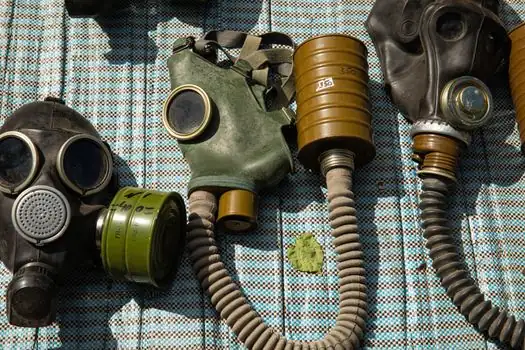
NIOSH particle filters are graded P (strongly resistant to oil, longest service life), R (somewhat resistant, time-limited), and N (not oil-resistant), and each grade comes in 95, 99, or 100 efficiency levels, so an N95 is the common minimum for non-oil dust [S3]. Gas and vapor cartridges are color-coded by chemical family: black for organic vapors, white for acid gases, green for ammonia, olive for multi-gas, and a magenta or other color stripe indicates a P100-grade particulate prefilter stacked on the chemical cartridge [S2][S3].
Combination cartridges stack a chemical sorbent with a P-grade particulate prefilter, which is the right pick when both hazards show up in the same exposure assessment, for example spray painting with a pigment aerosol plus solvent vapor [S2][S7]. The 3M selection guide flags that filter selection also depends on whether the contaminant is a particle, a gas, or a mixture, and warns explicitly that the hazard ratio against the OEL drives the assigned protection factor, not the filter letter alone [S4].
OSHA's 29 CFR 1910.134 standard mandates a written respiratory protection program that includes training, fit testing, and medical evaluation; in Canada the equivalent is CSA Z94.4 [S4]. Buyers shopping catalog respirators in isolation skip the medical evaluation step at their legal peril, and the program's fit-test record is what makes the assigned APF actually hold on the wearer's face.
Fit Testing, Facial Hair, and Human Factors
A tight-fitting respirator's APF only holds if a qualitative or quantitative fit test passes on the wearer's face, and the fit test also determines whether a half mask or full-face elastomeric is the right size [S6]. Beards, stubble, and facial hair that crosses the sealing surface disqualify tight-fitting devices; loose-fitting PAPR hoods or headcovers are the alternative that does not require a fit test [S4][S6].
For buyers specifying for a crew, common selection errors include picking a half mask when the hazard ratio plus APF requires a full face, picking a single-gas cartridge when the exposure assessment shows multi-gas, and skipping the medical evaluation that screens for cardiac or pulmonary conditions that make breathing resistance unsafe [S2][S4]. Leaving the contaminated area immediately on dizziness, breakthrough smell or taste, breathing difficulty, or cartridge damage is also part of the rule, and is a write-up, not optional behavior [S4].
For related selection work on adjacent personal-protective equipment categories, this PPE sizing walkthrough on stainless-steel-tool selection covers material-spec pairing, and this paper-pulp helmet vs industrial safety helmet comparison covers head protection selection in a similar hazard-driven way. For a deeper look at flame-protection hardware that pairs with respirators in petrochemical work, see the flame arrester advantages and disadvantages reference.
Who Should Not Pick a Mainstream Filtering Facepiece

Three duty profiles break the filtering facepiece (N95-class) choice even though it is the most common catalog buy. First, oxygen-deficient or IDLH atmospheres, which require SCBA or combination supplied-air/SCBA regardless of filter efficiency, because air-purifying devices do not add oxygen [S1][S2][S4]. Second, organic vapor or acid gas exposure, which requires chemical cartridges that a particulate-only facepiece cannot carry, and 3M and NIOSH both route gas and vapor hazards to elastomeric cartridges or PAPRs, not to N95s [S2][S7]. Third, workers who cannot pass a fit test or who have facial hair on the sealing surface, where a loose-fitting PAPR hood with the appropriate cartridge is the correct alternative, and the assigned APF jumps accordingly [S4][S6].
Within industrial PPE maintenance, the sander belt failure-modes reference and the wind turbine shaft collar material guide follow the same hazard-first selection logic that drives respirator choice. For facility-side specification beyond PPE, test leads for water treatment selection is a parallel buyer's map anchored on measured parameters rather than catalog SKUs.
Reuse, Storage, and the Maintenance Loop
Reusable elastomeric respirators need a maintenance, cleaning, and storage program that runs on a routine schedule, and that program is part of the OSHA 29 CFR 1910.134 written program, not a separate initiative [S1][S4]. Discard disposable filtering facepieces when they become damaged, soiled, or breathing resistance rises; replace cartridges on the change-out schedule dictated by the manufacturer and the exposure pattern, or earlier if the wearer smells or tastes breakthrough [S2][S4].
Storage matters more than buyers expect: cartridges left in a contaminated or humid atmosphere lose service life, and the 3M guide specifies that cartridges must be sealed or stored per the User Instructions to keep the sorbent active [S4]. Pair the program with a medical evaluation recheck on a defined cadence, since a worker's pulmonary or cardiac status can shift and erode the safe use of any tight-fitting device [S4].
Closing signal: track NIOSH respirator approval label revisions on the NIOSH Certified Equipment List and any updates to OSHA 29 CFR 1910.134 Table 1 APF values, and cross-check CSA Z94.4 if Canadian sites are in scope, since those are the two reference points that anchor the legal APF of any catalog buy [S1][S4].
Detailed specification references: respirator, pressure transmitter, and flow meter.