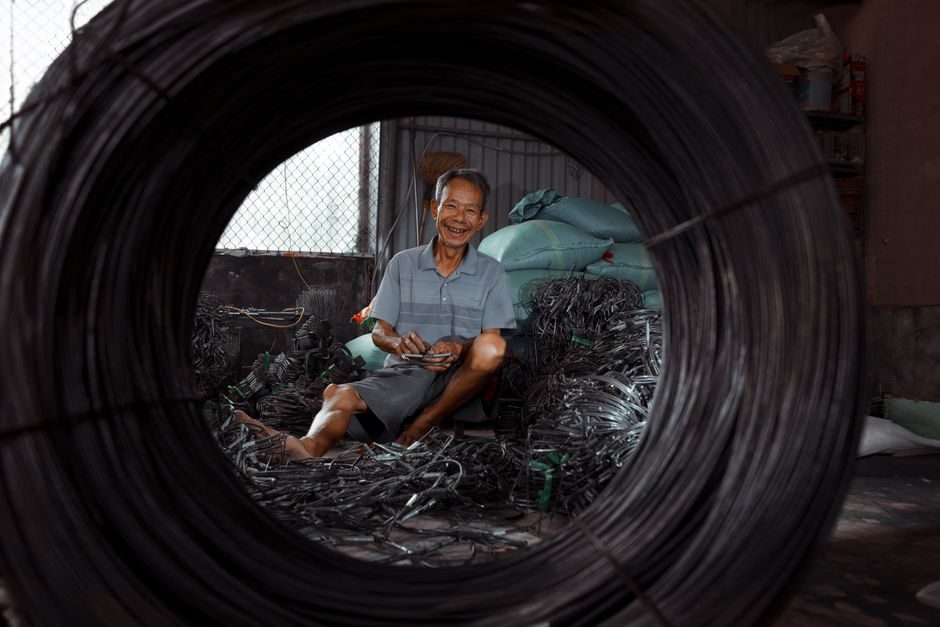
Wire rod is hot-rolled round steel in the 5–22 mm diameter range, also covering special-shaped cross-sections, supplied in coil form rather than straight bar [S1]. That single definition drives every spec decision, because diameter, grade, and surface condition all map back to what the rod will be drawn, headed, or welded into downstream.
Buyers shopping wire rod in 2026 should fix four variables before quoting: (1) steel grade family, (2) diameter and ovality tolerance, (3) surface and descaling condition, and (4) coil weight / inner diameter. Skipping any one of these usually produces a coil that cannot run on a multi-station drawing machine or a cold-header [S1].
Grade Family and End-Use Mapping
Wire rod is specified by intended downstream process, not by generic strength class. Common grade families include low-carbon (drawing and welding wire), medium-carbon (nails, fasteners, concrete mesh), high-carbon (spring, rope, bead wire), and cold-heading quality (CHQ) for bolt and screw stock [S1].
Low-carbon rod (typically SAE 1006–1018) feeds welding wire and galvanised tying wire, while CHQ grades (SAE 1018–10B21, 10B33, 10B38) feed cold heading where uniform hardness and grain flow matter. For sour-service or oil-and-gas fasteners, the rod itself is not NACE-rated; the rating applies to the finished fastener and its heat treatment, so engineers should track the finished component rather than the coil [S1].
Diameter, Tolerance and Ovality
Standard wire-rod diameters run 5.5, 6.0, 6.5, 7.0, 8.0, 9.0, 10.0, 11.0, 12.0, 13.0, 14.0, 15.0, 16.0, 17.0, 18.0, 19.0, 20.0, 21.0 and 22.0 mm, covering the bulk of mesh, nail, and wire-rope demand [S1]. Tolerance bands tighten as drawn downstream processes demand finer feed: mesh and nail makers typically accept ±0.30 mm, while CHQ bolt stock commonly needs ±0.15 mm or tighter on diameter and a defined ovality ceiling (often ≤50% of the diameter tolerance) [S1].
Ovality is the silent reject cause at the drawing bench. A coil that measures 8.00 mm on one axis and 8.45 mm on the other will break dies on the first block, even though every average-diameter check passes. Insist on a written ovality figure (mm) and a sampling frequency per coil on the mill test certificate [S1].
Surface Condition, Descaling and Scale

Hot-rolled wire rod exits the last stand with a tenacious oxide scale layer. The three commercial surface conditions are: (1) "as-rolled" with intact mill scale, (2) mechanically descaled (shot-blast or brushed) for direct drawing, and (3) pickled for premium surface. As-rolled rod is the cheapest but forces the buyer to run an acid or mechanical descaling cell before wet drawing [S1].
Surface defects — seams, laps, scabs, edge cracks on shaped rod — propagate straight into the wire and the finished fastener. A 0.05 mm surface seam on an 8 mm rod is invisible at the receiving dock but becomes a 0.5 mm split at the finished 2 mm wire. Specify ASTM E45 inclusion rating and a longitudinal surface-defect sampling rate on the MTC, especially for spring and bead-wire grades [S1].
Coil Weight, Inner Diameter and Mill Layout
Wire rod ships in coils whose weight and inner diameter must match the buyer's payoff cradle. Standard export coils run 1.5–2.0 tonnes with a 850–900 mm ID, but Chinese and Korean mills also offer heavy coils up to 2.5 t for high-tonnage wire-draw lines, while small-jobbers take 500–800 kg coils for nail and mesh shops [S1].
Mismatched coil ID is a top cause of payoff-arm fatigue and snarl break-outs. A 900 mm-mill coil on a 1250 mm payoff will crush the inner wraps; a 1250 mm coil on a 900 mm cradle will not unwind. Lock the ID on the PO, not just the OD and weight [S1].
Mechanical Properties and Test Certificate Discipline
Three numbers dominate the wire-rod MTC: tensile strength (Rm), reduction of area (Z) and elongation (A). Low-carbon mesh rod typically lands at 380–520 MPa Rm with A ≥25%; CHQ rod runs 450–600 MPa Rm with tighter Z minima to guarantee cold-heading ductility; high-carbon spring rod (SAE 1070–1090) climbs to 900–1200 MPa Rm as-rolled, with Z falling below 20% [S1].
For drawn or heat-treated applications, the buyer should also request a decarburisation depth (mm) and a microstructure rating (perlite fraction, band spacing for high-carbon). A coil that passes tensile and Z but shows 0.30 mm ferrite decarb on 6.5 mm rod will crack at the first cold-heading station [S1].
Application Snapshot: Mesh, Fastener, Spring, Welding
Concrete mesh (welded wire fabric) uses 5.5–12 mm low-carbon rod at 380–520 MPa; galvanized tying wire uses 5.5–6.5 mm low-carbon rod bought on elongation, not tensile. Cold-heading bolts and screws use 6.5–22 mm CHQ rod graded for the finished fastener class (4.8 up to 12.9). Spring and wire rope use 6.0–14 mm high-carbon or patented rod, with the highest pearlite-band demands. Welding wire uses 5.5–6.5 mm low-carbon rod with tight chemistry windows on C, Mn, Si and residual Cu/Sn/P to keep the wire feed clean [S1].
The decision matrix for a procurement engineer is therefore simple: pin the end product first, then the grade, then the diameter and tolerance, then the surface, then the coil geometry. Reverse the order and the spec drifts. Buyers comparing related industrial inputs — for example, the deformed rebar that goes into the same rebar-yard or the deformed rebar spec landscape for 2026 — should apply the same grade-first logic to keep the coil and the bar auditable against the same MTC discipline.
Cross-Check: Drawing Behaviour and Steel Cleanness

Two rods with identical tensile strength can draw very differently. Steel cleanliness — the count, size and distribution of non-metallic inclusions — controls drawability far more than the headline Rm figure. A "dirty" heat with alumina clusters draws to a 2 mm wire with frequent breaks; a clean heat of the same grade runs the same reduction without a snap [S1].
Specify a maximum inclusion rating per ASTM E45 (Type A sulfides, Type B aluminates, Type C silicates, Type D oxides) on the MTC for any rod destined for multi-pass wet drawing or for cold heading above 10.9 grade. For sour-service fasteners, the finished component must meet NACE MR0175 / ISO 15156 limits, but the rod itself is qualified at the heat-treatment step, not at the coil [S1].
Engineers sourcing from Chinese OEM clusters will see mill test certificates in both EN 10080 and GB/T 14981 formats; the chemistry and mechanical ranges are equivalent, but the sampling and frequency wording differs. Cross-check both, and require the original mill stamp plus a third-party SGS or BV inspection for first-trial orders above 200 t [S1].
Trackable Next Signals
Track three signals on the next sourcing cycle: (1) mill-published tolerance band on the MTC (≤±0.15 mm or ±0.30 mm), (2) coil inner-diameter confirmation on the packing list, and (3) decarburisation depth and inclusion rating for any rod going into cold heading above 8.8 grade. These three numbers — not the headline tensile — decide whether the coil runs cleanly on the line or breaks dies on the first block [S1]. Engineers can cross-reference the related deformed rebar sourcing map for 2026 when the same yard is buying both rebar and rod stock, and revisit the foundational wire-rod spec reference when grading a new supplier trial.
For component-level specifications, see draw wire sensor, and pressure transmitter.