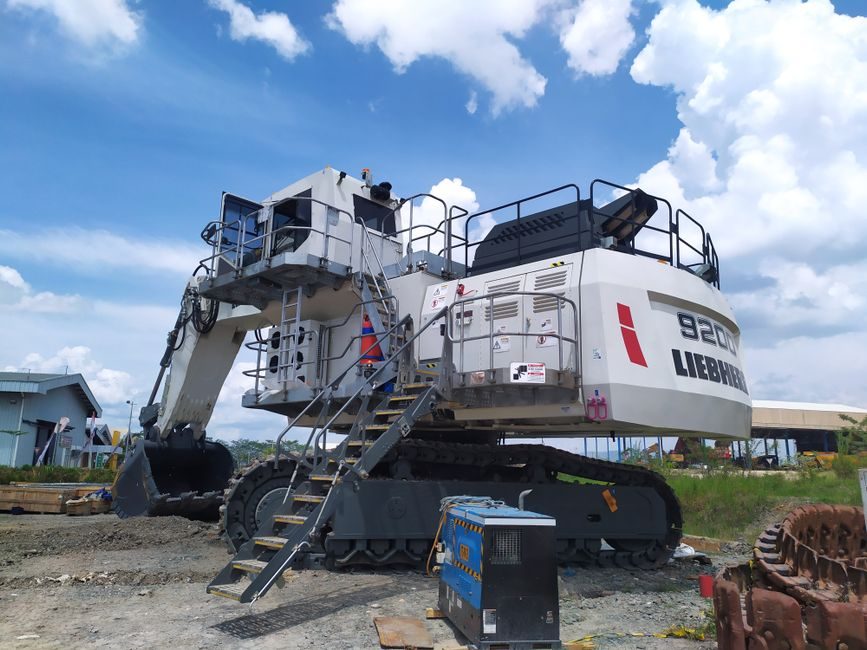
For surface mining duty, the dominant decision variables are operating weight, engine rating, bucket capacity, and how cleanly the loader mates to the haul-truck fleet, with Komatsu's loading tool guide mapping the 200–409 t class to trucks from 90 t up to 240 t [S2].
This selection map covers the three product lanes an engineer will be offered: electric rope shovels, hydraulic mining excavators (diesel or electric), and front-shovel/backhoe hydraulic mining-class units from Komatsu, Liebherr, and Hitachi [S2][S3][S6]. For broader context on the excavator size bands, the small/medium/large split runs at 10–25 t, 25–50 t, and >50 t, with a thin tier above 500 t reserved for intense mining projects [S1].
Class Boundaries: From 100 t to 400+ t
Mining-class hydraulic excavators typically sit between 100 t and 400 t operating weight, with the Komatsu PC2000 at 200 t (12 m³ bucket) matched to 90–160 t trucks, the PC3000 at 257–264 t (16 m³) matched to 85–165 t trucks, and the PC4000 at 398–409 t (22 m³) matched to 150–240 t trucks per the Komatsu loading tool selection guide [S2].
Liebherr's G7 generation occupies a lower-mid mining band: the R 9150 G7 weighs 116 t with a 565 kW engine at 1800 rpm and 7.00–7.50 m³ backhoe bucket (7.30 m³ shovel), while the R 9200 G7 holds 130 t on either backhoe or face-shovel attachment with 8.80–9.60 m³ backhoe and 8.30 m³ shovel capacity at 1.8 t/m³ material density [S3]. Liebherr's broader mining product line runs eight models with bucket capacities from 7 to 47.5 m³, covering 13–80 tonnes of material weight per pass [S3].
Loading-Tool Types and What Each Is For
Komatsu's loading tool selection guide identifies four product lanes for surface mining load-and-haul: electric mining shovels with AC drives, hybrid shovels with reduced fuel burn and onboard hydraulics, hydraulic mining excavators in front-shovel or backhoe configuration (diesel or electric drive), and wheel loaders as the fourth option [S2].
Electric mining shovels remain the workhorse for hard-rock, high-tonnage pits where a dedicated power supply is available; hybrid shovels target the same duty cycle with materially lower fuel consumption and a smaller hydraulic service load; hydraulic mining excavators cover the widest truck-match range and are the only practical option when the mine face must be relocated frequently or power infrastructure is unavailable [S2]. The Komatsu lineup also bundles Intelligent Machine Control on certain models, integrating machine guidance and payload monitoring without aftermarket add-ons [S4]. Hitachi markets its mining excavator range under the same load-and-haul logic, framing the product line around the intersection of mining technology and sustainability rather than a single bucket-size class [S6].
Decision Criteria: Bucket, Truck Pass Match, Engine Power
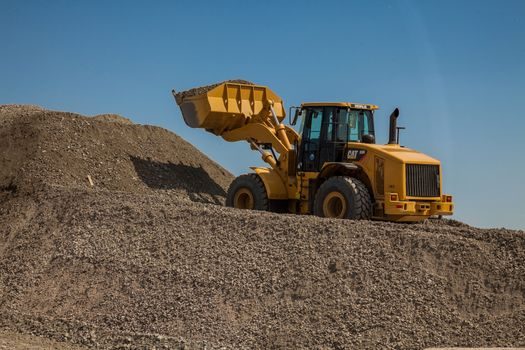
Four criteria drive a defensible selection in most tenders: (1) bucket capacity at a stated material density, (2) truck-pass count per loading cycle (typically 4–6 passes for an optimal match), (3) engine power relative to operating weight, and (4) energy source — diesel vs. electric — which governs fuel logistics, ventilation, and emissions exposure for underground-adjacent pits. [S2]
Komatsu's guide lists the engine ratings and bucket volumes directly against the recommended haul-trick tonnage for each model: PC2000 at 200 t paired to 90–160 t trucks (12 m³), PC3000 at 257–264 t paired to 85–165 t trucks (16 m³), and PC4000 at 398–409 t paired to 150–240 t trucks (22 m³) [S2]. Equipment selection modelling for surface mining, reviewed by Burt and Caccetta, treats the loader–truck pass-match problem as a constrained optimisation, not a horse-power race, because an over-sized bucket on an under-sized truck fleet simply queues the pit [S5].
Engine, Hydraulic, and Drive-Train Specifics
At 565 kW (≈757 hp) the Liebherr R 9150 G7 and R 9200 G7 sit in the same engine-output band, but the larger machine converts that power into 8.80–9.60 m³ of bucket volume rather than higher cycle speed [S3]. Komatsu's PC2000 to PC4000 series spans roughly 200–409 t and bucket volumes of 12–22 m³, a range that more than doubles material moved per pass from the smallest to the largest unit in the line [S2].
For a fleet planner, the operating-weight to bucket-volume ratio is the figure that predicts ground-bearing pressure and pit-floor wear: the R 9150 G7 at 116 t and 7.00–7.50 m³ carries ~15.5 t per cubic metre of bucket, while the PC4000 at 398–409 t and 22 m³ carries ~18 t per cubic metre, indicating a heavier, more aggressive digging platform better matched to blasted hard rock [S2][S3]. Cycle-time figures vary with material density and truck spotting, which is why the Komatsu guide frames the choice around the loading tool's interaction with the truck fleet rather than the engine's headline kW [S2].
Standards, Sourcing, and Application Boundaries
Komatsu explicitly positions the loading tool selection guide as a first-pass tool, advising the buyer to follow up with a Komatsu loading tool expert for site-specific conditions, on-site maintenance capability, and capital-recovery modelling [S2]. The same guide ties equipment selection to mine layout, geologic conditions, blasting technique, and maintenance footprint — none of which can be solved by the spec sheet alone [S2].
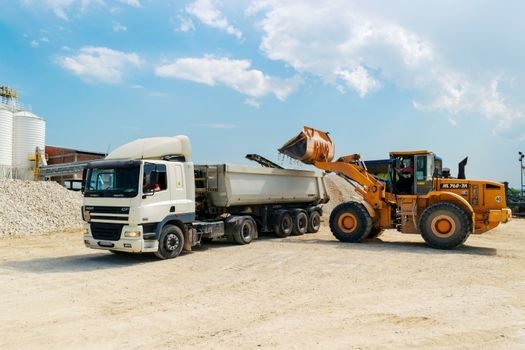
Selection is also constrained by truck-fleet availability: a mine running 90 t rigid-frame trucks has no business pairing a 22 m³ PC4000-class bucket, and a mine running 240 t trucks wastes money on a 12 m³ PC2000-class unit [S2]. For pits that also handle mining dump truck fleets, the loader's bucket must be sized so 4–6 passes fill the truck box without spillage, and so the truck's payload-to-bucket ratio stays inside the engine's tractive-effort envelope on grade. The mining-excavator sizing logic therefore mirrors the broader construction-excavator rule that operating weight, dig depth, dump height, reach, bucket capacity, and engine power must be evaluated together rather than as independent KPIs [S1].
Limitations and Failure Modes
Common failure modes in mismatched fleets include under-trucked shovels (queue time at the face), over-trucked shovels (empty truck cycles), and over-buoyed buckets that cannot fill on a single pass in light-density material, which is why Komatsu publishes bucket volume at a stated t/m³ rather than a nominal maximum [S2][S3].
Electric-drive excavators and shovels remove diesel-particulate and ventilation load but lock the asset to a fixed cable plan, which constrains face mobility and inflates capex in greenfield pits without existing substation infrastructure [S2]. Hybrid shovels sit between the two, cutting fuel burn versus a diesel hydraulic but still requiring on-board hydraulic service, so parts commonality with the diesel fleet matters more than the marketing fuel-saving figure [S2]. At the smaller end, the 10–25 t mini and compact range is excluded from mining-class duty entirely; small models typically run 50–170 hp and 15–22 ft dig depth, suited to utility work and congested sites rather than a truck-loading face [S1].
Trackable Signals to Watch Through 2026
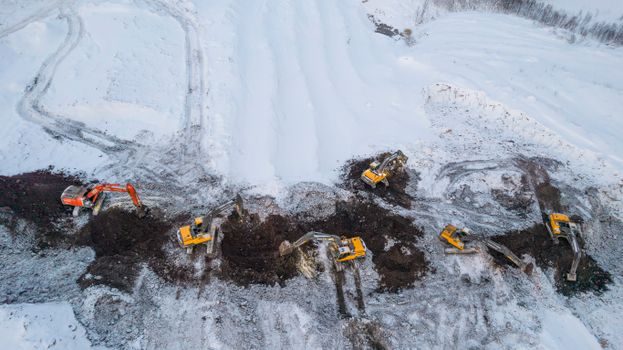
Two signals to track through the rest of 2026: the rollout of Intelligent Machine Control on additional Komatsu mining-class models [S4], and the expansion of the Liebherr G7 generation — the R 9150 G7 and R 9200 G7 are the published 2024-onwards entry points, with the larger eight-model line still scaling to 47.5 m³ bucket capacity [S3]. Hitachi's framing of the mining-excavator line around the "intersection of mining technology and sustainability" also points to a hybrid or electric variant arriving on its 100 t-plus platform, though no model has been published at the time of writing [S6]. For buyers, the next decision node is a site-specific pass-match simulation that locks in the bucket volume and truck class together — see the excavator reference for the full size-band breakdown, and cross-check the haul-truck side at mining dump truck before committing capital.
Spec-level background on the components involved: pressure transmitter.
Background reading: Ready-Mix Concrete Selection for Residential Construction: A Spec-Driven Map.