
An edge server for plant analytics is a ruggedized, locally deployed compute platform that ingests sensor and vision data, runs ML inference and historian buffering on-site, and forwards only curated insights to the enterprise cloud. Sizing is driven by four numbers: peak ingest rate, model inference latency, storage window, and the network uplink budget to the control room and cloud.
The market math backs the shift: the global edge server segment is forecast to reach USD 91.1 billion by 2033 at a 36.7% CAGR [S7]. ARC Advisory Group tracks the segment as a distinct industrial-edge-server category separated from IPCs, defined by 24/7/365 operation, hot-swappable drives, redundant power, and remote management [S2].
Start With the Workload Profile, Not the Vendor Datasheet
The single biggest sizing mistake is starting from a chassis spec sheet. A steel plant generates more than 2 petabytes of sensor data per year across thousands of temperature, vibration, gas and process tags, and the cloud round-trip of 500-2000 ms is too slow for blast furnace thermal control and rolling-mill cobble detection [S3]. The edge server's job is to absorb that data, run inference locally, and emit only events.
Build the profile from three numbers: tags-per-second ingest, frames-per-second for any vision pipeline, and the model class (FFT/CNN/RNN/LLM). Blast furnace thermal modeling in the cited steel reference ingests 500+ sensor inputs every 30 seconds and demands inference under 100 ms to be actionable [S3]. A cobotic safety loop, by contrast, needs sub-cycle decision time measured in milliseconds, not seconds [S5].
CPU, RAM, GPU, Storage: The Sizing Math
Edge servers are assembled from server-class components arranged to process, store, and manage data locally: processor, memory, AI acceleration, storage, networking, and remote management [S1]. The processor, memory and cache are the clearest indicators of real compute capability, and industrial edge servers use server-grade silicon rather than desktop parts [S1].
Data historian / SCADA bridge: 8-16 cores, 32-64 GB ECC RAM, 4-8 TB industrial SSD or NVMe, no GPU. AOI and machine vision: 16-32 cores, 64-128 GB ECC RAM, one or more rack/embedded GPUs (or edge TPUs), 10-25 GbE uplink, 8-16 TB storage. Predictive maintenance analytics: 16-32 cores, 64-128 GB ECC RAM, optional GPU for FFT + classifier, 8-20 TB. Soft-PLC or soft-CNC controller workloads, which ARC expects to consolidate onto the edge server, demand deterministic cores, real-time OS or RT patches, and redundant PSUs [S2].
Storage sizing should hold at least 30 days of raw plus derived data locally so analytics survive WAN outages [S3]. Hot-swappable drive bays are specified precisely so a failed disk can be replaced without a process stop [S2].
Hardening for the Cabinet: Temperature, Vibration, Dust, Power
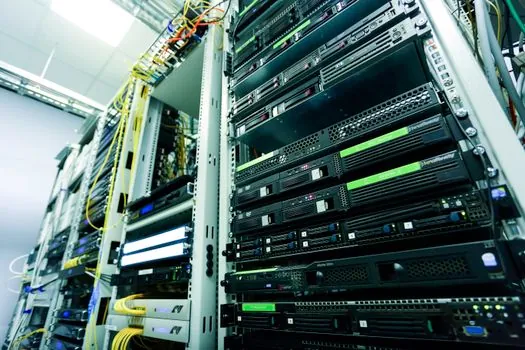
Industrial edge servers are built for harsh deployment environments, not the climate-controlled data center aisle, and are engineered with wide operating temperature ranges, ESD protection, and vibration resistance [S1]. STL Partners makes the same point more bluntly: a base-station or oil-rig edge server will be standalone and ruggedized because it has no enclosure to live in [S4].
Match the chassis spec to the actual cabinet. For a control-room rack, a 1-2U short-depth server with 0-40 degrees C operating range is usually fine. For a rolling-mill or forge floor, specify -25 to 60 or 70 degrees C, 5 g vibration, conformal coating, and fanless or sealed heat-pipe cooling. Dual redundant power supplies, surge protection, and IEC 61850-3 or similar substation-grade isolation are typical in energy sites.
Network I/O is part of the hardening. Plants still speak PROFIBUS, PROFINET, EtherNet/IP, Modbus TCP and a long tail of legacy fieldbuses, and the edge server typically sits behind a protocol gateway that normalizes these into OPC UA or MQTT. For brownfield sites with serial instrumentation, an industrial modem or serial server front-end is still common.
Latency Budget: Where Edge Wins and Where It Does Not
Cloud-only architectures impose 500-2000 ms latency for plant telemetry, which rules them out for thermal control and cobotic safety, and that latency is the entire reason edge exists for these applications [S3]. Edge cuts this to 1-100 ms depending on model size, hardware acceleration and I/O path.
Set the latency target first, then size backward. Sub-10 ms safety loops need deterministic cores, RTOS or kernel patches, and direct fieldbus access, often a soft-PLC. Sub-100 ms quality and predictive loops can tolerate Linux plus a GPU. Sub-second dashboards and historian replication are comfortable on standard server hardware. Anything looser than 1 second is a candidate for cloud; pushing it to the edge wastes capex. The broader cloud-vs-edge decision is laid out in Cloud vs Edge for Manufacturing Analytics: Latency Budget and Cost Verdict.
Comparison: Edge Server Classes by Use Case

Industrial edge servers are not one product. STL Partners and ARC split them by where they sit on the edge spectrum and by form factor, and the right class depends on the workload, environment, and lifecycle expectation [S2][S4].
Device-edge node: a small computer or processing block bolted to a single asset, typically a smart camera or vibration sensor; used for asset-monitoring analytics on one machine. Best for OEMs embedding analytics per unit; too small for plant-wide historian or AI inference. On-premise edge server, fanless/rugged: a single ruggedized box mounted on the shop floor, oil rig, or cabinet; runs vision, FFT, and condition monitoring for a line or work cell. Best for 1-3 production lines with harsh environment. On-premise data-room edge server: 1-4U rack server in a plant IT closet; runs historian, ML inference, optional soft-PLC for a plant or unit. Best for plant-wide analytics and OT/IT integration. Network or regional edge server: telco or colocation facility further from the plant; used for shared inference across multiple sites. Best when the workload tolerates 10-50 ms WAN latency.
The sizing, ruggedization, and cost scale with the class. The math is the same in each: cores, RAM, accelerator, storage, and network matched to the workload peak plus headroom.
Failure Modes and Sizing Pitfalls
Under-provisioned storage is the most common field failure. Local retention must cover at least one full maintenance window plus any cloud-outage scenario, and 30 days of raw plus derived data is a working baseline [S3]. Skimping here forces a rollback to cloud-only just when the WAN fails.
Ignoring accelerator mismatch is the second. Running a CNN-based surface-defect model at 60 frames per second without a GPU or edge TPU is not realistic; cited steel-plant AOI reaches 99.8% detection at 60 fps by using edge TPUs and trained CNN classifiers, not a CPU-only box [S3]. Conversely, buying a GPU for a pure FFT vibration workload is wasted capex.
Third, lifecycle. Industrial edge servers are specified for long lifecycle operation in operational environments, years longer than consumer or even standard enterprise server refresh cycles [S1]. A chassis that goes EOL in three years can orphan a plant deployment, so confirm the vendor's roadmap against the plant's capex horizon. Fourth, management: ARC's definition of the category requires remote server maintenance because no plant wants to dispatch IT to a cabinet every time a service pack ships [S2].
Standards, Sourcing, and a Practical Sizing Workflow

There is no single ISO or IEC standard that dictates edge-server sizing, so the engineering practice is to work from a published workload profile and verify against the vendor's benchmark on the target model class, not the marketing peak TOPS number. For environment hardening, common references include IEC 60079-series for hazardous areas when the edge server is mounted in or near Ex zones, IEC 61850-3 for substation communications, and the NEMA TS-2 traffic-control envelope for outdoor cabinets. For OT network integration, lean on the industrial router and fiber converter selection, since the edge server's uplink determines whether the latency budget actually holds at the fieldbus layer. [S1]
Two trackable signals to watch: a published edge-server model code with an operating temperature envelope at or above 60 degrees C, hot-swappable storage, and a redundant PSU; and a published benchmark on the target CNN/FFT workload at the required fps. Either is enough to shortlist for a plant trial.