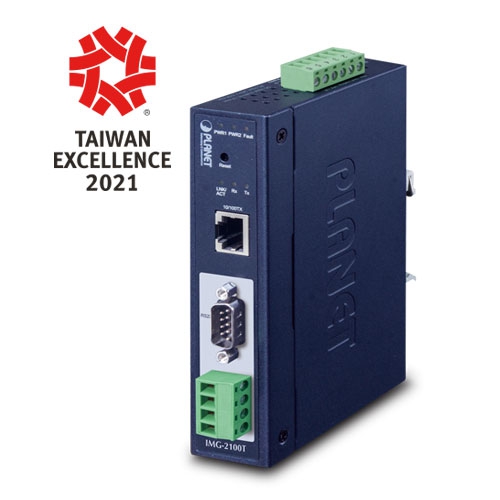
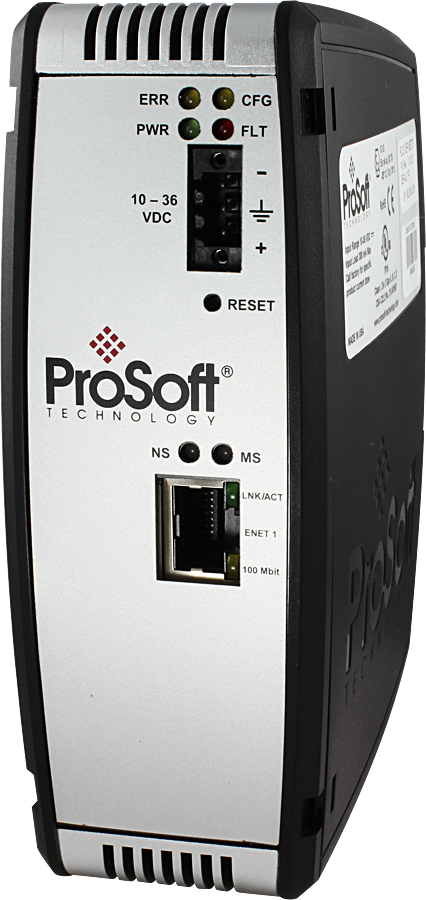
A protocol gateway is an industrial communication device that translates the data model of one automation protocol into the data model of another, letting devices that speak Modbus, PROFIBUS, PROFINET, EtherNet/IP, or other fieldbus and industrial Ethernet languages exchange process data without rewiring or reprogramming the endpoints. Unlike a serial device server, which only tunnels raw bytes, a gateway understands both protocols and re-maps registers, words, and I/O modules between them.
Gateways are the connective tissue of mixed-vendor plants. They let a new PROFINET PLC read legacy Modbus RTU meters, bridge an EtherNet/IP line into a PROFIBUS DP cell, or aggregate field assets into an OPC UA or MQTT stream for the cloud. This guide explains how they work, the main types, the protocol families they bridge, the hardware specifications that matter, and the decisions that drive selection.
Photo: Xqt, CC BY-SA 4.0, via Wikimedia Commons
This guide is aimed at industrial purchasing engineers and design engineers. It covers 6 chapters from conversion principles, gateway types, fieldbus and industrial Ethernet protocol families, hardware specifications, to selection decisions, with 7 selection FAQs and manufacturer comparisons, helping you build a complete protocol-conversion knowledge framework in 30 minutes. Protocol references follow the IEC 61158 fieldbus standard, the IEC 61784 communication-profile series, IEC 62541 (OPC UA), and the published EMC and hazardous-area standards IEC 61000, ATEX, IECEx, and EN 50121-4.
Chapter 1 / 06
What is a Protocol Gateway
A protocol gateway is a networking device that converts process data between two incompatible industrial communication protocols so that controllers, drives, instruments, and software on different networks can exchange information. In automation terminology it is also called a fieldbus gateway or protocol converter. The defining feature is that the gateway understands the data model on both sides: it does not simply forward packets, it parses the source protocol, holds the values in an internal shared-memory image, and re-encodes those values into the structure the destination protocol expects.
This distinguishes a gateway from a serial device server, which transports raw RS-232, RS-422, or RS-485 bytes inside a TCP or UDP tunnel and leaves all interpretation to the endpoints. It also distinguishes a gateway from a router or managed switch, which moves Ethernet frames between IP subnets or segments without altering the application payload. A gateway changes the application data representation itself, mapping, for example, a block of Modbus holding registers into a set of PROFINET IO modules, or a PROFIBUS DP cyclic data telegram into an EtherNet/IP assembly object.
Internally, a typical gateway runs a microprocessor with two independent protocol stacks, one bound to each physical interface, sharing a common memory image. Each stack polls or is polled by its own network at its own rate, so the two networks operate asynchronously. The gateway continuously copies the latest input image from one side into the output image of the other. Because the two cycles are decoupled, the device adds buffering latency but isolates the timing, addressing, and electrical domains of the two networks from each other.
Protocol gateways became essential because industrial automation never standardized on one network. Decades of installed PROFIBUS, Modbus, DeviceNet, and CC-Link coexist with newer PROFINET, EtherNet/IP, and EtherCAT lines, and each major control vendor favors its own ecosystem. Rather than scrapping working field devices when a plant adopts a new PLC platform, engineers insert a gateway to preserve the existing investment. The same need recurs at the IT and OT boundary, where modern systems expect OPC UA or MQTT rather than register-level fieldbus access.
The market reflects this permanence. ARC Advisory Group tracks industrial network gateways as a distinct multi-year market category, and notes that devices once limited to simple protocol conversion now increasingly target sensor-to-cloud integration, hosting edge applications and IIoT agents alongside their core translation function. A protocol gateway is therefore best understood not as a temporary patch but as a durable architectural element of any heterogeneous plant network.
Four engineering attributes determine whether a gateway fits a given job: the protocol pair and the role it plays on each side, the volume of process data it can carry, the timing it can sustain, and the environmental and certification envelope of the hardware. The rest of this guide decodes each of these in turn so that a buyer can move from a vague requirement, "connect our old meters to the new PLC," to a precise, defensible model specification.
Chapter 2 / 06
Gateway Types and Form Factors
Protocol gateways are grouped by physical form factor and by the scope of conversion they perform. Choosing the wrong category, for example specifying a simple two-port fieldbus bridge when the real need is many-to-cloud aggregation, leads to either an underpowered device or an overcomplicated chain of converters. The table below summarizes the five mainstream categories before each is discussed.
Standalone fieldbus gateways are the most common type: a rugged, fanless DIN-rail box with its own processor and exactly one network on each side. The Moxa MGate 5111, for example, joins a Modbus, PROFINET IO, or EtherNet/IP Ethernet side to a PROFIBUS DP-V0 serial side in a single metal-housed unit. The strict two-port, one-to-one architecture is deliberate: it is easy to validate, easy to diagnose, and behaves predictably because only two data models ever interact.
Serial-to-Ethernet gateways are a specialized subset that move a serial fieldbus onto an Ethernet fieldbus, most often Modbus RTU or ASCII on RS-485 to Modbus TCP. Because the application protocol is the same on both sides, the conversion is largely a matter of repackaging frames and managing addressing, but the device still understands Modbus structure, which separates it from a plain serial device server that would tunnel the bytes blindly.
PLC backplane modules are gateway cards that slot directly into a controller rack and present a foreign network to the PLC backplane, so the controller sees the remote devices as native I/O. This removes a separate wiring point and lets the PLC program address the data directly, at the cost of vendor lock-in to that specific backplane. ProSoft Technology and similar vendors supply scanner and adapter cards for the major PLC platforms.
Embedded gateways place a protocol stack inside another device, such as a fanless industrial PC or an HMI panel, so a single product both displays data and bridges networks. OEMs also embed gateway modules into their own equipment so it can speak whichever fieldbus the end customer's plant uses. Edge and IIoT gateways are compute-capable units that aggregate several southbound fieldbus and serial channels and publish a consolidated northbound stream over OPC UA (IEC 62541) or MQTT, the architecture chosen when the goal is sensor-to-cloud data collection rather than a single point-to-point bridge.
Chapter 3 / 06
Protocol Families Bridged
A gateway is only useful if it speaks the right protocols on both sides, so the buyer must first identify the protocol family of every existing device. Industrial protocols split into two broad groups: traditional serial fieldbuses and modern industrial Ethernet, with a third emerging layer of IT-oriented protocols at the cloud boundary. The table below lists the major protocols a gateway is commonly asked to bridge, their physical layer, and their governing standard.
Protocol
Class
Physical Layer
Governing Standard
Modbus RTU / ASCII
Serial fieldbus
RS-485 / RS-232
Modbus spec (in IEC 61158)
Modbus TCP
Industrial Ethernet
Ethernet, port 502
Modbus spec (in IEC 61158)
PROFIBUS DP
Serial fieldbus
RS-485
IEC 61158 / 61784-1
PROFINET
Industrial Ethernet
Ethernet
IEC 61158 / 61784-2
EtherNet/IP
Industrial Ethernet
Ethernet
IEC 61158 / 61784-2
EtherCAT
Industrial Ethernet
Ethernet
IEC 61158 / 61784-2
OPC UA
IT / IIoT
Ethernet / TCP
IEC 62541
MQTT
IT / IIoT
TCP/IP
OASIS / ISO 20922
Modbus is the oldest and most widespread open protocol. Its serial form, Modbus RTU on RS-485, supports multi-drop wiring up to about 1,200 m (4,000 ft) at baud rates to 115.2 kbaud, though long lines are usually run at 38.4 kbaud or below for stability, and a single segment carries up to 32 devices without repeaters. The data model is identical across Modbus RTU, ASCII, and TCP: coils, discrete inputs, input registers, and holding registers, addressed by the same function codes. Modbus TCP wraps the same protocol-data-unit in a TCP/IP packet on port 502 with an MBAP header, so a serial-to-Ethernet gateway preserves the register map unchanged.
PROFIBUS DP is the dominant legacy serial fieldbus in process and factory automation, running on RS-485 and governed by IEC 61158 with profiles in IEC 61784-1. A DP master polls DP slaves cyclically, and a single DP slave is limited to 244 bytes of input and 244 bytes of output per the standard. PROFIBUS is the protocol most often paired with a gateway today, because plants migrating to Ethernet must keep large installed bases of DP field devices alive.
Industrial Ethernet protocols, PROFINET, EtherNet/IP, EtherCAT, and Modbus TCP, are the modern target side of most conversions. They are not interoperable with one another despite sharing Ethernet hardware, because each defines its own application layer and timing model. PROFINET RT carries cyclic I/O at roughly 1 to 10 ms, and its isochronous IRT mode reaches cycle times as low as about 250 microseconds for motion control. EtherNet/IP uses CIP implicit messaging for real-time I/O, typically 1 to 10 ms. EtherCAT uses a sum-frame method that processes data on the fly and can reach cycle times under 100 microseconds, the fastest of the group. A gateway between two of these networks bridges their data, but it does not and cannot make one network's determinism available to the other.
At the top of the stack, OPC UA (IEC 62541) and MQTT serve the IT and cloud boundary. OPC UA provides a secure, typed, self-describing address space for plant-side SCADA and historians, while MQTT is a lightweight publish-subscribe transport, often with Sparkplug B payloads, for cloud telemetry. IIoT gateways commonly expose both so on-premise and cloud consumers each get the protocol that suits them.
Chapter 4 / 06
Standards, Roles, and Data Mapping
Beyond naming the right protocols, correct gateway selection depends on three details that beginners often miss: the governing standards that bound interoperability, the communication role the gateway plays on each side, and the mechanics of mapping data between two different memory models. Getting any of these wrong produces a gateway that connects physically but never exchanges valid data.
On standards, the foundational document is IEC 61158, the international fieldbus standard that incorporates the protocol specifications for Modbus, PROFIBUS, PROFINET, EtherNet/IP, and EtherCAT among others. The companion series IEC 61784 defines communication profiles: profiles such as PROFIBUS sit in IEC 61784-1, while the real-time Ethernet profiles for PROFINET, EtherNet/IP, EtherCAT, and Modbus TCP are organized under IEC 61784-2. OPC UA is published separately as IEC 62541, and MQTT is standardized as ISO/IEC 20922 through OASIS. A gateway datasheet that cites the specific profile, for example "PROFIBUS DP-V0 slave," tells you exactly which slice of the standard it implements.
On roles, every industrial protocol is a master-slave or client-server relationship, and the gateway must take the complementary role to the device already on that side. The terminology varies by protocol: Modbus uses client and server (formerly master and slave), PROFIBUS uses DP master and DP slave, PROFINET uses IO controller and IO device, and EtherNet/IP uses scanner and adapter. The table below decodes the role pairs the buyer must reconcile.
Protocol
Initiating Role
Responding Role
Gateway Usually Acts As
Modbus TCP
Client (master)
Server (slave)
Either, depends on PLC role
Modbus RTU
Master
Slave
Master to poll field meters
PROFIBUS DP
DP master
DP slave
DP master or DP slave
PROFINET
IO controller
IO device
IO device scanned by the PLC
EtherNet/IP
Scanner
Adapter
Adapter scanned by the PLC
The rule is simple but unforgiving: if your PLC is a Modbus TCP client polling devices, the gateway must present a Modbus TCP server; if the gateway must read downstream Modbus RTU energy meters, it must act as a Modbus RTU master. On a PROFINET side the gateway is almost always an IO device that the PLC controller scans. Confirm the role of every existing device before specifying the gateway, because reversing a role makes the link silent even when cabling and addresses are correct.
On data mapping, the gateway holds an internal shared-memory image and the engineer builds a table that links each source tag to a destination tag. This is where byte and word order matters: Modbus transmits 16-bit registers big-endian, but many controllers store 32-bit floats with a different word order, so a value can arrive numerically scrambled even when every byte transfers correctly. Endianness and word-swap errors are the single most common gateway fault, which is why mainstream units, including the Moxa MGate series, include protocol diagnostics and a traffic monitor that captures frames so the engineer can confirm the byte order on the wire.
Commissioning a gateway also requires the destination network's device description file: a GSDML file for a PROFINET IO device, or an EDS file for an EtherNet/IP adapter, imported into the controller's engineering tool so the PLC knows the gateway's I/O structure. Keeping these files and the gateway configuration backed up turns a failed-unit replacement into a few-minute swap rather than a re-engineering exercise.
Chapter 5 / 06
Key Specification Parameters
Reading a gateway datasheet is a core purchasing skill. A datasheet can list dozens of lines, but only a handful drive the buy decision: supported protocols and roles, data capacity, port and isolation specifications, power input, operating temperature, certifications, and configuration tooling. Each is decoded below, with verified figures from the Moxa MGate 5111 used as a concrete reference point for a typical industrial unit.
Protocol pair and role is the first specification, covered in Chapter 4: the datasheet must explicitly state which protocols and which roles each port supports. The MGate 5111, for instance, supports Modbus TCP client and server, PROFINET IO device, and EtherNet/IP adapter on its Ethernet side, with Modbus RTU/ASCII master and slave plus PROFIBUS DP-V0 slave on its serial side. If a role you need is absent, the device is disqualified regardless of any other strength.
Data capacity is given in bytes of input and output per direction. Mid-range fieldbus gateways such as the HMS Anybus X-gateway family carry up to 512 bytes input and 512 bytes output in each direction, while protocol ceilings such as the 244-byte-per-direction PROFIBUS DP slave limit apply independently. Size the I/O map against both the gateway maximum and the protocol maximum, and leave roughly 20 percent headroom for future tags.
Ports and isolation define the physical interfaces. A typical unit provides two 10/100BaseT(X) RJ45 Ethernet ports and one DB9 serial port selectable for RS-232, RS-422, or RS-485. Galvanic isolation protects against ground loops and surge: the MGate 5111 specifies 2 kV serial isolation and 1.5 kV Ethernet isolation built in. In electrically noisy plants, isolation is not optional, since a ground-potential difference between cabinets can otherwise destroy an unisolated port.
Power input is usually a wide DC range so the gateway runs from common control-cabinet supplies; the MGate 5111 accepts 12 to 48 VDC. Operating temperature separates standard from wide-temperature variants: the standard MGate 5111 is rated 0 to 60 degrees Celsius (32 to 140 degrees Fahrenheit), and the -T variant extends to -40 to +75 degrees Celsius (-40 to +167 degrees Fahrenheit) for outdoor cabinets and unheated plants. The mechanical envelope is compact, about 45.8 by 105 by 134 mm in a metal housing.
Certifications gate where a gateway may be installed. The baseline for control rooms is CE plus UL listing and EMC compliance to the IEC 61000 series, all carried by the MGate 5111. Hazardous-area duty in oil, gas, and chemical plants requires ATEX and IECEx Ex certification, which the MGate 5111 also holds, and rail and trackside applications require EN 50121-4. The output list below summarizes the certification axes a buyer should confirm.
EMC: IEC 61000 series immunity and emissions, the baseline for industrial deployment.
Safety and market access: UL listing and CE marking for North America and the EU.
Hazardous area: ATEX (EU directive 2014/34/EU) and IECEx (international IEC 60079 scheme) for explosive atmospheres.
Rail: EN 50121-4 for signalling and telecommunications apparatus on rolling stock and trackside.
Marine and other: class-society marine approvals where required by shipboard installation.
Configuration and diagnostics tooling is the last specification engineers overlook. A gateway with built-in protocol diagnostics, a traffic monitor, and an exportable, version-controlled configuration file is far cheaper to own than one configured by opaque dip switches, because most lifetime cost is commissioning and troubleshooting labor, not the purchase price.
Chapter 6 / 06
Selection Decision Factors
To turn the preceding chapters into a specific model, follow the decision sequence below. As with most field instruments, gateway mistakes rarely come from a single wrong line item; they come from deciding details before the higher-level architecture is fixed. These eight steps work as a fixed RFQ template.
Protocol pair: Identify the exact protocol on each side, including serial versus Ethernet form, for example Modbus RTU versus Modbus TCP, or PROFIBUS DP versus PROFINET. This single decision narrows the candidate list more than any other.
Role on each side: Confirm the role of every existing device, then specify the complementary gateway role: server versus client, DP master versus DP slave, IO device, or adapter. A reversed role yields a silent link.
Data volume: Count the tags and bytes per direction, check them against both the gateway maximum and the protocol ceiling such as 244 bytes per PROFIBUS DP slave, and reserve about 20 percent headroom.
Timing tolerance: Confirm the application tolerates gateway buffering latency. Monitoring and supervisory data is fine; never place a gateway inside a closed-loop motion or safety reaction path that needs guaranteed sub-millisecond updates.
Physical and electrical interface: Port types (RJ45, DB9, terminal block), serial mode (RS-232/422/485), required galvanic isolation in kV, and DC power input range against the available cabinet supply.
Environment and certification: Standard 0 to 60 degrees Celsius versus wide -T to -40 to +75 degrees Celsius, ingress protection, and the certification set demanded by the site: IEC 61000 EMC, UL, CE, ATEX/IECEx, or EN 50121-4 for rail.
Configuration and diagnostics: Software-based configuration, built-in protocol diagnostics and traffic monitor, and availability of GSDML or EDS device description files for the destination network.
Architecture fit: Decide between a two-port point-to-point bridge and an edge or IIoT gateway with OPC UA or MQTT when the real goal is many-to-cloud aggregation rather than a single conversion.
One last dimension that buyers underweight is serviceability and lifecycle: the availability of a backed-up, restorable configuration file, vendor support for device description file updates, firmware maintenance, and local spare-part stock. A gateway sits silently in a cabinet for a decade, then fails at 3 a.m. during a production run. A unit whose configuration can be exported, version-controlled, and reloaded into a spare in minutes is worth far more than its purchase-price difference. Established suppliers in this category include Moxa (MGate series), HMS Networks (Anybus X-gateway), ProSoft Technology (PLX gateways and backplane modules), Advantech, Phoenix Contact, ICP DAS, and Softing, all of which publish full datasheets and maintain regional support.
FAQ
What is the difference between a protocol gateway and a serial device server?
A serial device server only transports raw serial bytes over Ethernet, typically tunneling RS-232/422/485 traffic inside TCP or UDP without understanding the application data. A protocol gateway parses the data model of one industrial protocol and re-encodes it into the data model of another: it maps Modbus holding registers into PROFINET IO modules, or PROFIBUS DP cyclic data into EtherNet/IP assembly instances. The gateway therefore acts as a slave or adapter on one side and a master or scanner on the other, exchanging structured process data, while a serial server is protocol-agnostic and leaves interpretation to the endpoints.
Does a protocol gateway add latency, and how much?
Yes. A gateway buffers an internal shared-memory image and polls each side independently, so the two networks run asynchronously. End-to-end latency is roughly the sum of the slower network's cycle time plus the gateway's internal scan. For Modbus RTU at 38.4 kbaud polling a few slaves, this can be tens of milliseconds; for two industrial Ethernet sides such as Modbus TCP to PROFINET RT at 1 to 10 ms cycles, total transfer is usually under 20 ms. Gateways are not deterministic motion-control devices: never place a gateway inside a closed-loop servo or safety reaction path that requires guaranteed sub-millisecond updates.
How do I know whether I need a master, slave, client, or server gateway?
The role is defined per port and must complement the existing device on that side. If your PLC is a Modbus TCP client polling field devices, the gateway must present a Modbus TCP server. If the gateway must collect data from downstream Modbus RTU meters, it acts as a Modbus RTU master. On a PROFINET side a gateway is almost always an IO Device that a PLC controller scans; on PROFIBUS DP it can be a DP master polling slaves or a DP slave reporting to a master. Misreading these roles is the most common gateway configuration error, so confirm the role of every device that already exists before specifying the gateway.
How much process data can a gateway transfer?
Data capacity is specified in bytes of input and output per direction. Entry serial gateways move a few hundred Modbus registers; mid-range fieldbus gateways such as the HMS Anybus X-gateway family handle up to 512 bytes of input and 512 bytes of output in each direction. Bus protocols impose their own ceilings: a single PROFIBUS DP slave is limited to 244 bytes input and 244 bytes output per the DP standard. Always size the I/O map against both the gateway maximum and the protocol maximum, and reserve roughly 20 percent headroom for future tags rather than filling the map to its limit.
What operating temperature and certifications does an industrial gateway need?
Standard control-cabinet gateways are rated 0 to 60 degrees Celsius; wide-temperature variants, usually marked with a -T suffix, extend to -40 to +75 degrees Celsius for outdoor cabinets, rolling stock, and unheated plants. For control rooms, CE plus UL listing and EMC compliance to the IEC 61000 series are the baseline. Hazardous-area installations in oil, gas, and chemical plants require ATEX and IECEx Ex certification, and rail projects require EN 50121-4. Confirm both the temperature class and the certificate scope against your installation environment before purchase, since a non-T gateway in a sun-exposed roadside cabinet is a frequent field failure.
Can one gateway connect more than two protocols at once?
Most fieldbus gateways are intentionally two-port bridges that join exactly one network on each side, because a strict one-to-one mapping is easier to validate and diagnose. Connecting many heterogeneous protocols is the job of an edge or IIoT gateway, which aggregates several southbound fieldbus and serial channels into a northbound OPC UA or MQTT stream. If your goal is sensor-to-cloud aggregation across mixed Modbus, PROFIBUS, and OPC UA assets, choose an IIoT gateway with an embedded OPC UA server or MQTT client rather than chaining several point-to-point bridges.
What is the difference between OPC UA and MQTT on an IIoT gateway?
OPC UA, standardized as IEC 62541, is a rich information model with built-in discovery, browsing, security, and a typed address space, ideal when the consumer needs structured, self-describing process data on a plant network. MQTT is a lightweight publish-subscribe transport with minimal overhead, well suited to constrained links and many-to-cloud telemetry. Modern IIoT gateways often expose both: OPC UA for on-premise SCADA and historians, and MQTT, frequently with Sparkplug B payloads, for cloud platforms. They are complementary rather than mutually exclusive, so map each data consumer to the protocol that matches its bandwidth and structure needs.
Protocol Gateway Manufacturers
Source-backed product routes. Open a company dossier for procurement scope and cited evidence.


.jpg)