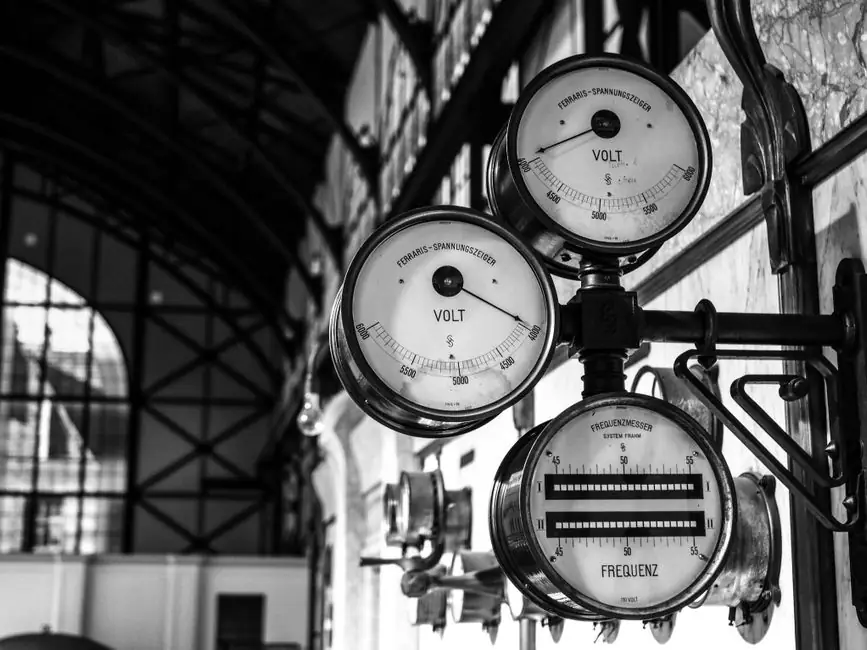
Pressure gauges on water-treatment skids sit on pump discharge headers, RO feed lines, filter inlet/outlet manifolds, chemical dosing heads, and post-UV sample points, and each location imposes a different combination of media, range, and wetted-material requirement. The dominant construction is a Bourdon-tube type with 316L stainless wetted parts and a 63 mm or 100 mm dial, with 1.6% or 1.0% of full-scale accuracy class for general service and 0.5% where a transmitter-calibration reference is needed [S2][S6].
Pressure gauges are elastic-element instruments that measure and indicate pressure above ambient and are present across nearly every industrial process, including water-supply and chemical-feed systems [S4]. For a skid-mounted water-treatment package, that means the specifier must translate the P&ID instrument list into unambiguous RFQ lines that suppliers can price without follow-up phone calls.
Process Media and Wetted-Material Selection
Media is the first decision field, because the wetted material of a Bourdon tube, socket, and diaphragm seal must chemically tolerate the process fluid, and the wrong pairing triggers a requote within 24 hours of issue. For potable water, raw intake, and filtered water, 316L stainless steel wetted parts with an EPDM or fluoroelastomer gasket are the conservative default, while for sodium hypochlorite (NaOCl, 10–12% available chlorine) dosing lines, the gauge body and socket must be specified in either PVDF, PTFE-lined 316L, or Hastelloy C-276 to resist pitting and stress-corrosion cracking [S2][S6].
Dial thermometer equivalents and other wetted parts use stainless steel for corrosion-heavy service, and the same logic applies to pressure gauges, since the special-service gauges used in chemical plants are built with all-stainless wetted paths and a welded pressure-lead system [S6]. On an RFQ line, write the media name in the “service” field and the material in the “wetted parts” field, never as free text inside a single box, because the vendor needs to look both up against their compatibility matrix in parallel.
Range, Accuracy, and Dial Size
Operating pressure on a typical skid rarely exceeds 10 bar, but the full-scale range you write on the RFQ should be 1.5–3.0 times the normal operating pressure, so that the needle sits in the middle third of the dial during normal running, per industry convention [S2]. For an RO pump discharge at 12 bar working, specify a 0–25 bar or 0–30 bar gauge; for a filter inlet at 4 bar, specify 0–10 bar; for a chemical dosing head at 2 bar, specify 0–4 bar. A range chosen too close to the working point pegs the needle and destroys the bourdon tube within weeks.
Accuracy class follows a fixed ladder: 2.5% of full scale is utility/visual-only, 1.6% is the skid-default, 1.0% is for trend recording, and 0.5% is reserved for calibration reference gauges that sit beside a pressure calibrator on a test bench. The pressure gauge accuracy class must be written as a percentage of full scale, not as a percentage of reading, because the two definitions diverge at 25% of range and the quote is only comparable across vendors if the same definition is used. Dial size is usually 63 mm for skids with a 1.5 m eye-line and 100 mm for panel-mounted local readouts, and 40 mm only for OEM machine builders with severe space constraints [S2][S9].
Process Connection, Mounting, and Case Protection
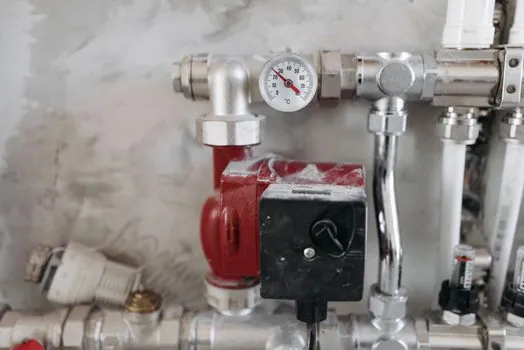
Process connection defaults to a 1/2 NPT male bottom-entry on North-American skids and G 1/2 B bottom-entry on European skids, with back-entry (rear-mount) reserved for panel-board installations and 3-hole or 5-hole flange clamps reserved for differential gauges on filter housings. The exact thread standard must be written explicitly: NPT vs BSP vs BSPT vs G, because the seat geometry is different and a gauge ordered with the wrong thread will leak at torque-up on site. For 42 mm and 2″ dial sizes used in compact OEM equipment, the typical port is 1/8 NPT or 1/4 NPT back-center, as published in commercial inquiry listings for industrial gauges [S9].
Case protection on water-treatment skids is most commonly IP65 for indoor skid rooms and IP66/IP67 for outdoor containerized plants, with a stainless-steel case (AISI 304) preferred over painted mild steel in coastal or chlorinated atmospheres. Filling the case with glycerine (for pump-discharge service with high vibration) or silicone oil (for ambient swings of −40 °C to +70 °C) dampens the needle and protects the movement; a dry-case gauge is only acceptable on panel boards away from the pumps [S2][S6].
Output Signal and Smart Features
Local-indication gauges without an output signal remain the majority on water-treatment skids, but where the P&ID calls for SCADA integration, the RFQ line must specify a 4–20 mA + HART output, a 0–10 V output, or a switching contact, and the supply voltage. WIKA groups these under “pressure gauges with output signal” in their product overview, alongside contact pressure gauges and pressure switches, all of which can be ordered as variants of the same mechanical platform [S2]. A digital pressure gauge with 0.05% indicated-value accuracy and a panel-mount form factor is a different SKU entirely and is typically used only on laboratory sample panels, not on the process line.
If the project is a process-transmitter retrofit or a new digital build, a pressure transmitter on a 4–20 mA loop may be more appropriate than a local gauge with electronic output; the specifier must confirm the control-system I/O count before locking the output-signal field. Output-signal options left blank on the RFQ trigger the most quote revisions of any field, because every vendor will assume a different default (dry-case no output vs 4–20 mA vs switching contact) and the resulting line-item spread can swing 3–5x on price.
Certifications, Standards, and Documentation
Drinking-water projects usually require NSF/ANSI 61 or WRAS approval on the wetted path, while pharmaceutical or food-adjacent skids require 3-A or EHEDG and a surface-finish Ra ≤ 0.8 µm. For non-potable industrial skids, EN 837-1 / EN 837-3 (Bourdon tube and diaphragm seal gauges), ASME B40.100 (pressure gauges and gauge attachments), and ISO 5171 (compressed-gas cylinder gauges) cover the most-cited references. ATEX and IECEx certification are not normally required on a water skid because the process is not flammable, but they are required when the gauge is mounted inside a chemical-room boundary classified as Zone 1 or Zone 2 [S2].
Calibration documentation is a separate line item: a factory calibration certificate traceable to NIST or NPL, with 3 or 5 calibration points across the range, adds measurable cost and lead time. For a 10-skid municipal order, the realistic calibration-traceable lead time is 4–6 weeks, and the specifier should write that timeline into the RFQ to avoid vendors defaulting to a 2-week uncertified delivery.
Common RFQ Mistakes and How to Avoid Them
The three most expensive mistakes on a pressure-gauge RFQ line are: (1) omitting the wetted-material requirement, which forces a requote when the vendor realizes 316L is unsuitable for NaOCl; (2) specifying range at or below maximum working pressure, which guarantees a pegged needle; and (3) conflating accuracy class with the accuracy of the calibration, since the class is full-scale and the calibration can be either full-scale or reading-based. Each of these can be detected by the vendor from a P&ID and a brief process description, but the specifier who writes them onto the RFQ line saves 3–5 days of back-and-forth per skid package [S2][S4].
A second tier of mistakes is leaving the case-filling fluid blank (vendor defaults to dry when in doubt, which is wrong for a pump-discharge gauge), leaving the process connection thread standard off (vendor defaults to NPT when the plant is BSP, or vice versa), and failing to specify dial size relative to viewing distance (a 63 mm dial is unreadable across a 4 m skid hall). Each of these becomes a field rework ticket once the gauge is installed. The same hygiene applies when specifying a differential pressure transmitter for a hydraulic test bench RFQ, where the connection and range fields carry similar weight in vendor selection.
Spec Comparison: Local Gauge vs Digital Gauge vs Gauge with Output
The three options on a water-treatment skid line up as follows. A local Bourdon-tube gauge (dry or liquid-filled) is the lowest cost, 1.6% full-scale accuracy, no electronics, IP65, and is the right call for non-instrumented skids. A digital pressure gauge adds 0.05% indicated accuracy, a battery or loop-powered LCD, and USB or HART output, and is the right call for laboratory sample panels and for portable spot-checks, though it costs 3–8x the Bourdon equivalent. A pressure gauge with 4–20 mA output combines a Bourdon-driven sensor with a transmitter electronics board, sits between the two on cost (roughly 1.5–2x the dry-case local), and is the right call when the P&ID calls for a local readout plus a SCADA tag, because one device replaces two [S2].
Decision rule: if the P&ID has only a local ISA symbol, write a Bourdon-tube gauge; if the symbol is a square with a slash, write a transmitter, not a gauge; if the symbol is a circle with an output tag, write a gauge with output signal. Mixing these up is a common RFQ error and forces the vendor to either re-quote or substitute, both of which delay the skid delivery.
Putting It on the RFQ: A One-Line Template
The next signal to track is the revision of EN 837-1 and EN 837-3, which are the European reference standards for Bourdon-tube and diaphragm-seal gauges, and any 2026 update will shift the accuracy-class nomenclature that most OEMs currently print in their data sheets; the same watch applies to ASME B40.100 for North-American projects. For a related view of how output signalling reshapes instrument selection, the industrial PC selection for water treatment: 2026 specs and field reality piece covers how a SCADA-side I/O count decision rolls back to a gauge-with-output call on the field side.