High-speed low-torque (HSLT) and low-speed high-torque (LSHT) hydraulic motors sit at opposite ends of the same speed-torque curve, and the spec sheet differences drive every subsequent component choice in the circuit.
HSLT units from Parker, Nichols, and Permco are catalogued at 0.218 to 0.375 cu in/rev with 3,000–7,500 rpm intermittent capability and 39–230 lb-in torque per published M4-series performance data [S4]. LSHT orbital and piston motors on the surplus channel span 0.48 to 40+ cu in/rev, with the 0–4.9 cu in/rev bracket alone holding 56 part numbers from Char-Lynn, Danfoss, Dynamic, and Parker [S3].
Defining the two families by displacement and speed envelope
HSLT motors, also called "high-speed motors," are characterised by low geometric displacement per revolution (typically under 1 cu in/rev for gear and vane types) and free speeds that often exceed 3,000 rpm, requiring external gear reduction whenever the driven machine wants low rpm. The Parker MGG series at 0.218 and 0.375 cu in/rev is a stock example, priced at $418.23 and $542.24 respectively on the Beiler Hydraulics shelf as of the September 27, 2026 catalog snapshot [S1].
LSHT motors, by contrast, use large-displacement orbital or radial-piston architecture (commonly 2 to 40 cu in/rev) and deliver rated torque at shaft speeds under 500 rpm, letting them bolt directly to a winch drum, swing bearing, or track roller without an inline reducer [S2][S3]. The 23 cu in/rev example cited on TractorByNet produces 4,500 in-lb at 150 rpm, which after a 5:1 gear-up to 750 rpm drops to roughly 900 in-lb, a textbook illustration of the torque-speed tradeoff [S5].
Decision criteria: torque, speed, mounting, and circuit complexity
Four criteria separate the two families in 2026 spec work: continuous torque demand, required output rpm, allowable drivetrain length, and acceptable maintenance access. LSHT wins on the first three: it eliminates the gearbox, bolts straight to the load, and survives stall conditions that would destroy a gearbox input stage [S2][S6].
HSLT wins on cost and high-speed efficiency: a 0.375 cu in/rev Parker MGG retails for $542.24, whereas an equivalent 0.76 cu in/rev Dynamic BMM12.5 orbital LSHT unit is $195.90 but a 1.21 cu in/rev Char-Lynn 129-0003 climbs to $644.55 [S1][S3]. When the application needs 3,000+ rpm output (conveyor, fan, generator, auger), HSLT is the only practical choice because LSHT cannot physically reach those speeds without catastrophic internal lubrication failure [S4].
Application fit: which family for which job
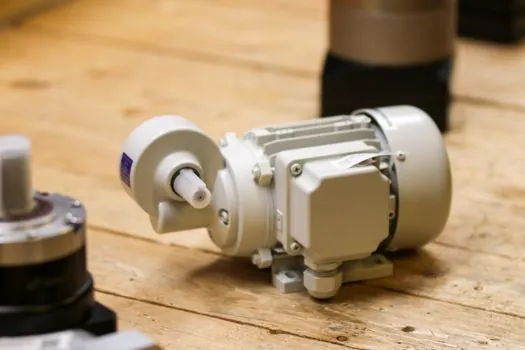
HSLT motors are the standard pick for continuous-rotation, high-rpm loads: hydraulic-driven fans, alternators, concrete mixer augers, and any skid-steer attachment that needs a spinning element. The Parker Nichols M4 spec sheet referenced for a Tulsa winch conversion shows 3,000–7,500 rpm intermittent and 3.25–19 lb-ft torque, enough to drive the 280:1 reduction of an OEM winch but not enough to replace the gear train [S4].
LSHT motors dominate direct-drive applications: hydraulic winch drums, crane swing drives, track and wheel propulsion, grapple rotators, and auger drives on mini-excavators. A 0.48 cu in/rev Hydro Custom BMM at $175.40 covers small-swing-duty work, while 15–29.9 cu in/rev units handle winch and track propulsion; the surplus catalog lists 84 part numbers in that band alone [S2][S3]. One practitioner on TractorByNet confirmed he built a homemade tractor winch with an LSHT motor coupled directly to the drum, and found the conversion simpler than retrofitting a high-rpm electric motor with a reducer [S4].
Failure modes and operating limits specific to each family
HSLT motors fail when external gear reducers are skipped or undersized; the shaft speed and inertia of a direct-coupled load will overheat the case drain and burn the front seal within minutes. Electrical winches rated for short duty, like the Tulsa 280:1 referenced in the field thread, will be damaged by a continuous-duty hydraulic motor if the relief valve is not set to clamp output torque at the electric-equivalent level [S4].
LSHT motors fail when operated at very low shaft speed under high load, where the internal gerotor or piston slip generates heat faster than the case can reject it. The Blince 2025-08 selection guide flags two operational rules: avoid excessive load or torque at very low speeds, and ensure stable system flow before applying hold pressure, both of which point to thermal case-drain management rather than mechanical failure [S6]. The TractorByNet gear-up example also demonstrates the inverse: pushing a 23 cu in/rev motor to 750 rpm through a 5:1 chain drive cuts torque to roughly 20% of nameplate, so the larger displacement buys nothing useful once you gear for speed [S5].
Specification and standards context for hydraulic motor selection
Hydraulic motor selection in 2026 still relies on the OEM performance curve, not a single industry-wide test standard, because HSLT and LSHT architectures serve different rating methodologies. Surplus catalog displacement bands (0–4.9, 5–5.9, 6–9.9, 10–14.9, 15–19.9, 20–29.9, 30–39.9, 40+ cu in/rev) align with how Char-Lynn, Danfoss, Dynamic, Parker, and Poclain publish torque and speed envelopes, with the 4-bolt SAE B and 2-bolt SAE A flange options dominating the LSHT catalog and keyed shafts (190 part numbers) outnumbering splined (8) and tapered (3) [S3].
For two-speed LSHT operation, where a single motor needs both high-torque low-speed and high-speed low-torque modes, the TractorByNet thread notes that manufacturers must confirm shifting under load capability, because gerolor and radial-piston designs behave differently during displacement changeover [S5]. In parallel work on motion control and torque measurement elsewhere on the spec encyclopedia, torque sensor selection for motor dynamometer testing and hydraulic motor sizing share the same power = torque × rpm arithmetic, but hydraulic circuits add the pressure × flow / 2πη efficiency term that electric motor selection does not.
Buying and lead-time signals as of September 27, 2026
The Beiler Hydraulics HSLT shelf lists 49 part numbers with same-day shipping on most items ordered by 3 PM Eastern, and the Permco M257A731RRZA15-00 gear motor at $1,087.86 is the most expensive stocked HSLT unit, while the Parker MGG20010 at 0.218 CID is the lowest at $418.23 [S1]. The LSHT surplus channel stocks 207 distinct part numbers across 10 brands, with 76 of them from Hydro Custom and 80 from Dynamic, and a 0.48 cu in/rev Hydro Custom BMM at $175.40 is the price floor in the catalog [S3].
Two trackable signals for the rest of 2026: HSLT suppliers continue to expand same-day-ship SKUs (49 currently in the Beiler catalog), and the LSHT market remains fragmented across at least 10 brands with overlapping Char-Lynn 101, Danfoss DH, and Parker ME-MB-TE-TJ interchangeability claims [S1][S2]. Related engineering work on related motion-control decisions is collected at stepper motor selection for surface temperature and cost tradeoffs, and the practical realities of retrofitting older mechanical drives (like a 280:1 Tulsa winch) with hydraulic power parallel the broader question of repair vs replace for aging industrial controls.
For component-level specifications, see high voltage tester.