Most industrial PLCs deliver 10–20 years of service, with a 15-year replacement-cycle benchmark common in plant planning because power supplies, electrolytic capacitors, and I/O modules degrade with heat cycles long before the CPU does [S1].
The decision is rarely about the controller itself: roughly 80% of PLC failures are repairable at the component level when spare parts and qualified repair labs are available, so obsolescence, cybersecurity exposure, and software support are the real triggers that flip a unit from "fix it" to "migrate it" [S3].
Repair-Replace Decision Matrix by PLC Age and Fault
Repair makes sense when the fault is localised to a power supply, battery, capacitor bank, single I/O card, or firmware corruption on a controller under 10 years old; documented mail-in repair typically costs a fraction of replacement and returns the original serial, program, and firmware [S4]. One repair lab reports 70% of submitted units are returned to service, with "no LEDs / no fan" symptoms (PSU failure) at 95% repair odds and "+5 V rail below 4.7 V" at 90% odds when the cause is regulator drift rather than cascade damage [S3]. Replacement becomes the correct call when repair cost climbs past roughly 50–60% of a new unit, the OEM has declared the product end of life, or the controller sits in a safety PLC SIL-2/SIL-3 loop where a fault tolerance argument depends on current, supported hardware [S1][S2].
Warning Signs That Force a Replacement Decision
Three engineering signals consistently indicate a PLC has crossed from "aging" into "end of life": recurring nuisance faults, intermittent I/O drops, and frequent hard resets, all of which point to capacitor or backplane degradation rather than a single failed part [S1]. The second signal is supply-chain: when the catalog number is obsolete (legacy SLC 5/04, PLC-5, S7-300, Modicon Quantum generations), firmware updates stop, batteries become unobtainable, and repair shops are forced to harvest donors, which inflates turnaround from days to weeks [S3][S4]. The third signal is strategic: the engineering team can no longer update the programming software, vendor security patches have ended, or the controller sits on a network that must meet modern IEC 62443 zones, conditions that justify a migration to a current PLC control platform even if the hardware still runs [S6].
When Repair Clearly Beats Buying "New" From the Surplus Market
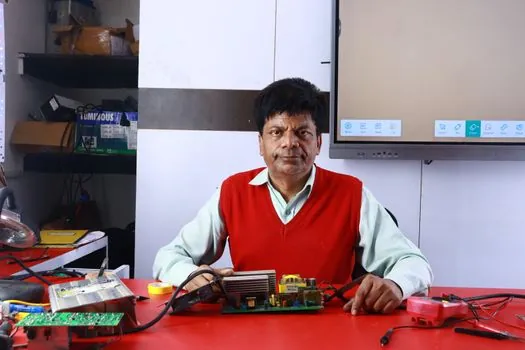
For Allen-Bradley PanelView, SLC 5/04, and PowerFlex family equipment, documented component-level repair outperforms marketplace "new old stock" because technicians preemptively replace parts that fail repeatedly in the field, such as backlights, overlays, electrolytic caps, and cooling fans, then verify the unit in an OEM test rack against IPC-7711/7721 rework standards [S3][S4]. Used surplus, by contrast, carries unknown run hours, unknown thermal history, and unknown exposure to power events, so the next common fault for that catalog number is still ahead of the buyer [S4]. For plants running matched panel cutouts, keyed programs, or certified safety panels, sending the installed unit back also preserves serial-number traceability that a random pull-out cannot match [S4].
Comparing the Three Options Side by Side
On four decision criteria, the ranking is consistent: documented repair wins on cost, lead time, and program continuity; current-platform replacement wins on support, cybersecurity, and future capacity; marketplace "new" spares rarely win on any axis once the buyer's-guide checklist is applied [S2][S4].
The cost gap closes quickly once a unit needs a second repair in a 12-month window: paying twice for PSU, I/O, and backplane swaps is the classic inflection point where procurement should pivot to replacement [S2][S5].
Environmental and Operational Factors That Compress the 10–20 Year Window
Heat, vibration, electrical noise, humidity, and frequent power cycling each subtract years from the upper bound of the 10–20 year range, and most plants under-count these because they look at calendar age rather than thermal and electrical stress hours [S1]. Capacitor life roughly halves for every 10 °C rise above the rated ambient, which is why a PLC mounted in an unventilated cabinet near a VFD or a hydraulic power unit can hit end-of-life behaviour at year 7 while the same model in a climate-controlled MCC room runs past year 20 [S1][S3]. Plants that run continuous shift patterns with no planned shutdown also accumulate more power-on hours, so a 24/7 line at 5 years may have seen the equivalent thermal stress of a single-shift line at 10 years, and the replacement-planning clock should track duty cycle, not just the invoice date [S1].
Standards, Documentation, and What to Demand From a Repair Lab
Any shop that offers flat-rate repair without a diagnostic report should be avoided; a qualified lab will provide top-and-bottom board photos, a component-level BOM, a test-jig photo showing the unit powered in an OEM rack, and a 6–12 month minimum warranty, with the evaluation fee credited against the final repair [S3]. Repairs performed to IPC-7711/7721 with full program-load verification before return are the practical baseline, because rework quality is the variable that determines whether a "repaired" unit will hold up for another duty cycle or fail on the same component within months [S3]. For facilities governed by NFPA 70E electrical-safety practices or UL 891 / UL 1558 switchgear co-located with the pressure transmitter and flow meter instrumentation skids, documented repair records also feed the maintenance audit trail that insurers and AHJs expect during arc-flash and safety-system reviews [S5].
Planning the Migration Path Before Failure Forces It

Once a unit crosses 12 years in service, plants should build a parallel-track plan: a documented repair quote path with a vetted lab, plus a migration design that maps the existing I/O list, program structure, and HMI screens onto a current-platform controller so a forced outage can be converted into a planned one rather than a 72-hour scramble [S1][S6]. Early warning signals to track quarter-over-quarter are increasing mean time between faults on the same controller, lengthening spare-parts lead times, and the engineering team's loss of ability to compile or modify the program, all of which precede the first hard failure by 6–18 months in most documented cases [S6]. For plants weighing repair today against a full migration, the next trackable node is the OEM end-of-life notice date for the installed catalog number, which is publicly published and is the single cleanest trigger for budgeting a replacement rather than funding another repair cycle.
Background reading: Choosing kV Range for Inspecting Thick Steel Castings.