Published market outlooks converge on a single shape for hydraulic cylinders between 2026 and 2030: a global market rising from roughly $20 billion in 2025 to between $23.7 billion and $27.19 billion by 2030-2034, depending on which forecaster you read [S2][S3][S4].
The Business Research Company pegs the 2025 base at $20.02 billion, the 2026 value at $21.11 billion, and the 2030 figure at $26.06 billion at a 5.4% CAGR, with Asia Pacific identified as both the largest and fastest-growing region [S2]. Persistence Market Research lines up with a $16.4 billion 2026 starting point and $23.7 billion by 2033, also at 5.4% [S4].
Segment Mix: Welded Mobile Units and the 51-100 mm Bore Class Dominate
Welded cylinders hold 49.8% of the 2026 hydraulic cylinder market by product type, chosen for compactness, durability, and cost in mobile and industrial service [S4]. The 51-100 mm bore band is the single largest application slice at 43.2% of 2026 share, used across tractors, excavators, loaders, forklifts, and general industrial machinery because it balances force output against envelope and weight [S4]. Double-acting cylinders commanded roughly 70% of 2023 demand by function, while single-acting variants are projected to grow at 5% CAGR from 2024 to 2030 [S1].
For buyers, that means a hydraulic cylinder sourcing plan should anchor on welded mobile designs in the 50-150 mm bore window first, then layer telescopic and tie-rod variants for specialty duty cycles. Specification language should reference the operating principle (single vs double acting), the bore class, and the cylinder construction because these three axes map directly to the dominant 2026 share and to the growth bands the forecasters identify [S1][S4].
End-Use Pull: Construction, Agriculture, and Mobile Hydraulics Set the Pace
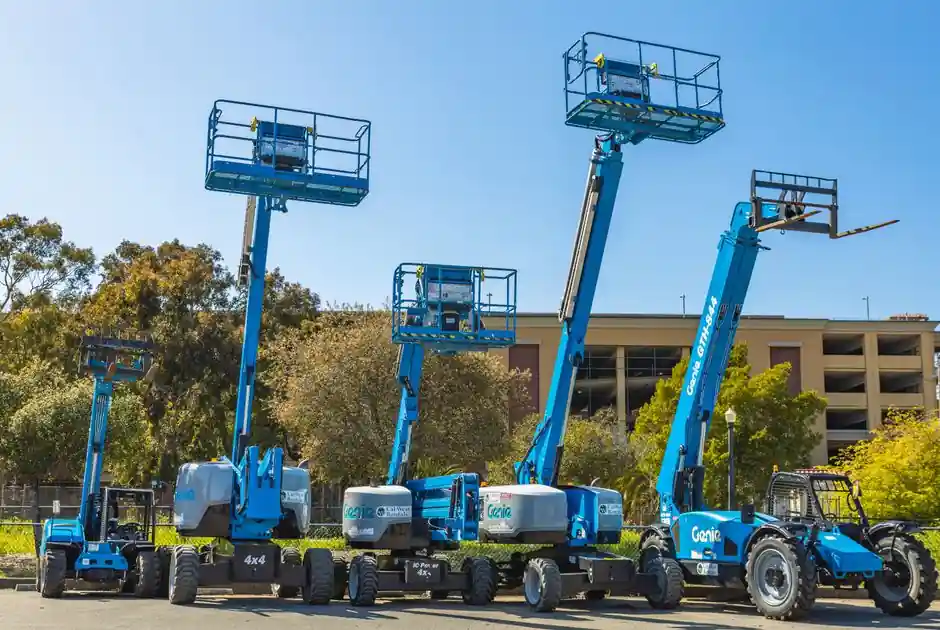
Construction remains the single largest demand engine, with excavators, backhoes, motor graders, dozers, skid steers, concrete cutters, and dump trucks all dependent on cylinders for push, pull, lift, and dig functions [S1]. Asia Pacific infrastructure spending is the proximate driver behind much of that demand, with China and India cited as the two largest single-country markets for new cylinder volume [S1].
Material handling, mining, oil and gas, marine, and agriculture round out the demand stack, and the hydraulic actuator category overall is being pulled by three overlapping currents: mobile hydraulics electrification, automation of heavy equipment fleets, and demand for energy-efficient actuation. TBRC attributes the forecast-period tailwind to automation in heavy equipment, expansion of construction fleets, demand for energy-efficient hydraulics, growth of electric and hybrid machinery, and advanced sealing technologies [S2]. In the India sub-market, IMARC shows the local market moving from $486.8 million in 2025 to $507.4 million in 2026, on the way to $657.5 million by 2034, a useful regional proxy for the broader South Asia growth pattern [S6].
Forecast Comparison: Why Three Big Reports Disagree on the 2030 Number

Reading the three primary forecasts side by side, the CAGR cluster is tight at 4.7% to 5.81% but the absolute 2030 endpoints fan out: PSMR reaches $19.88 billion by 2030 on a 4.7% CAGR from a 2023 base of $14.56 billion [S1]; TBRC reaches $26.06 billion by 2030 at 5.4% CAGR from a higher 2025 base of $20.02 billion [S2]; PMR reaches $23.7 billion by 2033 at 5.4% CAGR from a 2026 base of $16.4 billion [S4]; Fortune Business Insights projects $27.19 billion by 2034 from $18.11 billion in 2026 [S3]. Maximize Market Research gives a 5.81% CAGR from a $16.86 billion 2025 base to $18.14 billion by 2032, a notably more conservative slope given the higher starting value [S8].
The divergence is driven by base-year definitions, end-user scope, and whether mobile equipment replacement demand is layered on top of OEM build volumes. For a spec engineer, the practical read is that the CAGR is consistent at roughly 4.7% to 5.8% annually across multiple market research sources, though absolute revenue figures vary between reports [S1][S2][S8].
Tariffs, Steel, and the Localisation Squeeze on Supply
Tariff movements are reshaping the supply curve for hydraulic cylinders by raising the landed cost of imported steel tubes, precision rods, seals, and machined subcomponents [S2]. North America and Europe are the most exposed regions because they rely on imported raw material and subcomponents, while Asia Pacific suppliers face reduced export competitiveness, and the net effect is higher production costs and longer OEM lead times [S2].
The structural response is localization of cylinder manufacturing, which over the forecast window should shift regional share rather than flatten it. For buyers, the practical implication is that supplier audits should now ask for country of origin on steel tube, chrome-plated rod, and seal kit separately, because a domestic cylinder head can still be assembled from imported subcomponents and pick up tariff exposure. This is consistent with the broader 2026 pressure visible across adjacent metal products, where stainless steel coil buyers are running into the same carbon and tariff overhang and galvanized steel sheet sourcing has been reshaped by 2026 capacity and trade flows [S2].
Technology and Product Trends Inside the 2026-2030 Window
Inside the cylinder itself, the design envelope is shifting toward higher load-bearing architectures, longer service life, and custom-engineered configurations for non-standard strokes, with Idroteck's recent introduction of BIM models for hydraulic cylinders cited as a marker of how engineering and design processes are being streamlined for specifiers [S2]. The forecast-period product direction includes growing demand for custom engineered cylinders, expansion of mobile hydraulic applications, focus on high load bearing designs, rising use in heavy duty machinery, and a preference for long service life cylinders, all of which favour suppliers with in-house sealing, honing, and chrome-plating capability rather than pure assembly shops [S2].
Adjacent component demand rises in lockstep: a hydraulic pump and hydraulic valve selection exercise now has to anticipate higher continuous-duty pressures, tighter leakage budgets under ISO 10100, and longer service intervals, while the hydraulic motor side is being pulled toward higher-efficiency units to match the energy-efficient hydraulics trend flagged in the 2026-2030 forecast [S2]. Buyers should treat the seal kit, the rod surface finish, and the cylinder's pressure rating as a single spec stack rather than independent line items, because that stack is where the differentiation between commodity and engineered suppliers will show up over the next five years.
What Spec-First Buyers Should Track Between Now and 2030
Three signals are worth instrumenting in any 2026 sourcing plan: the quarterly regional share of Asia Pacific vs North America in the hydraulic cylinder market, because PMR puts North America at 27.8% of 2026 share while TBRC names Asia Pacific as the largest and fastest-growing region, so the crossover point matters [S2][S4]. Second, welded vs tie-rod share movement, because welded dominates 2026 at 49.8% but custom engineered variants are the named growth trend [S2][S4]. Third, the bore-class mix below 50 mm, between 50-150 mm, and above 150 mm, because the 51-100 mm sub-band alone holds 43.2% of 2026 share and any shift in mobile equipment design toward higher-pressure systems will drag that average up [S4].
For readers who want a parallel view on the broader industrial sourcing climate, the edge computing gateway demand forecast for 2026-2030 tracks the same five-year window from a different angle, and the tool steel supplier landscape for 2026 is a useful reference because cylinder rods and tubes pull directly on tool-grade steel availability.