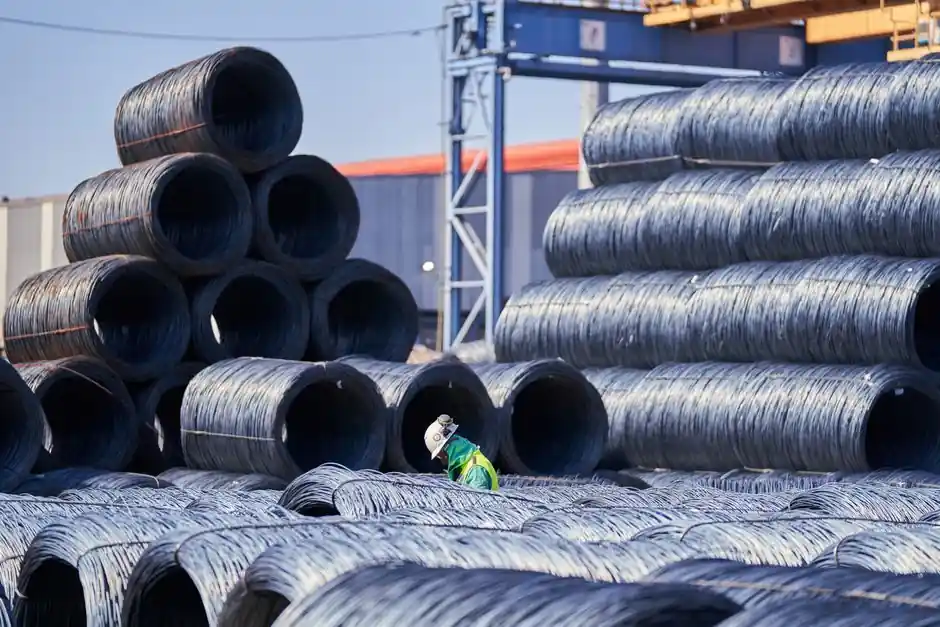
The global stainless steel coil market was valued at USD 4.12B in 2025 and is projected to reach USD 6.36B by 2034 at a 4.95% CAGR, per Business Research Insights [S1], while a parallel count of the wider stainless steel market (USD 135.71B in 2025, USD 144.93B in 2026, USD 254.94B by 2035 at 6.51% CAGR) puts Asia-Pacific at 67% share and the flat product segment at 31% [S4].
That headline growth masks a structural reset underway since February 2026: a U.S. 15% Section 122 import surcharge on stainless and downstream goods, the European Commission's anti-dumping review on Indian and Indonesian cold-rolled flat imports (measures expire 19 November 2026), China's expanded export-licensing system for all steel products effective 1 January 2026, and the Carbon Border Adjustment Mechanism (CBAM) are pushing buyers and mills into a multidimensional contest over carbon footprint, trade compliance, and upstream resource control, not price [S3].
How the 2026 Policy Stack Re-Prices Stainless Coil
The U.S. Supreme Court ruled on 20 February 2026 in Learning Resources, Inc. v. Trump that the President cannot use the International Emergency Economic Powers Act (IEEPA) to impose tariffs solely for revenue; the administration immediately invoked Section 122 of the Trade Act of 1974 and announced a 10% surcharge on most imports (including stainless) starting 24 February 2026, raised to 15% the following day, framed against a reported USD 1.2 trillion trade deficit [S3]. For coil buyers routing material through North America, this stacks on top of existing Section 232 Section 232 steel measures and shifts working-capital and landed-cost math in a single quarter.
In Europe, the European Commission issued a 20 February 2026 notice on the upcoming 19 November 2026 expiry of anti-dumping measures on stainless steel cold-rolled flat products from India and Indonesia, opening the review window that will determine post-2026 import pricing into the EU [S3]. Peripheral producers such as Turkey were warned to supply verified carbon emission data or face CBAM default penalties, while China renewed and continued anti-dumping enforcement on its import side and broadened export licensing to all steel categories from 1 January 2026, a regime that explains the late-2025 export rush and continues to throttle outbound flow in February 2026 [S3].
Grade, Geometry, and Application Mix Driving Coil Demand
Stainless steel is a versatile material that can be cast, forged, and welded into various shapes and sizes, with flat products (coil, sheet, plate) accounting for 31% of the broader stainless market in 2025 and the long-products segment forecast to grow at a 6.8% CAGR through 2035 [S4]. Within the wider cold-rolled coil universe (137.89 Mt in 2025, 143.24 Mt in 2026, 173.27 Mt by 2031 at 3.88% CAGR), low-carbon steel led with 46.61% volume share in 2025 and advanced high-strength steel (AHSS) is projected at a 4.55% CAGR through 2031, with automotive body and structural parts at 42.23% of cold-rolled coil demand in 2025 and consumer appliances advancing at 4.11% CAGR [S5].
Stainless steel's corrosion resistance, strength-to-weight ratio, and hygienic surface make it a default spec for food-processing lines, medical equipment, chemical tanks, and architectural cladding; India alone is targeted to produce nearly 345 million tonnes of food annually by 2030, a build-out that pulls directly on stainless coil and stainless pipe demand [S4]. Material selection here ties to the broader stainless steel family trade-offs covered in our reference encyclopedia, where austenitic 300-series grades dominate coil for formability and weldability while duplex and ferritic grades compete on strength and chloride resistance.
Who the 2026 Coil Market Is For, and Who It Penalises
This market rewards three buyer profiles: (1) spec-driven OEMs in food, pharma, and chemical processing with locked-in 300-series coil needs, (2) automotive and appliance Tier-1s migrating to thinner-gauge pre-painted and AHSS coils to hit efficiency targets, and (3) EPCs building data centres and modular housing in North America and Europe where cold-formed framing pulls on cold-rolled coil faster than traditional commercial builds [S5]. It penalises buyers running spot-priced 304/316L coil into tariff-exposed SKUs, mills without audited CBAM carbon data, and any specifier treating 2024 sourcing playbooks as still valid.
For procurement teams, the working assumption should be that the February 2026 policy stack is the new floor, not a temporary shock. A separate SMM read of the [global stainless steel market landscape in February 2026]((/news/stainless-steel-pipe-types-seamless-welded-and-the-five-metallurgical-families.html)) emphasises that the focus is moving away from traditional price wars toward carbon, compliance, and resource control, which is consistent with the trade-flow data above [S3]. On the supply side, the trade press flags tightening raw-material quotas as a structural constraint that benefits integrated mills with secured nickel and chrome supply.
Options Compared: Coil Grade vs. Decision Criteria
For a typical 2026 spec, the four decision vectors are corrosion environment, formability/weldability, carbon compliance posture, and landed cost under the new tariff stack. Against those criteria, 304 austenitic remains the default commodity coil with the broadest mill base and lowest unit cost, but carries the highest exposure to the U.S. 15% Section 122 surcharge and CBAM penalties for unverified emissions [S3]. 316/316L adds molybdenum for chloride and chemical service at roughly 1.4-1.8x the 304 price band, and is the practical choice where audit-grade surface finish or hygienic welding is on the spec sheet.
Duplex 2205 trades higher strength (roughly 2x yield of 304) for lower formability and higher nickel-moly content, paying back in thinner gauges and lower lifecycle weight in chemical tank and desalination builds; ferritic 430 sits below 304 on corrosion resistance and formability but offers a meaningfully lower nickel content, which is a CBAM-friendlier carbon profile and a stable option for appliance and architectural skins [S4]. Cold-rolled 304 in 2B/BA finish remains the volume workhorse, with 430 ferritic eating into appliance inner liners as Chinese and Indian OEMs shift to 0.4-0.5 mm pre-painted coil from 0.6-0.7 mm to cut material cost up to 12% and improve energy ratings [S5]. The alloy steel reference covers the metallurgy behind these trade-offs, while carbon steel remains the right call only where corrosion is not on the duty cycle.
Capacity, Upstream, and the AHSS Pull-Through Effect

India is commissioning more than USD 10 billion of new cold-rolled capacity, Southeast Asian automakers are localising sourcing, and Asia-Pacific commands 59.94% of cold-rolled coil volume in 2025 with a projected 4.36% CAGR through 2031, a setup that puts Chinese, Indian, Indonesian, and Vietnamese mills at the centre of 2026 global supply [S5]. Battery-electric-vehicle output reached 14 million units in 2025, each platform consuming 15-20% more AHSS than its internal-combustion predecessor to offset battery mass, with SSAB launching EV-optimised AHSS in 2025 at tensile strengths beyond 1,500 MPa allowing 10-15% gauge reduction while holding structural integrity [S5].
This AHSS pull-through does not replace stainless coil demand; it competes for the same cold-rolling and annealing lines, and integrated mills chasing AHSS premiums of USD 150-200 per ton over commodity low-carbon coil are upgrading those lines, tightening capacity for commodity stainless coil and indirectly supporting the solenoid coil and electrical-steel ecosystem that shares the same rolling assets. For buyers, the practical signal is to lock 2026 Q4 and 2027 Q1 stainless coil tonnage early, audit mill CBAM documentation, and pre-qualify a second-region source to reduce single-jurisdiction tariff exposure.
Failure Modes, Constraints, and Sourcing Signals to Track
The dominant failure modes in 2026 sourcing are policy-driven, not metallurgical: landed-cost overrun from the 15% U.S. surcharge stacking on existing duties, CBAM default penalties for mills lacking verified embedded-emission data, anti-dumping exposure as the November 2026 EU review proceeds, and raw-material quota cuts that lengthen lead times for nickel-bearing 300-series grades [S3]. World crude steel production for the 69 reporting countries was 166.1 Mt in March 2025, up 2.9% year on year, with China at 92.8 Mt (+4.6%) and India at 13.8 Mt (+7.0%), confirming that upstream capacity exists even as policy frictions reshape trade flows [S4].
Trackable signals for the next two quarters: the EU anti-dumping review outcome on Indian and Indonesian cold-rolled flat imports (due before 19 November 2026), any CBAM verification deadlines for Turkish and Korean peripheral producers, U.S. Section 122 surcharge duration and any successor Section 232 adjustment, and the silicon steel and stainless capacity-allocation moves that follow India's USD 10 billion cold-rolled build-out [S3][S5]. Buyers who anchor 2026 contracts to CBAM documentation, dual-region supply, and locked Q4-2026 coil tonnage will outpace those still running 2024 spot-price playbooks, and the wider procurement lens applies just as cleanly to adjacent equipment categories like the hydraulic cylinder and mill-drive spec cycles.
Related analysis: Tier-1 Lithium Cell Suppliers 2026: Share, Chemistry, and Sourcing Map.