
The global pneumatic actuator market in 2026 is concentrated among seven named majors, with ABB, Parker Hannifin, Emerson, Rotork, SMC, Cameron, and Festo identified as the leading suppliers [S3].
Regional revenue concentration is high, with Europe alone accounting for 32.9% of global pneumatic-actuator revenue, the largest single regional block in 2025 [S1]. The technology sits across both pneumatic actuator and pneumatic valve actuator categories, with the broader pneumatic components market projected to reach USD 25.35 billion by 2035 at a 5.0% CAGR [S7].
Global market size and growth context
The global pneumatic actuators market was estimated at USD 51.71 billion in 2023 and is projected to reach USD 73.83 billion by 2030 [S2]. A separate forecast puts the pneumatic actuator segment at USD 18.0 billion in 2025, growing to USD 26.8 billion by 2035 at a 4.8% CAGR, with Germany forecast as the fastest-growing country at a 6.8% CAGR [S1]. Yet another analyst sizes the pneumatic actuators market at USD 54.8 billion in 2024, expanding at a 6.3% CAGR to USD 95.8 billion by 2034 [S8]. The wide spread between USD 18.0 billion and USD 54.8 billion reflects different scoping: one captures core industrial pneumatic actuators while the other bundles broader pneumatic component value chains.
Automotive pneumatic actuators are themselves a USD 55.92 billion segment in 2026, growing at a 5.17% CAGR to USD 71.96 billion by 2031 [S4]. Within the broader actuators universe, the global market reached USD 70.30 billion in 2026 and is projected to reach USD 174.69 billion by 2034 [S5], with a competing model projecting USD 50.1 billion in 2025 to USD 85.2 billion by 2034 at 5.90% CAGR [S6]. The variance is methodology-driven, not contradictory.
Named manufacturers and competitive positioning
Seven manufacturers are publicly identified as leaders in the pneumatic actuators market: ABB (Switzerland), Parker Hannifin (US), Emerson (US), Rotork (US), SMC (Japan), Cameron (US), and Festo (Germany) [S3]. ABB is called out as one of the leading players, holding high-value automation contracts in China and pursuing acquisitions of smaller players to expand product offerings and market share [S3]. The supplier base is split between US-headquartered majors (Parker Hannifin, Emerson, Rotork, Cameron) and European (ABB, Festo) and Japanese (SMC) specialists, with the US contingent heavy in process-valve automation and the European/Japanese suppliers broader in factory automation components.
Competitive differentiation now hinges on diagnostics and control-system integration rather than raw torque output, with suppliers offering sensor and feedback packages positioned to win smart-actuator supply [S1]. Process operators evaluating pneumatic cylinder and rotary actuator packages increasingly require the same diagnostic envelope that electric-actuator suppliers deliver, and the pneumatic majors are responding with integrated position feedback and fieldbus interfaces. This is also reshaping sourcing for pneumatic conveyor systems and pneumatic fitting networks that need to communicate with plant asset-management platforms.
Product-type and application breakdown
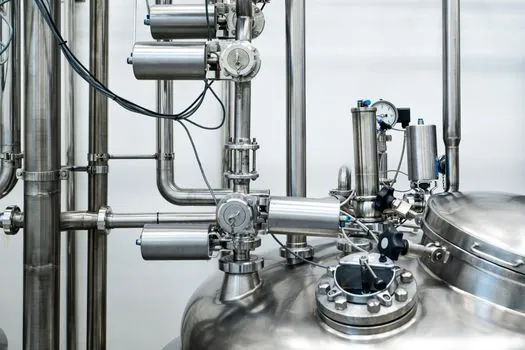
Scotch-yoke pneumatic actuators lead the product type with a 51.0% share in 2025, reflecting their torque density in heavy-duty valve service [S1]. Industrial automation is the leading application at 55.0% of 2025 revenue [S1]. Within the automotive slice, brake actuators led with 31.12% of the 2025 segment, and turbocharger wastegate actuators are forecast to grow fastest at 6.43% CAGR through 2031 [S4].
By mechanism, single-diaphragm designs held 42.78% of the automotive pneumatic actuator share in 2025, with electro-pneumatic hybrids projected to grow at 6.08% CAGR through 2031 [S4]. OEM sales channels dominated automotive distribution at 72.45% of 2025 revenue, with the aftermarket at 5.05% CAGR [S4]. By region, Asia Pacific captured 45.08% of automotive pneumatic-actuator revenue in 2025, with Middle East and Africa advancing fastest at 7.42% CAGR to 2031 [S4].
Who the pneumatic actuator majors are FOR (and who they are not)
Process-industry buyers running continuous chemical, oil and gas, water treatment, and power-generation operations are the core fit, since these segments need quarter-turn valve automation with proven fail-safe spring-return behaviour and ATEX/IECEx suitability for hazardous areas. The seven named majors all serve this core, with ABB and Emerson particularly visible in oil and gas, Rotork and Cameron in upstream and midstream valve automation, Parker Hannifin and Festo across factory and process automation, and SMC in high-cycle factory automation [S3].
High-volume discrete-manufacturing lines (automotive assembly, packaging, electronics) are also well served, where the same majors plus Asian specialists deliver pneumatic fitting and pneumatic cylinder ecosystems at scale. For procurement teams that already work with established process-control vendors, the process-control instrumentation buying guide covers adjacent selection criteria that overlap with smart-actuator specification. Buyers who need only a few units for non-critical manual-valve replacement, or who operate in highly explosive zones without certified partners, are not a fit for the top tier and should look to regional system integrators instead.
Decision criteria when comparing pneumatic actuator vendors

For process-valve duty, a usable four-criteria comparison is: torque density and T-rating, hazardous-area certification (ATEX 2014/34/EU, IECEx), diagnostic and feedback integration, and global service footprint. By those four, ABB and Emerson lead on integrated diagnostics plus global service, Rotork leads on quarter-turn valve-specific track record, Parker Hannifin and Festo lead on factory-automation breadth, SMC leads on compact light-duty units at scale, and Cameron (now part of Schlumberger's OneSubsea and valve portfolios) sits upstream-skewed [S3].
Pricing tiers split cleanly: the European and US majors price at a premium, justified by certifications and lifecycle support; Japanese suppliers (SMC) typically price 10-20% below on light-duty cylinders; Chinese-domestic suppliers price further below but with limited ATEX/IECEx coverage. Lead time follows the same pattern, with European/US majors at 8-12 weeks for certified units and SMC/Festo at 4-6 weeks on catalogue items. For process buyers who already handle exotic alloys and joint methods in their piping (see stainless-steel pipe joint methods), the same vendor-qualification discipline applies to pneumatic actuator sourcing.
Limitations, constraints, and failure modes
Compressed-air supply quality is the binding constraint: pneumatic actuators fail when supply pressure drops below the 4-5.5 bar working range typical of most quarter-turn designs, or when moisture and particulates degrade seals. Spring-return units lose fail-safe capability if the spring is corroded or replaced with the wrong grade. Hazardous-area mis-specification (using a non-ATEX/IECEx unit in Zone 1) is a common procurement error, since the visual difference between certified and uncertified housings is small. [S4]
Smart-actuator diagnostics reduce unplanned downtime but introduce cybersecurity exposure on fieldbus networks, an issue the seven named majors are addressing through IEC 62443-compliant firmware lifecycles. Automotive-segment buyers also face regulatory pull: US EPA Phase 3 heavy-duty standards enacted in 2024 tightened NOx thresholds, raising the bar on pneumatic dosing precision for EGR and aftertreatment [S4].
Standards and sourcing references

The governing standards most buyers will reference include ATEX 2014/34/EU for EU hazardous-area equipment, IECEx for global hazardous-area certification, ISO 5211 for actuator-to-valve mounting interfaces, and EN 15714 for industrial valve actuators. Process buyers in oil and gas will also reference API 6D for pipeline valves and NACE MR0175 for sour-service materials. Automotive-segment sourcing follows different paths, typically OEM-specific drawings and IATF 16949 quality management. For procurement teams who want a comparable spec-first vetting workflow on a related product line, the hydraulic cylinder procurement field guide walks the same three-step vendor qualification pattern that applies to pneumatic actuator sourcing. [S3]
Trackable signals for the next reporting cycle: the next 12-month OEM quarterly disclosures from ABB, Emerson, and Parker Hannifin will break out motion-control and process-automation revenue, letting buyers cross-check the 4.8-6.3% CAGR spread across analysts [S1][S2][S8]. Watch also for IEC 60079-0 and IEC 60079-1 amendment activity in 2026-2027, since the next revision cycle on explosion-proof enclosures will affect certification timing for new hazardous-area pneumatic actuator families. Buyers tracking electric versus pneumatic substitution should also follow the broader [actuator market CAGR range of 5.90-12% through 2034 [S5][S6] to gauge substitution pressure on pneumatic share in non-safety-critical loops.