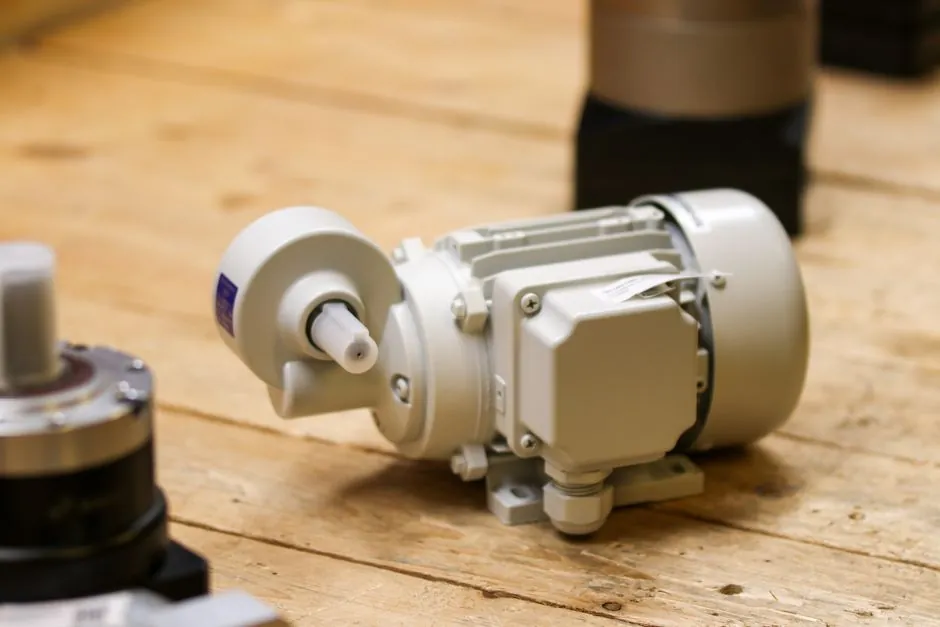
Specifying a hydraulic power unit starts with four hard numbers: peak flow (L/min), working pressure (bar), duty cycle, and reservoir size (L); everything else, including motor kW, pump family, and cooler class, follows from those four.
Across the 2025-2026 supplier landscape, units cluster into three duty classes: light industrial/machine-tool (typically under 25 MPa, under 60 L/min, single fixed or variable pump), mobile and off-highway (21–35 MPa, 60–150 L/min, often load-sensing), and aerospace/ROV isolation (3000–5000 psi, 12–60 USgpm on dual independent circuits) [S2][S1].
Four sizing inputs and the equations behind them
Peak flow Q = V × N / 1000, where V is pump displacement in cc/rev and N is shaft speed in rpm; on a fixed-displacement gear pump running at 1450 rpm with V = 25 cc/rev, the math lands at roughly 36 L/min, which sets the reservoir turnover at about 6–8 cycles/min on a 50 L tank. [S1]
Motor power P = (p × Q) / 600, with p in bar and Q in L/min giving kW; for a 200 bar, 60 L/min duty the shaft demand is 20 kW, so the motor is typically overspec'd to 22 kW to hold efficiency above 90% at the working point [S2].
Duty cycle in minutes per hour is the most commonly fudged input; continuous-duty HPUs hold at 60 min/h with the reservoir sized to 3–5× Q (in L/min) for natural-convection cooling, while intermittent-duty units (10–30 min/h) can drop reservoir to 2–3× Q once a fan-cooled air-to-oil heat exchanger is fitted.
For aviation GSE the pressure band is fixed by the airframe: 3000 psi (207 bar) on most regional and narrow-body types, 5000 psi (345 bar) on wide-body and newer platforms, with flow reaching 12 USgpm (45 L/min) for single-channel carts and 60 USgpm (227 L/min) on dual independent systems driven by two motors and two pumps [S2].
Pump family selection: fixed, variable, load-sensing
Fixed-displacement gear or vane pumps (14–25 cc/rev, 1450–1750 rpm electric, up to 3000 rpm on engine drives) are the cheapest path and suit constant-load machine-tool or elevator-levelling duty, but waste power as throttling heat on variable loads. [S2]
Pressure-compensated variable piston pumps (e.g. axial-piston swashplate, 10–45 cc/rev) hold a set pressure and cut flow as load rises, which is why subsea ROV isolation packs are built around them: the IHPU from Sub-Atlantic uses a pressure-compensated pump plus integral pressure and return-line filters plus a pressure-relief valve on a compensated reservoir skid, isolating the dirty-tooling circuit from the main ROV supply [S1].
Load-sensing piston pumps add a hydraulic signal line from the actuator; they are the default on modern mobile HPUs, with pressure cut at 350 bar and standby flow at 5–10 L/min, dropping the no-load power draw on a 22 kW unit from roughly 18 kW (fixed) to 4–6 kW (LS).
Quick comparison on the three families for a 200 bar, 60 L/min peak brief: gear/vane fixed at roughly 0.7–0.8 volumetric efficiency and 18–22 kW draw; pressure-compensated piston at 0.92–0.95 VE and 13–15 kW draw at the same load; load-sensing piston at 0.94–0.96 VE and 10–12 kW draw because throttling loss is removed.
Reservoir, filtration, and cooling gates
Reservoir sizing rule: 2–3× Q (L/min) for intermittent duty with an oil cooler, 3–5× Q for continuous duty with natural convection, and 5–7× Q on outdoor or dusty sites where the higher volume buffers temperature rise and contamination ingress; the IHPU skid uses a compensated reservoir sized to its pump class, with the compensator managing thermal expansion between cold-start and full-load [S1].
Filtration class follows ISO 4406; industrial HPUs typically run 18/16/13 (clean), mobile 20/18/15, and aerospace GSE 16/14/12, with pressure-line β10 ≥ 75 filters and return-line β10 ≥ 40; the Sub-Atlantic IHPU ships with both pressure and return-line filters as standard, plus a pressure-relief valve set inside the unit's own circuit so a downstream hose burst cannot back-feed the main ROV loop [S1].
Cooling choices: natural convection on tanks up to 150 L with continuous duty below 10 kW heat rejection; fan-cooled air/oil coolers on 10–30 kW packages; water-cooled plate exchangers above 30 kW or on marine/ROV skids where ambient airflow is poor. On a 20 kW HPU running at 50% efficiency, 10 kW of waste heat must leave the oil to hold a 40–50°C steady-state temperature, which a 100 L tank and a small fan cooler handles without active control.
Who an off-the-shelf HPU is for, and who needs an engineered skid
Off-the-shelf industrial HPUs in the 0.75–7.5 kW range with 4–25 L reservoirs and 6–30 L/min flow cover most clamping, press, lift, and test-stand duty, with a fixed pump, 80–160 L tank, 25 µm return filter, and a bimetallic or PTC heater; this matches what rental fleets and small fabricators typically specify [S4].
Rental-grade units from US suppliers are typically 5–75 kW electric or diesel-driven, with sound-attenuated canopies, twin-stage filtration, and air/oil coolers, aimed at construction, pipeline, and shutdown maintenance where the HPU arrives on a trailer and runs for days; lead time is often 24–72 hours on common ratings [S4].
Custom-engineered skids become mandatory for ROV isolation, aerospace GSE, and offshore/marine duty: here the HPU must meet a specific pressure band (3000 or 5000 psi), flow cap (12 or 60 USgpm), redundancy class (single or dual independent with two motors and two pumps), and clean-fluid protocol tied to the host machine, which is why TEST-FUCHS HGPUs are configured to order and globally distributed by HYDRO rather than stocked as a catalogue SKU [S2].
For elevator modernisation the constraint is different again: hydraulic elevators are typically specified for low-rise residential and commercial buildings up to 5 stops on smaller jacks, with the HPU sized to plunger bore, stroke, and rated load rather than to peak flow, and serviced on a 24-hour Otisline support contract [S3].
Common failure modes and selection traps

Three failure modes account for most field service calls: pump cavitation from a starved suction line (suction line undersized, above 0.5 m/s on cold oil or 1.0 m/s on hot); thermal overload when the calculated waste heat exceeds cooler capacity, typically because duty cycle was assumed rather than measured; and contamination-induced valve sticking when ISO 4406 code drifts two classes above the design target over 6–12 months because the breather was left off-spec [S4].
Selection trap #1: buying a fixed pump where load-sensing is needed; the electricity bill over 5 years typically exceeds the purchase premium on any unit running more than 2000 hours/year with varying load.
Selection trap #2: undersizing the reservoir to fit the machine footprint; a 60 L tank on a 30 L/min continuous-duty loop will heat from 30°C to 80°C in roughly 90 minutes without a cooler, and the seal life on a NBR piston seal at 80°C is roughly 1/3 of its life at 60°C.
Selection trap #3: mixing pressure ratings; specifying a 350 bar pump to run at 5000 psi (345 bar) aircraft duty leaves no margin for the transient 10–15% pressure spikes on actuator change-over, while overspec'ing to 420 bar for a 200 bar industrial loop adds cost and noise without buying useful life [S2].
Standards, sourcing, and what to verify before sign-off
Pressure-bearing components on industrial HPUs sold into the EU are governed by the Pressure Equipment Directive (2014/68/EU) for fluids above 0.5 bar; for hazardous-area duty, ATEX 2014/34/EU applies to the motor and control box, while the hydraulic side typically references ISO 4413 (general rules for hydraulic systems) and ISO 4414 (pneumatic). [S1]
Filtration ratings on data sheets should be quoted to ISO 4406:1999 with a target cleanliness code, not just a micron rating; an 18/16/13 code reads as roughly 1,300–2,500 particles per mL at >4 µm, >6 µm, and >14 µm respectively, and is the typical clean-system benchmark for new industrial HPUs.
Before sign-off, four numbers should be on the data sheet: rated flow at the working pressure (not just no-flow), reservoir turnover in cycles/min, full-load amp draw on the electric motor at the installed voltage, and ISO 4406 cleanliness code at the pressure port under test. Aviation GSE data sheets should also confirm pressure (3000 or 5000 psi), maximum flow (12 or 60 USgpm), and single or dual independent architecture [S2], while ROV isolation packs should confirm the pressure-compensated pump, integral filter rating, pressure-relief setting, and compensator behaviour on the dirty-tooling circuit [S1].
Two trackable signals to watch: a shift by rental fleets toward load-sensing piston units on 5–30 kW ratings as electricity costs rise, and tightening of filtration classes on aerospace GSE from 16/14/12 toward cleaner targets as hydraulic-system diagnostic sensors get cheaper; both are visible in the 2026 HPU data sheets of major distributors and rental houses [S4][S2].
The underlying component specifications are covered under lighting equipment and electric lamps, and linear guide.
This topic is covered further in Cold chain equipment upstream/downstream map: suppliers, spec gates, and selection rules.