
IEC 60417 registered symbols, drawn from the joint IEC/ISO graphical-symbol database maintained by IEC/TC 3/SC 3C, give machine builders a vetted set of glyphs that sit alongside the red, yellow, and green cap colors specified for industrial control devices and pilot lights [S1][S3].
For roughly 8% of men and 0.5% of women, the conventional red-stop / green-run color pair becomes ambiguous, so pairing an IEC 60417 pictogram (for example, the registered "I / O" mark on a power switch) with the illuminated cap removes reliance on hue discrimination [S4].
What IEC 60417 actually delivers for a pushbutton legend
IEC 60417 is the IEC register of graphical symbols for use on equipment, each entry identified by a reference number, a bilingual English/French title, and a vectorized PDF plus GIF/PNG rendering, distributed through the joint IEC/ISO database hosted at graphical-symbols.info [S1][S2]. The standard's purpose is explicitly twofold: identify the equipment or a part of it (a control, a display), and indicate a functional state (on, off, caution, ready) [S2]. For a 22.5 mm illuminated pushbutton, that means the symbol is the contract, and the LED color is a redundant cue layered on top.
Registered symbols cover power switches, start/stop, attention, refer-to-document, and a long tail of equipment-specific marks, and each entry ships with a defined title plus visual proportions so that the legend stays legible at 30 mm cap diameter and again on a 1 m tall panel [S1][S3]. Compliance with IEC 60417 is the route to "consistency, uniformity, and universal recognition" of those marks across vendors and plant sites [S3].
Why color alone fails, and what the population data says
Red-green deficiency is the most common form of color blindness, with blue-yellow and total (achromatopsia) forms considerably rarer, which is why the Schneider Harmony ZBRM22B0 twin pushbutton bundle with its six colored inserts (red, yellow, green, blue, white, black) is a useful test case for re-thinking cap pairing [S4]. A practical response is to keep the familiar red and green caps but add a non-color differentiator: an IEC 60417 "I" / "O" pair engraved or printed on the cap, a tactile dot on the stop button, or contrasting bezel text such as red with "O" and white with "SILENCE" [S4].
Industrial-control color guidance already treats red as danger/emergency, yellow (or amber) as warning/abnormal, and green as safe/normal, with blue reserved for mandatory or operator-action states and white/grey/black treated as neutral [S5]. That convention is sound for operators with normal trichromatic vision; for the affected minority, the symbol, the cap shape, and the position become the load-bearing channels, and the color is essentially decoration [S4][S5].
Comparing three practical cap+legend options
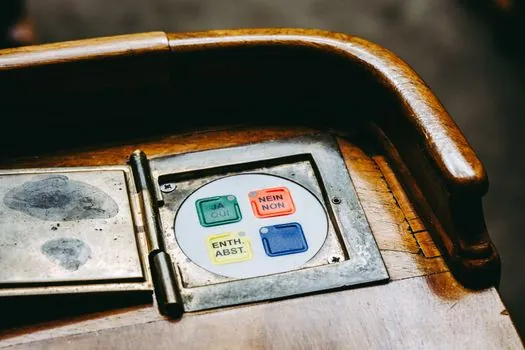
Three approaches are common on factory floors, each with a different balance of clarity, retraining cost, and panel real estate. [S3]
Option A, monochrome high-contrast caps (black-on-white or black-on-yellow) with engraved IEC 60417 I/O glyphs, gives the strongest non-color signal and works under degraded lighting, but breaks the muscle memory that operators already have for red/green. Option B, conventional red/green caps with an added IEC 60417 legend printed on the cap face, preserves muscle memory at the cost of small cap legends that may wash out under bright LED backlight at night. Option C, conventional red/green caps plus a tactile or shape differentiator (a raised arrow on start, a recessed palm stop on the E-stop), keeps color semantics intact and adds a redundant channel for both color-blind and gloved-hand operation, but requires operators to learn a new tactile map [S4][S5].
For an E-stop specifically, common standards pin the actuator color to red and a yellow background, so any accessibility retrofit there has to layer onto, not replace, that requirement [S5].
Selection criteria for specifying an accessible illuminated pushbutton
When writing a panel spec, the four decision criteria that matter are: (1) symbol coverage, meaning the IEC 60417 reference numbers for the specific functions on that machine are available in the chosen cap family; (2) cap diameter, typically 22.5 mm for compact panels and 30 mm for operator stations that need a larger legend area; (3) illumination type, since a fixed-color LED cap with an engraved glyph stays legible in a wider ambient range than a translucent RGB cap that depends on software color choice; (4) tactile differentiator, ideally a molded or laser-etched feature so the cap is also distinguishable through a glove [S3][S4][S5].
A practical pre-build checklist: confirm the IEC 60417 reference numbers for every legend on the bill of materials are published in the joint IEC/ISO database, request vectorized PDFs from the cap vendor so the symbol proportions match the standard, and require a tactile differentiator on every safety-rated function regardless of cap color [S1][S3][S4].
Limits, failure modes, and what the standard does not solve
IEC 60417 governs the symbol, not the color, the LED drive, or the panel layout, so an accessibility retrofit has to combine 60417 with a separate color convention (IEC 60204-1 style red/yellow/green semantics) and a layout rule for cap spacing and bezel text [S2][S3][S5]. Two failure modes show up repeatedly in the field: engraved legends that vanish under a bright LED when the cap is translucent, and "color-only" status stacks (six RGB pilot lights set to red, orange, yellow, lime, green, cyan) that no IEC 60417 symbol can rescue because the differentiation was never encoded into a glyph in the first place [S5].
For personnel on the plant floor, the constraint is also cultural: operators with normal color vision are implicitly trained to read red as stop, so a panel that goes monochrome-black-and-white high-contrast will be readable but disorienting for a majority, which is the trade-off the spec writer has to balance [S4].
Where the joint database sits, and what a buyer actually subscribes to
The IEC 60417 and ISO 7000 collections are jointly searchable at graphical-symbols.info, with each symbol keyed by a reference number, a bilingual title, and a vector PDF plus raster preview, and the database is maintained by IEC/TC 3/SC 3C (for 60417) and ISO/TC 145/SC 3 (for 7000) [S1][S2]. Three subscription tiers exist: the joint collection (most cost-effective for buyers who need both), the IEC 60417-only collection, and the ISO 7000-only collection, with PDF snapshots of the entire 60417 register available as a download add-on for each tier [S1]. A Japanese-localized version of IEC 60417 is also hosted on the IEC side, maintained under the responsibility of the Japanese National Committee [S1].
For a panel designer, the practical procurement path is to subscribe to the joint collection, pull the vector PDFs for every legend on the BOM, and supply them to the cap vendor so the engraving tooling hits the registered proportions rather than a re-drawn approximation [S1][S3].
Trackable signals for the next planning cycle: monitor whether cap vendors begin publishing the IEC 60417 reference numbers directly in their catalog part numbers, and watch for PLC-side color-profile templates that pair an RGB LED value with a mandatory 60417 symbol, since that is the cleanest way to keep an illuminated pushbutton accessible without bloating the bezel text. For a deeper look at how standardized components flow into a programmable logic controller stack, the related coverage on indicator-light strategy in industrial control panels is a useful adjacent read.
Detailed specification references: color mark sensor, and pressure transmitter.