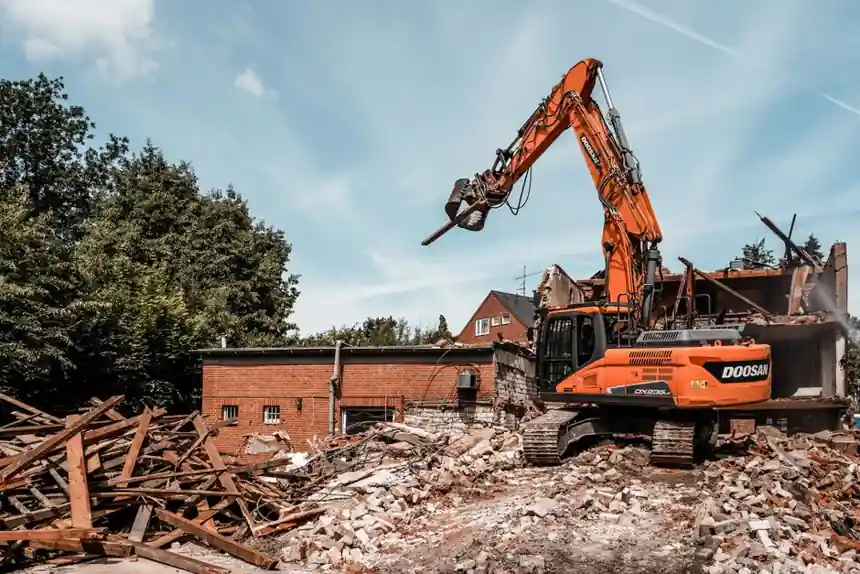
Impact drills, even at 700–900W with hammer function engaged, are not designed for sustained demolition: their percussion is a side-effect of the rotary mechanism and rapidly wears both chuck and bit [S6]. For breaking tile, chasing channels, or removing small sections of concrete, a dedicated demolition hammer in the 1000W+ class (e.g. Makita HR400C) is the correctly specified tool [S4].
The confusion is structural: an impact drill combines rotation with light axial taps, a rotary hammer adds true pneumatic linear concussion via SDS-plus, and a demolition hammer removes rotation entirely and delivers pure forward hammering [S1][S4]. A site selecting an impact drill for chipping concrete is misreading the tool class, not just the model.
Why the Impact Drill Class Fails as a Demolition Tool
An impact drill produces its percussion through angled, intermeshing clutch plates, not a sealed pneumatic or electro-mechanical hammer mechanism, so impact energy per blow is roughly an order of magnitude below an SDS-plus rotary hammer [S1]. The rated impact drill band of 500–750W (compact/home) to 700–900W (workshop) is sized for drilling ≤13mm holes in brick, mortar, and concrete block, not for chipping or breaking [S6]. Sustained chiselling on an impact drill overheats the gearbox, the auxiliary handle cannot react the high linear forces, and standard three-jaw chucks lose bit retention well before an SDS chuck would [S1][S5].
For light demolition only, the impact drill remains usable on thin-set tile backer board, mortar joints, and plaster, where the substrate yields in single-digit minutes per hole and the bit never has to take a sustained lateral load [S3]. Beyond that envelope, the tool's clutch mechanism is the failure point, not the motor.
Correct Demolition Substitutes by Job Scale
Site guidance groups the demolition toolset into three sizes, each tied to a power floor [S4]. Small to medium breakers deliver ≥1000W and target tile removal, light vertical work, and small-section concrete breaking. Large breakers, rated above 1200W (e.g. Hitachi H70SD), are specified for thick slabs and foundations where impact energy per blow, not wattage alone, drives productivity. Rotary hammers sit between the two, with SDS-plus chucks and hammer-only modes that allow chiselling without rotation, and they remain the workhorse for serial anchor drilling in reinforced concrete [S1][S4].
A practical rule from hire-fleet guidance: choose the breaker by material thickness and job scale, not by motor wattage alone, because two 1100W machines with different impact mechanisms deliver very different Joules-per-blow at the chisel tip [S4]. The auxiliary handle, vibration-damped side handle, and bit class (SDS-plus vs hex vs 1-1/8" hex) all carry more of the demolition spec than the nameplate wattage.
Selection Criteria When an Impact Drill Is Still the Right Pick
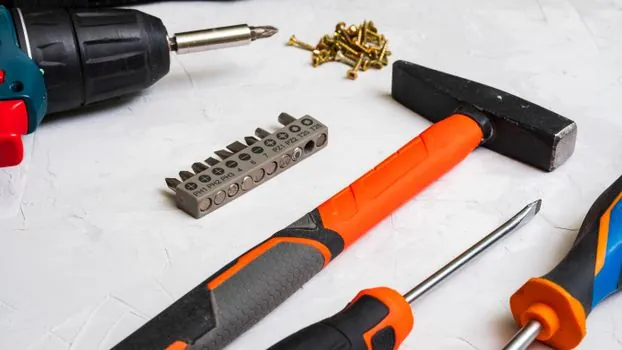
The impact drill remains the correct tool for three site tasks, and the spec criteria narrow fast. Second, intermittent duty cycles under 15–20 minutes per hour, so gearbox heat stays inside its thermal envelope. Third, mixed drilling and screw-driving, which is where the impact drill's combination of high torque (axial-tangential impacts for fasteners) and selectable hammer mode genuinely earns its place [S1][S5].
Mandatory features for any demolition-adjacent use: variable speed (so the operator can ramp into the cut rather than shock-load the bit), a 360° rotating auxiliary handle (to react the percussion reaction torque), a depth stop (for repeat anchor holes), and a keyless metal chuck rated to the chuck-to-bit mass ratio for the intended bit diameter [S5][S6]. Corded impact drills remain the default for sustained hammer work because 18–20V batteries derate under the high inrush of repeated percussion cycles, while cordless wins on mobility for trim and overhead work [S1][S5].
Comparison Table: Impact Drill vs Rotary Hammer vs Demolition Hammer
The table below lines the three tool classes up against the four decision criteria that drive tool selection on a demolition-adjacent site: percussion mechanism (which sets impact energy per blow), power floor, primary use envelope, and chuck/bit system [S1][S4][S6].
Impact drill: clutch-plate percussion, 500–900W, ≤6mm holes in brick/mortar and screw-driving, keyless 3-jaw chuck with round or hex-shank bits. Rotary hammer: electro-pneumatic (SDS-plus) percussion, 800–1500W typically, anchor drilling 6–32mm and light chiselling, SDS-plus bit system. Demolition hammer: electro-pneumatic linear-only mechanism, 1000W+ (small/medium) to 1200W+ (large), pure breaking of tile, masonry, slabs, foundations, 1-1/8" hex or SDS-max bit system [S1][S4].
For the operator, the cleanest test is: if the bit needs to turn while it hammers, the tool is an impact drill or a rotary hammer; if the bit must not turn, the tool is a demolition hammer, and no impact drill class meets that requirement regardless of wattage.
Failure Modes and Mis-Selection Costs

Three failure patterns show up consistently when impact drills are pushed into demolition. First, chuck slippage under repeated axial impact, where the three-jaw chuck walks off the bit shank and the operator interprets it as a bit problem rather than a chuck problem. Second, gearbox overheating within 20–30 minutes of continuous hammer-on drilling in dense concrete, because the clutch plates are sized for short bursts, not continuous percussion [S5]. Third, operator-fatigue injuries from missing auxiliary handles, which double the vibration exposure compared to a properly handled rotary hammer [S4].
From a project-cost view, the difference is roughly an order of magnitude in tool life: an impact drill used in a demolition role typically reaches end-of-life within 6–12 months on a working site, while a properly sized rotary hammer or breaker runs 3–5 years in the same service [S4]. Specifying the wrong class also voids most OEM warranties for hammer-mechanism wear parts, because clutch percussion duty cycles are not covered when the tool is run continuously in hammer mode [S1].
Standards, Bit Systems, and Operator Safety
Two bit-system boundaries govern this category. SDS-plus (rotary hammers, 4–32mm holes) uses a slotted shank that slides axially inside the chuck and converts hammer energy directly, with no reliance on chuck grip. The 3-jaw keyless chuck on an impact drill transmits percussion only through friction, which is why impact-rated drill bits (tungsten-carbide tipped, cylindrical shank) wear rapidly under sustained hammer load and should be replaced at the first sign of tip rounding [S1][S5]. For pure breaking, the bit system is SDS-max or 1-1/8" hex, neither of which is interchangeable with an impact drill chuck [S4].
Safety floors are not optional on demolition-adjacent work: side-handle two-handed operation, ANSI Z89.1-class hard hat, Class 3 hearing protection (impact drills and rotary hammers both exceed 100 dB(A) under load), vibration-reduction gloves where daily exposure exceeds the A(8) action value, and a GFCI/RCD on the corded supply because wet masonry and 230V mains do not mix [S4][S5]. These are not soft guidance; they are the baseline on which a site can hold the tool selection against an audit.
Where the Impact Drill Still Wins, and a Trackable Signal

The impact drill is the right call for interior fit-out, MEP drilling, and light masonry anchor setting, where the bit diameter stays ≤6mm and the substrate is brick, mortar, or block rather than reinforced concrete. A correctly specified corded impact drill in the 700–900W band with a metal keyless chuck, variable speed, depth stop, and 360° auxiliary handle will out-perform a budget rotary hammer on those tasks because it is lighter, cheaper, and the SDS-plus hammer mechanism has no advantage at small diameters [S1][S6]. Pair the impact drill with a separate air impact wrench for the fastening side of the same job, and the tool selection is internally consistent.
Trackable signals worth watching over the next two quarters: 18V/20V brushless cordless impact drills are closing the duty-cycle gap on corded 700–900W units for intermittent hammer use, so any OEM release of a sub-2kg brushless model with a metal chuck and SDS-style adapter is a spec-event worth flagging; second, hire-fleet SKU shifts between SDS-plus rotary hammers and dedicated demolition hammers track real demolition volume, since contractors rent (not buy) when work spikes, and a 10–15% YoY shift in fleet composition is a leading indicator of project mix change [S1][S4].
This topic is covered further in TIG Welder Selection for Electrical Installation: AC/DC, Duty Cycle, and Arc-Start Spec.