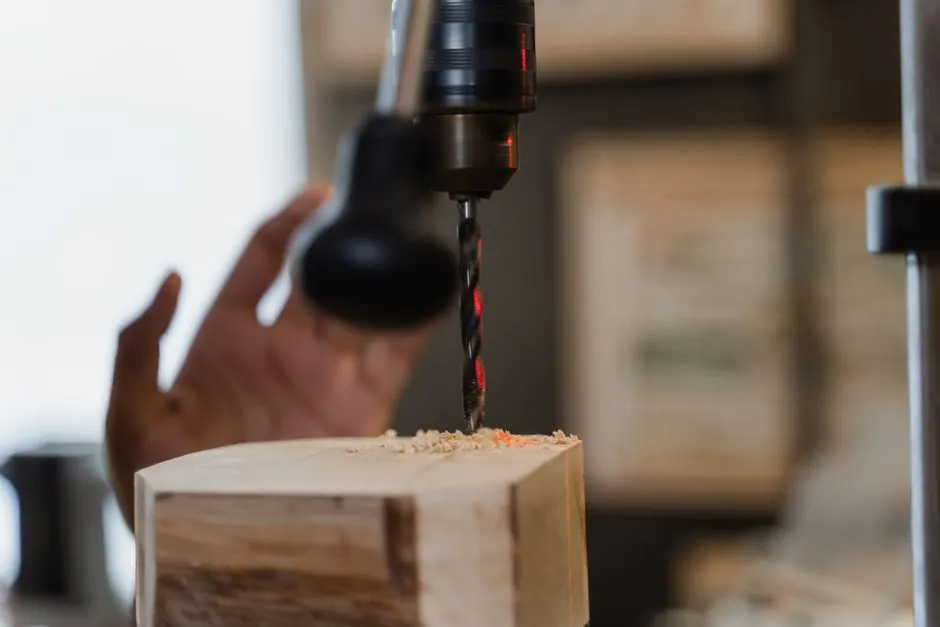
An impact driver in the 18V brushless class is the primary fastener tool for interior finishing crews in 2026, because a tangential hammer mechanism delivers high torque with low back torque, reducing wrist strain during repetitive screw driving into sheet metal, plywood, and dense wood [S2].
The decision is no longer "drill vs hammer drill" but "impact driver vs combi drill", and the answer depends on whether the dominant task is fastening (driver wins) or large-diameter hole making above 25 mm (combi drill or dedicated four-speed unit wins) [S1][S2].
Why Impact Driver Beats Impact Drill for Interior Finishing
An impact driver strikes with rotational force through a tangential hammer, while a hammer drill strikes back and forth along the bit axis, which is the opposite mechanism and the source of most buyer confusion [S4]. The rotational-impact action of an impact driver delivers high torque with minimal wrist effort, which is why residential remodelers and cabinet installers adopt it as the daily-carry tool [S3].
An impact/hammer drill adds the axial percussion mode for masonry, but interior finishing almost never requires drilling into cured concrete, since drywall, metal stud, wood stud, and plywood are the substrate set. The hammer mode on a combi drill therefore adds weight and cost without earning its place on a finisher's belt [S1][S2]. A dedicated impact driver is also significantly lighter and more compact than a combi drill, which matters when the tool is clipped to the belt for an eight-hour shift [S2].
Selection Criteria: Voltage, Chuck, Speed, and Kickback Control
18V brushless is the de-facto platform voltage for finishing crews in 2026, because 12V units struggle with long screws into hardwood and 36V+ platforms are oversized for trim work [S2]. Chuck type is a hard separator: impact drivers use a 1/4 inch hex quick-release, while combi drills use a keyless 1/2 inch or 13 mm three-jaw chuck for round-shank bits and hole saws [S4].
Two practical specs drive model selection: maximum torque in Newton-metres, and the presence of a kickback-stop sensor that cuts drive within a fraction of a second on a jam [S2]. A useful comparison on these criteria for an interior finisher is laid out below.
Side-by-Side: Impact Driver vs Combi Drill vs Four-Speed Percussion Drill
Three platform options are commonly specified for an interior finishing kit, and the right pick depends on the diameter and material mix of the day's work: [S2]
Option A: 18V brushless impact driver (e.g. class of the Milwaukee M18 FUEL Surge hydraulic driver, Festool TID 18). Best for screw-driving in sheet metal, plywood, hardwood, and cabinet assembly. Lightest, lowest back torque, but limited to 1/4 inch hex bits and cannot run a hole saw above ~25 mm [S2][S3].
Option B: 18V combi drill (drill + driver + hammer). Best as a single-tool compromise for crews who occasionally drill into masonry. Heavier than Option A, and the hammer mode is dead weight on finishing sites [S1][S2].
Option C: 18V four-speed percussion drill (e.g. Festool QUADRIVE TPC 18/4 class). Best for large-diameter drilling up to the chuck capacity and high-torque driving in one body. Heaviest of the three, but the four-speed gearbox and electronic torque setting cover both 1/2 inch hole saws and precision fastener work without a tool change [S2].
Decision rule that fits interior finishing: pick Option A as the primary, add Option C only if the crew regularly runs hole saws above 25 mm, and skip Option B unless masonry drilling is part of the same contract.
Use Cases in Interior Finishing
Drywall and metal-stud framing is the headline use case in 2026, and it is exactly where an impact driver's tangential hammer pays back: self-tapping screws into thin sheet metal are driven fast, with a T-mode that detects the material transition and drops speed before engaging impact, preventing screw burn-through on the wood side [S2]. Cabinet installation and residential remodeling round out the top three duty cycles, and the Surge-class hydraulic impact driver is explicitly listed as the best-suited tool for both [S3].
For larger holes such as door-locks, recessed lighting cutouts, and plumbing penetrations in plywood subfloor, a separate drill with a 1/2 inch chuck is still required because hex-shank hole saws above 25 mm are uncommon and round-shank bits cannot be gripped by an impact driver's 1/4 inch hex collet [S4]. Crews that ignore this end up borrowing a combi drill off the truck on day one.
Limitations and Failure Modes

An impact driver cannot replace a drill for precision hole boring, because it lacks an adjustable clutch in the traditional sense and applies concussive torque the instant it meets resistance, which strips small screw heads and overdrives finish fasteners [S4]. Standard drills, by contrast, use a clutch that disengages the motor at a set torque, protecting the material and ensuring consistent screw depth [S4].
Drills also skip or seize when driving long screws into hardwood or dense MDF, because their lower rotational force cannot match the impact driver's tangential hammer, so a finisher who owns only a drill ends up hand-finishing the last 20% of fasteners on every cabinet job [S4]. The fix is not a bigger drill but a second tool, with the impact driver carrying the screw-driving load and the drill reserved for hole boring.
Standards, Sourcing, and Adjacent Tools
No ISO or IEC standard governs hand-held cordless impact-driver performance, so procurement is driven by manufacturer spec sheets and the dominant 18V battery platforms (Milwaukee M18, Festool 18V, DeWalt 20V Max, Makita 18V LXT) [S2][S3]. For crew-level decisions on related jobsite kit, the spec map in Mag Base Drill vs Impact Drill: Spec-Based Selection Guide covers the metalworking side, while Pneumatic Nail Gun Types and Classifications: Spec Map for Specifiers is the matching reference for framing nailers that sit next to the impact driver on a finishing truck.
Trackable signals to watch through 2026: wider release of hydraulic impact drivers (oil-bath instead of hammer-and-spring) for quieter operation on occupied interior fit-outs [S3], and tighter integration of kickback-stop sensors below the 200 Nm torque class, which would extend the safe-use envelope for less-experienced finishers [S2].
For the relevant spec sheets and selection criteria, see impact drill, finishing material, and air impact wrench.