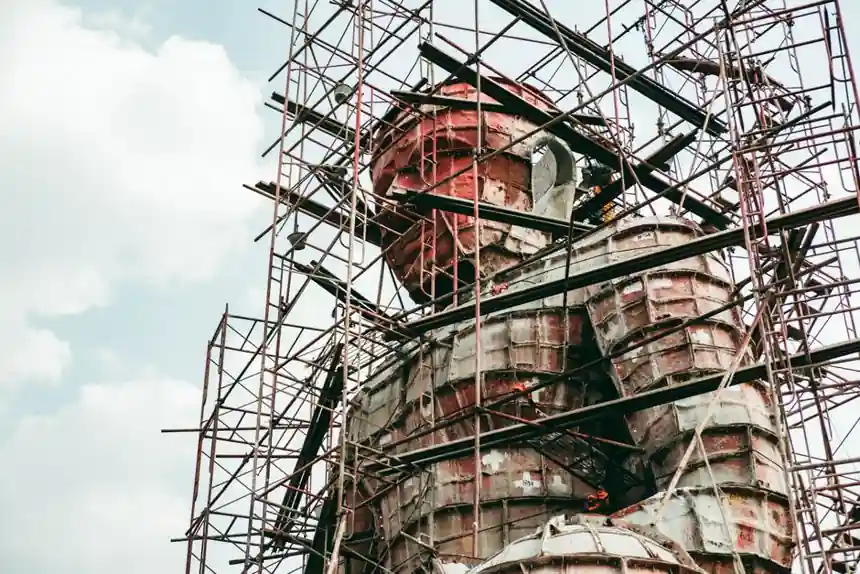
A mobile scaffold tower is selected by four binding variables: required working height, deck load class, frame material, and site footprint, with BS EN 1004 compliance and PASMA-trained assembly as the non-negotiable safety gate [S1][S2].
For one-person indoor work under 4 m platform height, a narrow aluminium single-width tower typically suffices; for façade or multi-trade sites, double-width aluminium or steel H-frame towers with outriggers, tie-ins, and a documented 450 kg safe working load (SWL) become the spec baseline [S2][S5].
Working Height and Reach Geometry
Working height should sit at least 1-2 m above the highest task point so an average operator can work with shoulders below the guardrail, a 1.5-2.0 m reach above the platform is treated as the safe operator envelope [S1][S5]. Lakeside Hire's 2026 sizing guidance tightens the rule to "at least 0.5 m above the task point" for short-duration light tasks, but 1-2 m remains the conservative default for sustained work [S7]. A wrong reading here is the most common spec error: an under-sized platform forces workers to lean past guardrails, an over-sized platform wastes SWL budget and adds wind load.
Three measurements must be reconciled: platform height (top of deck), working height (platform plus 2 m reach), and total tower height (platform plus guardrail frame) [S9]. On multi-floor sites, a stair-tower configuration with integrated treads and handrails replaces internal ladders, reducing trips during material moves and keeping egress within BS EN 1004 geometry limits [S2].
Material Selection: Aluminium, Steel, GRP
Material choice is driven by three constraints: mass, corrosion environment, and electrical conductivity. Aluminium towers (typical tube 50 mm dia., 2 mm wall) deliver the best strength-to-weight ratio, resist rust, and can be moved by one crew, but carry less point load than steel and need stabilizers in exposed wind [S2][S4]. Steel towers accept the highest SWL, hold stability in high winds, and cost less at purchase, yet they conduct electricity and corrode without paint or galvanizing [S4]. GRP (fiberglass) towers are non-conductive and are the only safe pick near live overhead lines or in petrochemical plants with ignition-risk atmospheres [S2][S4].
Quantitatively, double-width aluminium platforms commonly run 2.0-3.0 m long by 1.2 m wide with a 450 kg SWL, sized for two workers plus hand tools; steel equivalents push higher SWL but add 30-50% mass, which affects transport, floor loading, and erection labour [S5]. For indoor fit-out where a hatchback can carry the kit, folding aluminium single-width units are the practical default; for industrial maintenance near switchgear, GRP or fully insulated platforms are specified even at a cost premium [S4].
Load Class, Platform Size, and Crew
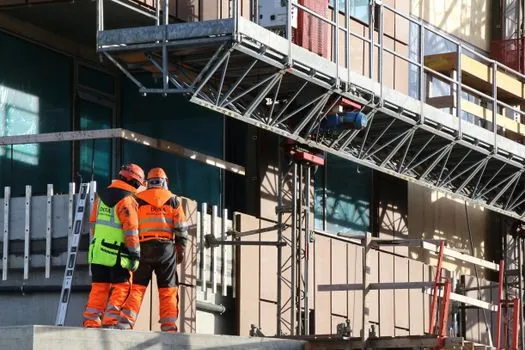
Tower catalogues segment platforms into light, medium, and heavy duty; the pick is governed by worker count plus the mass of tools, materials, and parts staged on the deck [S2][S5]. One worker with hand tools fits a minor or single-width tower (roughly 0.7-1.0 m wide); two workers with power tools or fit-out materials need a double-width deck, and bricklaying or mechanical replacement jobs often need a third load-up platform or a fixed, tied tower [S2][S5].
Under BS EN 1004, free-standing mobile towers are height-limited unless tied, outriggers are mandatory above the manufacturer's stated free-standing height, and the deck must carry a uniformly distributed load plus a concentrated 1.5 kN point load without deflection past the spec limit [S1][S2]. SWL is not a marketing number: it is the sum of worker mass, tool mass, and any staged materials, and any single component overload invalidates the cert.
Site Footprint, Casters, and Ground Conditions
Uneven ground kills more towers than wind does, height-adjustable casters (typical 0.3-0.5 m of thread) are a hard requirement on rough slabs, gravel, or slabs with camber, and add-ons such as stair-pack extensions can give another 1.2 m of vertical adjustment for stepped sites [S5]. Doorway width rules out wide towers: a single-width aluminium unit under 0.8 m clears a standard 900 mm door, while double-width 1.2 m platforms need double-door or industrial access [S3][S5].
Movement route is a design input, not an afterthought: a rolling tower's casters must lock positively (dual-locking type, not spring-loaded), and the travel path should be flat, clear of debris, and rated for the loaded tower weight per caster (commonly 200-400 kg per castor on 150 mm dia. wheels) [S3][S5]. On suspended slabs, the tower's point load must be checked against the floor's allowable load, a 450 kg SWL on four casters over 0.25 m² of contact area can exceed 4 kN/m² and overload an office slab.
Compliance, Training, and Inspection Cycle
BS EN 1004 is the design and testing standard for mobile access and working towers in the UK/EU, and PASMA or equivalent operator training is the practical route to compliant erection, alteration, and dismantle [S1]. In the US the equivalent is OSHA 1926.452 (towers) plus 1926.451 (general scaffolding), with the same height-vs-tie-in logic [S2]. Towers must be inspected after erection, after any event that could affect stability, and at intervals not exceeding 7 days while in service; a tagged scaffold system (e.g. Scafftag) records the inspection and the inspector.
Operators should refuse any tower missing a current inspection tag, with damaged frames, with mismatched components from different manufacturers, or without legible SWL labelling, defects here are a stop-work condition, not a judgement call [S1][S2]. For procurement or hire, the verifiable signals are: BS EN 1004 stamp on frames, manufacturer-matched components, current inspection tag, and proof of PASMA cards for the assembly crew.
Who Should NOT Pick the Default Aluminium Tower
Aluminium is the default but is wrong for: (1) live electrical work overhead, where GRP is the safe pick; (2) heavy masonry or mechanical-replacement loads that exceed aluminium's SWL, where steel or a fixed tied tower is required; (3) exposed sites above the free-standing height limit, where tie-ins, outriggers, or a fixed tower must replace the free-standing mobile; (4) sites with weak floor slabs where the tower's point load exceeds allowable loading; (5) any environment where the crew is not PASMA-trained to assemble that specific manufacturer's tower [S1][S2][S4][S5].
A shortlist logic that holds up on audit: confirm the reach height (platform + 1.5-2.0 m), confirm the SWL (workers + tools + materials, all summed), confirm the material (aluminium default, GRP near electricity, steel for heavy load), confirm the site (ground, doorway, slab capacity), and confirm the cert (BS EN 1004 + current tag + trained erectors). Any one missing flips the spec. Field crews running concrete finishing and floor prep work alongside tower work will also want to cross-check tool selection against the same safety gate, a power trowel TCO model helps size the equipment fleet that shares the site with the tower. Track BS EN 1004 revision status and any manufacturer SWL down-ratings as the next verification node before purchase or long-term hire.
Component reference pages worth checking: access scaffold, mobile crane, and tower crane.