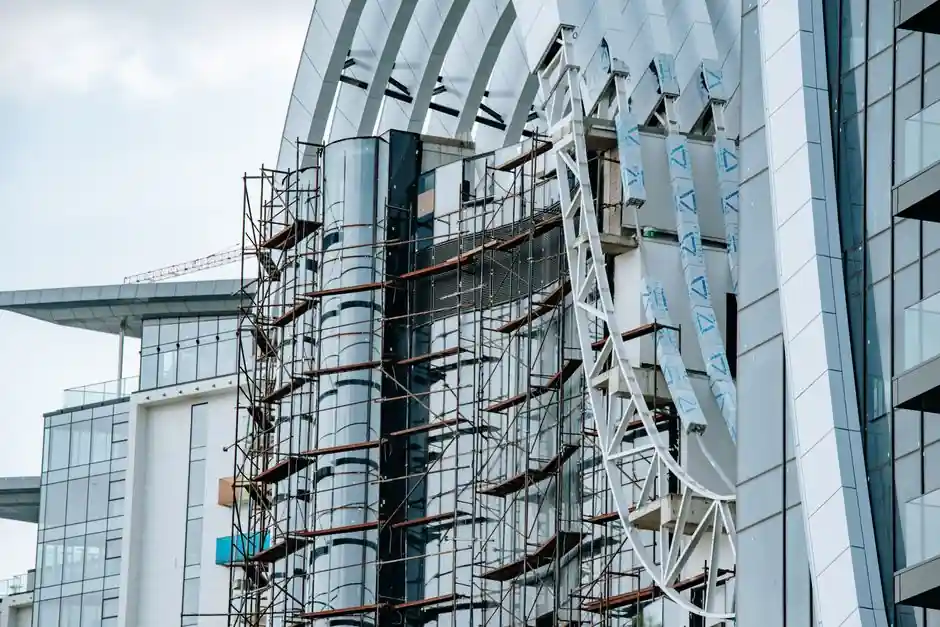
A mobile scaffold tower is a wheel-mounted, prefabricated access platform rated to roughly 200 kg/m2 and assembled from standard parts to working heights between 2.5 m and 12.35 m, designed to be relocated without disassembly [S4].
Traditional scaffolding, by contrast, is a tube-and-coupler or system-scaffold framework built around the structure being worked on, intended for multi-week to multi-month projects where mobility is secondary to load capacity and tie-in stability [S2][S3].
Structural Definition and Scope Under 29 CFR 1926.452(w)
OSHA classifies mobile scaffolds as a sub-type of supported scaffold set on wheels or casters, with explicit construction rules under 29 CFR 1926.452(w): platforms must be plumb, level, and squared; vertical members must be braced by cross, horizontal, or diagonal braces, or a combination; all brace connections must be secured; caster and wheel stems must be pinned or otherwise secured; and caster/wheel locks (positive wheel locks, wheel and swivel locks, or equivalent) must engage whenever the tower is in a stationary working position [S1].
Tube-and-coupler mobile towers must also comply with 29 CFR 1926.452(b), and fabricated-frame mobile towers with 29 CFR 1926.452(c); the OSHA rules treat these construction types as separate compliance paths even when the end product is functionally the same rolling tower [S1].
Decision Criteria: Duration, Mobility, Height, Load, Compliance
The four criteria that drive a mobile-vs-traditional choice are project duration, repositioning frequency, working height, and platform load class, with site footprint and tie-in feasibility as tiebreakers. A one-week façade job with daily moves points to a mobile tower; a six-week façade retention or demolition-prep job points to a fixed traditional scaffold [S3].
On height, the most common aluminium mobile towers in hire fleets span 2.5 m to 10 m working height in ladder-frame configuration and 4.0 m to 12.35 m in stair-frame configuration, with stabilizers supplied as standard above 6 m working height [S4]. Beyond roughly 12 m the free-standing mobile concept runs out of headroom and tube-and-coupler or system scaffolding with structural tie-ins becomes the practical option, particularly once EN 1004 free-standing limits and OSHA height-to-base-ratio rules are applied [S3][S4].
Options Compared on Cost, Mobility, Height, and Integration Effort
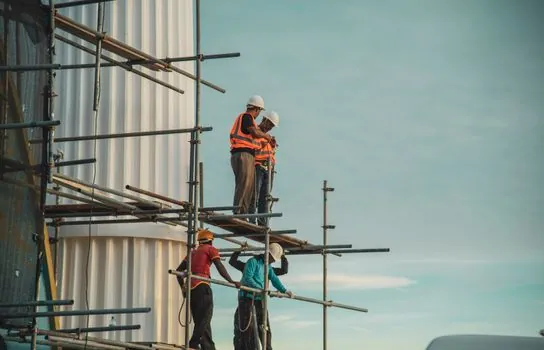
Across the four access options a contractor will actually choose between, the trade-offs are concrete: traditional tube-and-coupler scaffolding scores highest on raw load capacity and on height-with-tie-ins, but loses on mobilization cost and repositioning time, because each move is effectively a partial dismantle and re-erect by trained scaffolders [S2][S3].
Mobile aluminium towers score highest on mobility and on per-move labour cost, since one crew wheels the unit into place without tools, but cap out near 12 m free-standing and require stabilizers above 6 m to stay within the 200 kg/m2 platform rating that the common Chemey-class units are built to [S4]. Cantilever and GRP variants exist for obstacle-overreach and live-electrical work respectively, but are special-order modular add-ons with engineered design checks, not catalogue items [S3].
Stair-tower variants of mobile systems sit between the two: they keep the wheel-base mobility of a mobile tower but trade the internal ladder for an angled stair with 100 mm non-slip treads, which matters on multi-trade sites where workers and materials move up and down frequently [S4].
Material Selection: Aluminium vs Steel vs GRP
Aluminium mobile towers are marketed on a higher strength-to-weight ratio than steel, on a self-passivating oxide layer that limits corrosion after surface damage, and on hand-erectable weights that remove the need for powered lifting gear on most moves [S4].
Steel mobile towers are heavier per bay and more common in long-duration industrial yards where corrosion is controlled by galvanizing and where impact damage is a real risk; GRP (fiberglass) towers are the default pick near live electrical work or in petrochemical plants because the non-conductive frame removes the earthing and shrouding burden that aluminium or steel would impose [S3]. For general indoor fit-out and light maintenance, aluminium is the default hire-fleet material; for chemical or HV plant, GRP earns its premium back in reduced permitting [S3][S4].
Compliance Map: EN 1004, OSHA 1926.452(w), and the Moving Rule

European hire fleets typically cite BS EN 1004:2004 as the governing standard for the aluminium mobile tower product, with platform load class declared at 200 kg/m2 and stabilizers mandated above 6 m working height [S4]. US sites fall under OSHA 29 CFR 1926.452(w), which layers additional moving and stabilization rules on top of the construction rules: scaffolds must be stabilized to prevent tipping during any movement, manual force is the only force permitted unless specifically engineered otherwise, and personnel are not to ride the tower during a move [S1].
OSHA also requires that platforms not extend beyond the base supports unless outrigger frames or equivalent devices ensure stability, and that any necessary levelling be done with screw jacks or equivalent means rather than shimming [S1]. These are the items a site supervisor gets failed on during a 1926.452(w) inspection, and they are the reason a "wheels locked, brakes set, outriggers deployed" checklist is non-negotiable above 2 m working height on an uneven slab [S1][S3].
Use-Case Recommendations and Limitations
For painting, plastering, ceiling fix-out, M&E rough-in, and corridor work where the crew relocates several times a day, the mobile aluminium tower is the right tool: one or two workers can break it down, roll it, and re-erect within minutes, the platform rating covers two trades plus tools, and the hire cost is a fraction of a tube-and-coupler package [S3][S4]. The relevant access-scaffold category for these rolling units is covered in the mobile access scaffold reference entry.
For façade retention, multi-storey new-build, demolition prep, and any work above 12 m or with sustained point loads above 200 kg/m2, traditional scaffolding wins on stability, tie-in options, and ability to cantilever working platforms off the main frame, and the rules shift from 1926.452(w) to the broader scaffolding system requirements [S1][S3]. If the project also needs heavy plant lifts to the platform, the right access concept is usually a tower crane or mobile crane staging area combined with a fixed scaffold, not a rolling tower. Contractors weighing scaffold access against MEWP rental should also factor in the suspended working platform trade-offs when façade geometry blocks a ground-up build.
For site personnel needing hand-power tools on the platform, a mobile tower pairs naturally with a stud-welded or impact-wrench workflow; selection guidance for stud welder and impact-wrench kit setup is worth aligning with the tower's load class before bid day.
Trackable signals for the next planning cycle: EN 1004 revision activity and any OSHA 1926.452(w) interpretation letter covering powered mobile scaffolds above the current 12 m free-standing cap, plus the steady migration of hire fleets from 1.35 m wide aluminium bays toward 0.75 m narrow-frame single-width units for corridor refurb work [S3][S4].