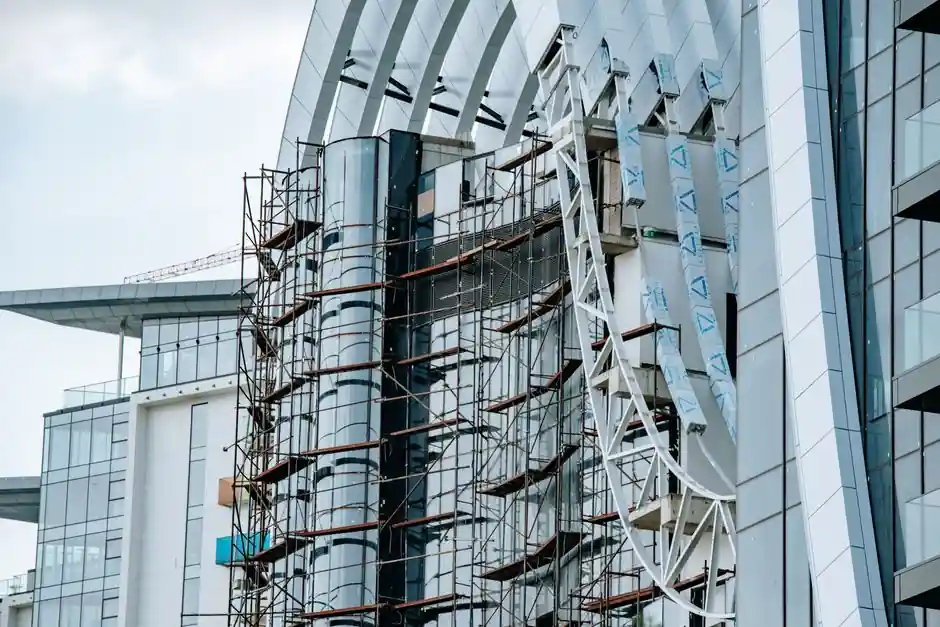
Cuplock is a modular scaffold system defined by a fixed bottom cup welded to the standard and a sliding top cup that locks forged ledger blades with a single hammer blow, joining up to four horizontals at each node [S1][S7].
General scaffolding, in the spec sense used here, covers traditional tube-and-coupler, H-frame, Kwikstage, and Ringlock systems, each built around a different connection logic and bay geometry [S5]. The choice between them is driven by bay layout, load case, labour rate, and reuse cycle, not by a single "best" system.
Node Geometry and Component Sizes
Cuplock verticals use 48.3 mm OD high-strength steel tube, hot-dip galvanized, with bottom cups welded at 500 mm centre-to-centre intervals, and standard lengths from 0.5 m up to 3.0 m [S1]. The forged ledger blade end drops into the lower cup, the upper cup slides down, and a single hammer strike locks up to four horizontals in one action, which is the mechanism that drives the system's erection speed [S1][S7].
Tube-and-coupler scaffolding uses the same 48.3 mm OD tube but joins every intersection with loose right-angle or swivel clamps, so geometry is set by the fitter, not by the system [S5]. Ringlock standards carry 8- to 12-hole rosettes, also typically at 500 mm centres, but each rosette accepts ledgers and braces at multiple angles rather than only the four right-angle seats of a Cuplock cup [S5][S8]. For readers new to the broader scaffold taxonomy, the scaffolding reference page lays out these connection families side by side.
Assembly Speed and Labour Cost
Cuplock is consistently described as faster than tube-and-coupler scaffolding because the cup node replaces loose fittings with a single-action lock, while still requiring more manual effort per node than Ringlock, where the wedge drops in by gravity [S2][S5]. One industry comparison rates Cuplock assembly speed as "Very Fast" against other modular systems, with Ringlock rated "Fast" on the same qualitative scale [S6].
In markets where the daily labour rate is high (Middle East, Singapore, Australia, Western Europe), the labour-saving delta of cup-and-wedge versus tube-and-coupler is typically recovered on the first 10-20 reuses of a galvanized Cuplock set. In low-labour-cost markets, that pay-back often does not close, and the lower capital cost of tube-and-coupler wins. The CupLock verticals, ledgers, braces, and trusses supplied in fully galvanized, high-strength low-alloy steel are designed for exactly this multi-reuse duty cycle [S3].
Load Capacity and Structural Use
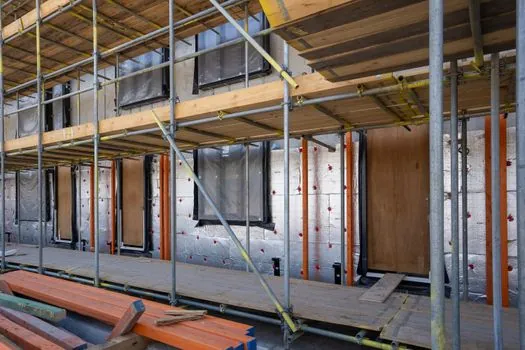
Cuplock is rated for high vertical load capacity on regular, repetitive bays and is widely used as formwork support, birdcage access, and straight façade access where the heavy-duty duty case dominates [S1][S3][S6]. Because the cup is a fixed right-angle seat, eccentric load paths (curved façades, circular tanks, domes) are inefficient with Cuplock and are usually re-engineered with tapered bays or replaced with Ringlock [S5][S8].
For heavy shoring and slab formwork, Cuplock is often the default in the Middle East and South Asia, supported by horizontal trusses and diagonal braces that allow long clear spans under slab loads [S3]. For complex industrial access (refineries, shipyards, offshore), Ringlock's rosette node is the more common specification because the same standard can serve vertical, horizontal, and brace members at variable angles [S5].
Flexibility and Bay Geometry
Flexibility is the line where the two systems diverge hardest. Cuplock is built for right-angle, orthogonal grids; the fixed cup positions and standard ledger lengths (typically 0.9, 1.2, 1.5, 1.8, 2.0, 2.5, 3.0 m) define a regular bay that is hard to deviate from [S1]. Curved, circular, or irregular structures force the contractor to mix lengths, add tube-and-coupler infill, or switch systems entirely.
Ringlock and Kwikstage both score higher on layout flexibility: Ringlock via the multi-hole rosette, Kwikstage via its hook-and-wedge interface on standard wedge-node verticals [S5]. If a project mixes straight-run façade work with curved access (for example, a tank farm with circular bunds), a single Ringlock set often replaces two specialized systems. If the project is 100% straight run with heavy-duty shoring, Cuplock still wins on raw erection speed and node strength.
Materials, Finish, and Reuse Life
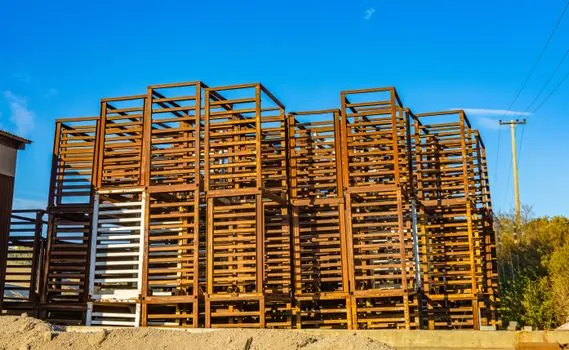
Cuplock components are routinely supplied in high-strength low-alloy structural steel with a hot-dip galvanized (HDG) finish, which is the default for site exposure and for rental fleet rotation [S1][S3]. Standards, ledgers, braces, and board brackets share the same HDG spec, simplifying inspection: a Cuplock ledger blade is usually visible wear point, and a missing or bent blade is a clear reject criterion during pre-shift checks [S1][S3].
Tube-and-coupler systems use the same 48.3 mm OD tube but rely on separate couplers (forged or pressed steel, often EN 74 / BS 1139 grades), which are a recurring consumable and a documented failure point if mixed-source couplers end up on a single bay. Galvanizing, material grade (S235, S275, S355), and re-galv options are similar between systems, so reuse life in the field is comparable when properly maintained, the differentiator is the connection, not the tube.
Safety, Inspection, and Code Compliance
All four systems (tube-and-coupler, frame, Cuplock, Ringlock) are typically designed to OSHA 1926 Subpart L in the United States, EN 12810/12811 in Europe, and equivalent local codes, with working load classes ranging from light-duty access (1.5 kN/m²) up to heavy-duty shoring (4.5 kN/m² and above) [S5]. Cuplock's right-angle node and forged blade make it tolerant of minor field misalignment, but the system's structural advantage depends on every cup being fully seated and every top cup being hammered home, partial lock-off is the most common Cuplock failure mode on poorly supervised sites [S1].
Inspection routines across systems share the same backbone: check verticals for bent tube or damaged spigot, check horizontals for bent blade or hook, check braces for bent swages, check boards for splits, check base jacks for free travel and intact threads. The Cuplock-specific addition is the cup inspection: a top cup that does not slide freely under hand pressure has to come out of service, because the hammer-blow lock depends on that slide [S1][S3].
Decision Matrix: Cuplock vs General Scaffolding Options

Across the four most common spec criteria, Cuplock, tube-and-coupler, Kwikstage, and Ringlock line up as follows [S1][S2][S5][S6][S8]:
1) Assembly speed: Cuplock = very fast on straight bays; Ringlock = fast on mixed geometry; Kwikstage = fast on simple bays; tube-and-coupler = slow, fully fitter-dependent. 2) Layout flexibility: Cuplock = moderate (right-angle only); Ringlock = high (multi-angle rosette); Kwikstage = moderate-high; tube-and-coupler = high but labour-intensive. 3) Load capacity (vertical bay): Cuplock = high, suited to heavy-duty shoring; Ringlock = high; Kwikstage = high; tube-and-coupler = depends on coupler grade and bay bracing. 4) Capital cost per tonne: Cuplock = moderate; Ringlock = moderate-high (more components per standard); Kwikstage = moderate; tube-and-coupler = low.
For procurement, the rule of thumb is: specify Cuplock when the project is 70%+ straight, repetitive bays with heavy-duty shoring or façade access; specify Ringlock when the project is industrial, curved, or has variable geometry; specify Kwikstage for residential and light-commercial façade work where its wedge node is the regional norm; specify tube-and-coupler only for short-duration, low-reuse, or highly irregular access where fleet capital must be minimized.
Use Cases and Field Limitations
Cuplock is the default spec for high-rise straight façade access in the Gulf and South Asia, for slab formwork support on residential towers, and for continuous birdcage access in refineries and power plants [S1][S3][S5]. It is also the standard hire-fleet workhorse in the UK, Middle East, and Australia, where the HDG component set and 500 mm node spacing are well understood by inspection bodies.
Cuplock is the wrong choice for circular tank access without a substantial Ringlock infill, for shipyard block staging where curved geometry dominates, and for offshore modules where every connection has to be torque-checked at variable angles [S5][S8]. It is also the wrong choice for sites with a casual or untrained labour force, because the system rewards correct cup seating and punishes partial lock-off more visibly than tube-and-coupler, where a loose clamp can sometimes still hold a bay until the next inspection.
The next decision node is matching Cuplock component grade to your local code's load class: EN 12811 Class 4 (3.0 kN/m²) versus Class 6 (4.5 kN/m²) shifts the required ledger spacing, the number of board brackets per bay, and the bracing pattern, and it should be locked in writing before the first standard goes up [S5]. For adjacent reading on the formwork and shoring side of this decision, the field comparison at Shotcrete Machine TCO: Where the Real Money Goes After the Sticker Price covers the concrete-pumping economics that usually run in parallel with a Cuplock shoring decision.
Spec-level background on the components involved: pressure transmitter, and flow meter.