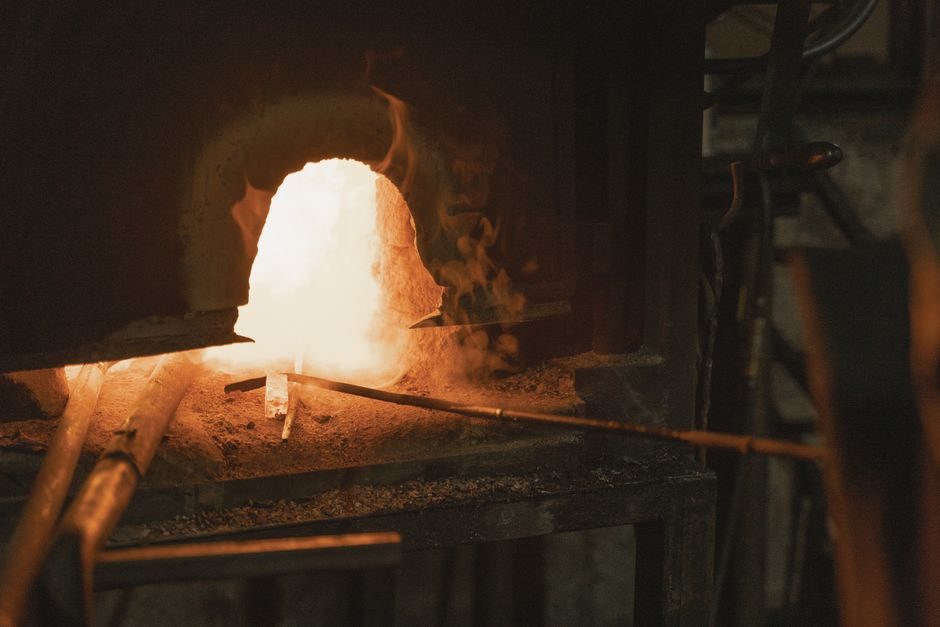
An induction furnace is selected by matching the melt mass per shift, the alloy chemistry, the available mains frequency and the refractory strategy to the coil and bus-bar design — the spec lives or dies on those five gates, not on brand preference [S3][S4].
The practical envelope on 2026-06-25 covers line-frequency (50/60 Hz) channel and coreless units from roughly 100 kW up to medium-frequency (MF, 1-10 kHz) coreless melting furnaces around 5,000 kW per unit, with one Chinese supplier quoting a power range of 10 kW to 50,000 kW across its KGCL power-supply line for induction melting, heating and forging applications [S3].
Frequency and Power Class: The Hard Physical Gate
Frequency sets the skin depth in the charge, which is why a 50/60 Hz line-frequency holding furnace penetrates a large iron bath several centimetres deep while a 10-30 kHz medium-frequency melting furnace drives current into a shallower surface layer of steel scrap and is preferred for cold-charge melts in 1-10 t sizes [S4].
For a 1-3 t steel melt, medium-frequency coreless furnaces are the default in 2026 builds, while 50 Hz channel-type holding units are used for iron and copper alloy soak duty. APS Induction (Taizhou) publishes a KGCL supply range of 10 kW-50,000 kW covering melting, heating and forging, which gives a working envelope for a single power supply; multi-supply paralleling is the path past 50 MW [S3].
Capacity, Tap Rate and Furnace Family
Capacity must be sized to the tap-to-tap cycle, not the daily tonnage: a 3 t medium-frequency coreless furnace typically delivers 2.5-3.5 t/h on steel at 1,200-1,500 kW, with energy consumption in the 530-600 kWh/t range when the charge is clean, dry scrap [S4].
Family choice is then forced by the alloy: coreless medium-frequency is the default for steel, stainless and superalloy melts; channel induction furnace units dominate cast iron holding at foundries because the molten heel supports the channel inductor and gives steady thermal head; small coreless units (under 100 kW) are used for precious-metal and laboratory melts. The cupola furnace competes with induction only on low-cost cast iron production where coke economics still win, and even there the induction line is taking share on emissions grounds.
Refractory, Lining Life and Water Cooling

Refractory life is the second-largest operating cost after electricity. A silica or magnesia dry-vibrated lining in a 3 t steel coreless furnace gives 200-400 heats on steel and 80-150 heats on ductile iron before re-ramming is needed; high-alumina and MgO-C ramming mixes extend the upper end at higher unit cost [S4].
Cooling water is the other constraint. The water-cooled copper coil carries the bulk of the heat extracted from the crucible wall, and a 1,500 kW medium-frequency coreless furnace typically demands 30-50 m^3/h of deionised or softened water with inlet temperature held below 35 deg C to prevent copper-tube scaling — exceed that, and coil life drops sharply. A clean-water skid with conductivity below 5 microS/cm and a closed loop is standard on 2026 builds, with heat rejected through a plate exchanger to a cooling tower.
Power Quality, Harmonics and Supply Coordination
Solid-state medium-frequency supplies are nonlinear loads: a 2 MW MF coreless rig with a 12-pulse rectifier still draws current at roughly the 5th, 7th, 11th and 13th harmonic orders, and IEEE 519 compliance at the PCC is the usual buyer gate, meaning active or passive harmonic filters sized to the supply transformer impedance [S3].
Coordination with the plant MV transformer is the gate most projects miss. A 3 MW induction melt line on a 6 MVA transformer leaves little headroom for the upstream forging press; either oversize the transformer by 30-50% or add a dedicated furnace feeder. Voltage flicker from arcing during bore-down is the other side of the same problem, and a static VAR compensator (SVC) or active front-end is the cure, with the active front-end now standard on premium 2026 builds because it also regenerates braking energy back to the bus.
Selection Criteria Matrix: Coreless MF vs Channel LF vs Small Coreless
The decision pivots on four axes. On tap size, coreless medium-frequency wins from 0.5 t to 20 t, channel line-frequency from 5 t to 100 t holding, small coreless under 0.5 t for lab and precious metal. On alloy, coreless handles steel, stainless, superalloy and most non-ferrous; channel is restricted to cast iron, copper and aluminium holding because the molten heel and lower loop temperature constrain chemistry. On energy, coreless MF on cold steel scrap sits in the 530-600 kWh/t band; channel holding is below 50 kWh/t because the charge is already molten. On capex per ton of capacity, coreless MF sits roughly 1.5-2x channel LF per installed kW but rebuilds faster and gives the alloy flexibility a channel cannot match [S4].
For buyers weighing line items against each other, the broader melting furnace 2026 price and cost guide breaks the same levers across the wider furnace family and is the place to validate capex per ton against the induction-specific numbers above.
Standards, Safety and Sourcing Footprint
The binding international standards for an induction furnace build are the IEC 60519-series on safety in electroheat installations, the IEC 60079-series if the charging area is zoned hazardous (aluminium and magnesium melts), and the energy-efficiency framework under ISO 13579 for high-temperature industrial furnaces. Sourcing remains concentrated in China, Germany, Italy, India and Japan; APS Induction (Taizhou) Co. Ltd. is a typical mid-tier Chinese supplier with the KGCL power-supply line at 10 kW-50,000 kW published as of 2026-06 [S2][S3].
Pre-RFQ discipline is straightforward: lock the alloy and tap rate, pick the frequency class from the skin-depth rule, size the transformer and harmonic-mitigation package together, and then validate refractory and water chemistry against the local supply. Skip any one of those gates and the unit either under-taps, overheats the coil, or trips on harmonics inside the first month.