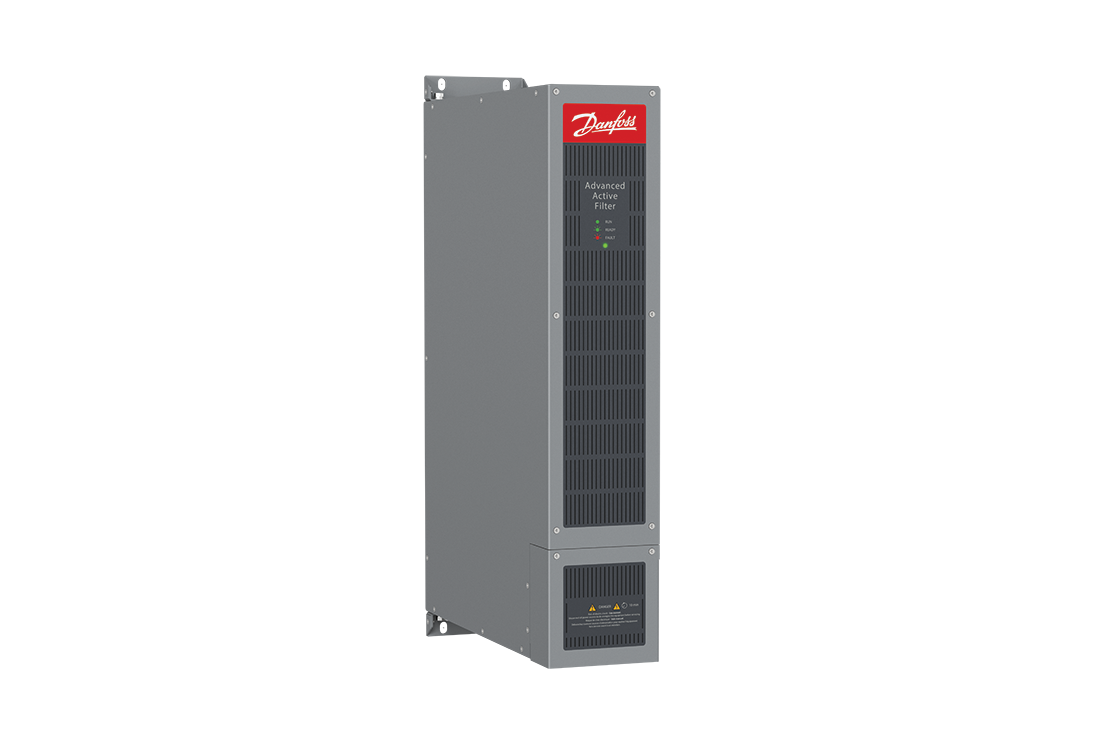
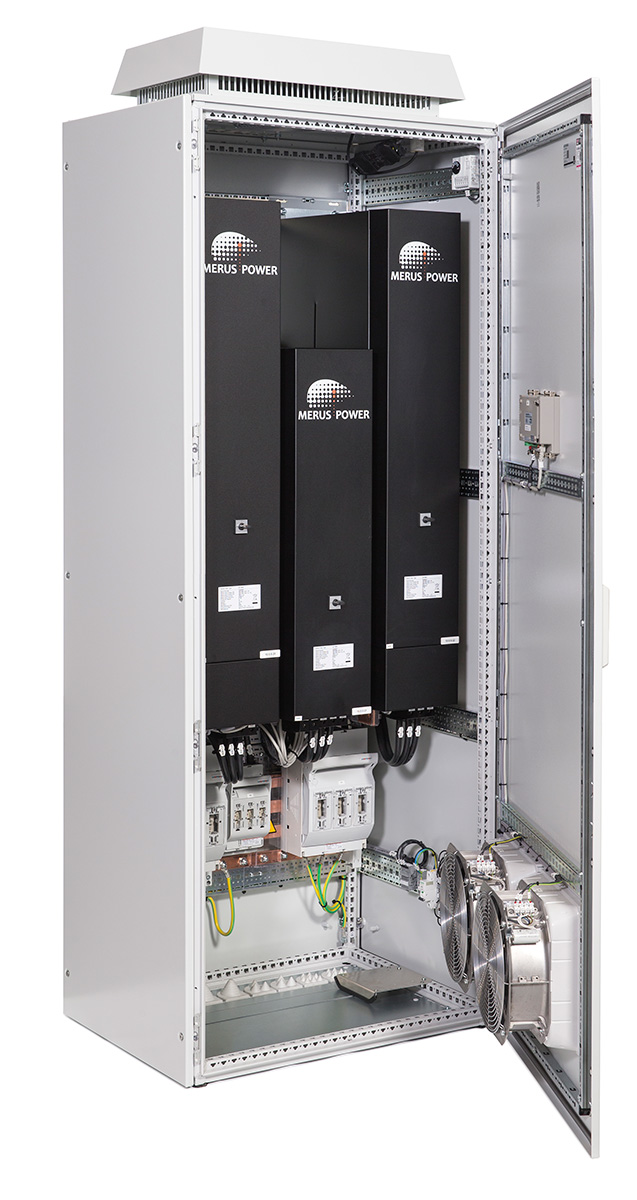
A harmonic filter is a power-quality device that removes or diverts the distorted, non-sinusoidal current that nonlinear loads such as variable-frequency drives, rectifiers, UPS systems and LED lighting draw from the grid. By suppressing those harmonic currents it lowers total harmonic distortion (THD), prevents transformer and neutral overheating, stops nuisance breaker trips, and brings an installation into compliance with IEEE 519 and the IEC 61000 series.
Two families dominate. Passive filters use fixed reactors and capacitors tuned to specific harmonic orders; active filters use a fast inverter that synthesises a cancelling current in real time. Choosing between them, and sizing the chosen filter correctly, is the core engineering decision this guide addresses.
Photo: Holger Urban, CC BY-SA 4.0, via Wikimedia Commons
This guide is written for industrial purchasing engineers and electrical design engineers. It covers 6 chapters from what harmonics are and why they matter, through passive, active and hybrid filter types, tuning and detuning theory, the IEEE 519 and IEC limits that govern compliance, the key rating parameters on a datasheet, to a step-by-step selection sequence, with 7 selection FAQs and manufacturer comparisons. All limits and parameters reference IEEE 519-2022, the IEC 61000-3 series, IEC 60076-6 / IEC 61642 on reactors, and IEC 60831 on capacitors.
Chapter 1 / 06
What Is a Harmonic Filter
A harmonic filter is a device that reduces the harmonic content of current or voltage in an electrical power system. Harmonics are sinusoidal components at integer multiples of the fundamental frequency: on a 50 Hz supply the 5th harmonic is 250 Hz, the 7th is 350 Hz, the 11th is 550 Hz. They are not produced by the supply; they are drawn by nonlinear loads whose current does not follow the applied voltage sinusoidally. The classic source is the six-pulse diode or thyristor rectifier at the front of a variable-frequency drive, which draws a characteristic spectrum of 5th, 7th, 11th, 13th and higher orders, following the rule that a p-pulse converter produces harmonics of order h equal to p times k plus or minus 1.
These currents do real damage. Harmonic current flowing in cables and transformer windings produces extra I-squared-R heating, so a power transformer feeding heavy drive load must be derated or it overheats; the IEEE C57.110 method exists precisely to calculate that derating. Triplen harmonics (the 3rd, 9th, 15th) are zero-sequence and add arithmetically in the neutral conductor of a four-wire system, so a neutral can carry more current than the phases and overheat even when the phases look balanced. High-frequency harmonic current raises losses in AC motors, trips circuit breakers and blows capacitor fuses by exciting resonance, and distorts the voltage waveform that every other load on the same bus must use.
The metric that captures the problem is total harmonic distortion. Current THD, written THDi, is the RMS of all harmonic currents expressed as a percentage of the fundamental current; voltage THD, THDv, is the equivalent for voltage. An unmitigated six-pulse drive can present a current THD of 30 to 80 percent. The job of the harmonic filter is to pull that figure down to a level the standards permit, commonly a current total demand distortion of 5 to 8 percent at the point of common coupling and a voltage THD below 5 percent.
The engineering of harmonic mitigation has a long lineage. Series-tuned LC filters for power systems date to the 1940s and the rise of mercury-arc rectifiers and electric-arc furnaces. The modern shunt active filter became practical only when fast insulated-gate bipolar transistors (IGBTs) and digital signal processors could measure and re-inject a cancelling current within a fraction of a fundamental cycle, which happened commercially from the 1990s onward. IEEE 519, first issued in 1981 and revised in 1992, 2014 and 2022, gave the industry a common compliance target and is the reason most filters are specified at all.
Four practical questions decide which filter an engineer buys: which harmonic orders dominate the spectrum, how much current distortion the utility or internal standard allows, whether the load is one steady block or many variable drives, and whether reactive power correction is also wanted. The rest of this guide works through each in turn, because there is no universal harmonic filter, only a filter matched to a measured spectrum and a compliance target.
Chapter 2 / 06
Filter Types and Classification
Harmonic mitigation divides into three families: passive, active, and hybrid. The choice is rarely a matter of one being universally better; it is a trade between cost, the breadth of orders covered, immunity to resonance, and whether the load is fixed or variable. The table below sets out the core differences before each is described.
Family
How It Works
Orders Covered
Relative Cost
Best Suited To
Passive (tuned)
Fixed L-C branch shunts one or two harmonic orders to a low-impedance path
1 to 2 orders
Low
Single large steady nonlinear load
Detuned bank
Reactor in series with PFC capacitors shifts resonance below the 5th
Light, broadband
Low
Power-factor correction in distorted networks
Active (shunt AHF)
Inverter injects a current equal and opposite to measured harmonics
2nd to 50th
High
Mixed and variable drive loads
Hybrid
Passive branch carries the bulk; small active stage trims the rest
Wide
Medium-high
Large loads needing low THD at lower cost than full active
Passive filters are networks of reactors and capacitors that present a deliberately low impedance at one or more harmonic frequencies, so the harmonic current flows into the filter rather than back into the supply. They are efficient, inexpensive and rugged, and they supply useful reactive power at the fundamental, doubling as reactive power compensation. Their weaknesses are intrinsic: they are fixed-tuned, so a change in the supply or load detunes them; their performance depends on the source impedance, which the buyer cannot always control; and a capacitor-bearing filter can form a parallel resonance with the supply inductance at an unintended frequency, magnifying rather than reducing a nearby harmonic. They also over-supply reactive power at light load, which can push the bus toward leading power factor.
Active harmonic filters, abbreviated AHF or sometimes APF, are a different animal. A current transformer measures the load current, a digital signal processor extracts the harmonic content in real time, and an IGBT inverter injects a current that is the mirror image of those harmonics so that the supply sees a clean, near-sinusoidal current. Because the filter computes the cancelling current cycle by cycle, it adapts automatically to a changing load and cannot resonate with the supply. It typically cancels every order from the 2nd to the 50th simultaneously, corrects displacement power factor, and can balance load between phases. The cost is higher per amp of correction, and the unit has a finite injection rating, so it must be sized to the harmonic current, not the load.
Hybrid filters combine the two: a passive branch handles the bulk of the dominant harmonic at low cost, while a much smaller active stage cleans up the residue and suppresses the resonance and detuning risks of the passive section. For very large loads where a fully rated active filter would be expensive, a hybrid can reach the same THD target at lower total cost. Beyond these three filter families sit mitigation methods that change the load itself rather than filter it: AC line reactors and DC-link chokes that broaden and flatten the drive current peak, and 12-pulse or 18-pulse phase-shifting transformer arrangements that cancel specific harmonics by combining two or three phase-displaced six-pulse bridges. An 18-pulse drive cancels every order below the 17th in the supply current, leaving the 17th, 19th, 35th and 37th as the lowest remaining orders.
Chapter 3 / 06
Passive Topologies and Tuning
Within the passive family there are four standard topologies, distinguished by how many orders they absorb and how they balance attenuation against losses. The table below compares them; the prose that follows explains the tuning theory that governs all of them.
The single-tuned filter is the workhorse. A reactor and a capacitor in series resonate at one chosen frequency, where the branch impedance collapses to the reactor and capacitor losses alone, drawing that harmonic out of the supply. It is highly selective, has low sensitivity to small grid-impedance changes, is reliable and is the cheapest per branch, but it covers only one order, so a spectrum with strong 5th and 7th content needs two branches. The double-tuned filter places a series L-C in cascade with a parallel R-L-C section so that a single physical branch resonates at two frequencies near the geometric mean of the two target orders, saving a set of switchgear at the cost of more complex tuning and greater sensitivity to detuning.
The high-pass or damped filter puts a resistor in parallel with the reactor, broadening the response so the branch attenuates a band of higher orders rather than a single line. It is the natural choice for the 11th and above, where many small orders cluster, but the damping resistor dissipates real power and the branch has higher fundamental-frequency losses than a tuned filter. The C-type filter solves that loss problem elegantly: an auxiliary capacitor is added so that the reactor and that capacitor resonate at the fundamental, short-circuiting the damping resistor at 50 or 60 Hz so almost no fundamental current flows through it, while the resistor still damps the higher orders. C-type filters are favoured at high voltage and on arc-furnace and flicker-prone supplies, where low fundamental loss and broadband damping both matter.
Distinct from a true tuned filter is the detuned reactor bank, the most common passive device in everyday low-voltage switchboards. Here a reactor is placed in series with a power-factor-correction capacitor step not to filter a harmonic but to move the series resonance of reactor and capacitor below the lowest harmonic present, so the bank cannot form a parallel resonance with the supply and magnify distortion. The detuning factor p is the ratio of reactor reactance to capacitor reactance at the fundamental. A p of 7 percent tunes the series resonance to about 189 Hz on a 50 Hz system, roughly 3.8 times the fundamental, safely below the 5th harmonic at 250 Hz; this is the most common value. A p of 5.67 percent tunes to about 210 Hz (4.2 times fundamental) where the 5th is the lowest order and a tighter margin is acceptable, and a p of 14 percent tunes near 134 Hz (about 2.7 times fundamental) where there is significant 3rd-harmonic content from single-phase loads.
Two cautions apply to every capacitor-bearing passive device. First, because a detuned reactor raises the voltage across the capacitor above the line voltage, the capacitor must be over-rated: a 400 V network with a 7 percent reactor typically uses 480 V capacitors built to IEC 60831, and a reactor and capacitor are always matched as a set. Second, a bare capacitor bank with no reactor must never be installed where harmonics are present, because its falling impedance with frequency makes it a sink for harmonic current and a resonance partner for the supply inductance, a classic cause of blown capacitor fuses and overheated banks.
Chapter 4 / 06
Standards and Compliance Limits
Harmonic filters exist to meet a limit, so the first thing to fix in any project is which standard applies and what number it sets. Two standards bodies dominate: IEEE in North America and adjacent markets, and IEC internationally. They take different philosophies. IEEE 519 sets shared limits at the point of common coupling (PCC), the boundary between the utility and the customer, and makes both parties responsible. The IEC 61000 series sets emission limits per item of equipment and per installation. The table below summarises the headline figures.
Standard
Scope
Voltage Limit
Current / Emission Limit
IEEE 519-2022
System at PCC, 1 to 69 kV
3.0% individual, 5.0% THD
TDD 5 to 20% by Isc/IL
IEC 61000-3-2
Equipment up to 16 A per phase
N/A
Per-order current limits by class
IEC 61000-3-12
Equipment 16 A to 75 A per phase
N/A
Per-order limits by Rsce ratio
IEC 61000-2-4
Compatibility levels, plant networks
Class 1/2/3 voltage THD
N/A
The heart of IEEE 519-2022 for current is the concept of total demand distortion. Unlike THD, which references the instantaneous fundamental, TDD references the maximum demand load current over a period, so a lightly loaded plant cannot pass simply because its instantaneous current is small. The current limit scales with the short-circuit ratio Isc/IL, the ratio of available short-circuit current to maximum demand load current at the PCC: a stiffer supply (higher ratio) tolerates more harmonic current because the same current produces less voltage distortion. The TDD limit is 5.0 percent for Isc/IL below 20, 8.0 percent for 20 to 50, 12.0 percent for 50 to 100, 15.0 percent for 100 to 1000, and 20.0 percent above 1000. Within each band the individual odd-harmonic limits step down with order; in the lowest ratio band, orders below the 11th are limited to 4.0 percent, the 11th to 16th to 2.0 percent, the 17th to 22nd to 1.5 percent, the 23rd to 34th to 0.6 percent, and the 35th and above to 0.3 percent. Even harmonics are held to 25 percent of the adjacent odd limit.
For voltage, IEEE 519-2022 holds systems from 1 kV to 69 kV to 3.0 percent on any individual harmonic and 5.0 percent total harmonic distortion; the limits tighten at higher transmission voltages. These are the targets a filter vendor must guarantee, and a compliant proposal should state the measured spectrum, the assumed Isc/IL, and the predicted TDD after filtering.
On the IEC side, the philosophy is to control emissions at source. IEC 61000-3-2 sets per-harmonic current limits for equipment drawing up to 16 A per phase, sorted into classes (Class A balanced equipment, Class C lighting, Class D for personal computers and televisions with a special waveform envelope). IEC 61000-3-12 extends limits to equipment between 16 A and 75 A per phase and indexes them to Rsce, the ratio of short-circuit power to equipment power, in the same spirit as the IEEE Isc/IL ratio. IEC 61000-2-4 defines compatibility levels for plant-internal networks in three classes, with Class 3 (heavy industrial, harsh) permitting the highest voltage distortion. The reactors and capacitors inside a passive filter are themselves governed by component standards: IEC 60076-6 and IEC 61642 for the filter reactor and series reactor, and IEC 60831 for self-healing shunt power capacitors.
Chapter 5 / 06
Key Specification Parameters
A harmonic filter datasheet lists many figures, but only a handful decide whether the unit will meet the target and survive the environment. The parameters differ between active and passive units, so each is treated below. For an active harmonic filter, the eight that matter most are compensation current rating, harmonic order range, residual THDi, response time, reactive-power capability, system voltage, switching frequency, and thermal derating.
Compensation current rating, given in amps RMS, is the single most important number on an AHF datasheet and the basis of sizing. It is the maximum harmonic and reactive current the inverter can inject, not the load current it serves, which is why an AHF rated at only 15 to 35 percent of the fundamental load current can clean a six-pulse drive: the filter handles only the harmonic component. Single low-voltage modules are commonly offered at 30, 60, 100, 150, 200 and 300 A, and modules are paralleled for larger duties, with paralleled systems reaching several hundred to over a thousand amps. Size by measuring the actual harmonic current with a power quality analyser, taking the RMS sum of the individual harmonic currents, then adding a 20 to 30 percent margin for measurement uncertainty and load growth.
Harmonic order range states which orders the unit corrects, typically the 2nd through the 50th for a modern AHF, and many units let the user select or weight specific orders. Residual THDi is the distortion the vendor guarantees after correction, commonly below 5 percent and often below 3 percent when the filter is at least half loaded and the load impedance is high enough. Response time, the speed at which the inverter tracks a changing harmonic, is on the order of tens of microseconds to a couple of hundred microseconds, well under one fundamental cycle, which is what lets the AHF follow a variable drive load.
Reactive-power capability matters because most AHFs can also supply or absorb fundamental reactive current to correct displacement power factor, commonly to 0.95 or better, within the same current rating shared with harmonic correction. System voltage fixes the model family: typical low-voltage units cover 208 to 480 V and 600 V three-phase, with medium-voltage solutions built differently. Switching frequency of the IGBT bridge, usually in the low tens of kilohertz, sets the highest order the filter can faithfully synthesise and influences losses. Thermal derating with ambient temperature and altitude is easy to overlook: a unit rated at 40 degrees C and 1000 m loses capacity above those values, so the installed rating must allow for the real cabinet and site conditions.
For a passive filter or detuned bank, the governing parameters are different: the tuned order or detuning factor p, the reactive power supplied in kvar at the fundamental, the rated harmonic current the reactor and capacitor can carry continuously, the quality factor that sets the sharpness of a tuned branch, the capacitor over-voltage rating to IEC 60831, the reactor linearity and saturation margin, and the step count if the bank is switched. A passive filter is sized to a specific measured spectrum, and because it cannot adapt, a change in the load or supply after commissioning can detune it, which is the chief reason variable and growing loads favour active units. The table earlier in this chapter notwithstanding, the practical rule is that an active filter is specified by its current injection rating and a passive filter by its tuning and kvar.
Chapter 6 / 06
Selection Decision Factors
To turn the preceding five chapters into a purchase, follow the decision sequence below. The most expensive selection mistakes come not from a single wrong figure but from skipping the measurement step and sizing from nameplate data alone. These eight steps work as a fixed RFQ template.
Measure the spectrum: Put a power analyser on the bus and record the harmonic spectrum, THDi, THDv, real and reactive power, and the load profile over a representative period. Everything downstream depends on real measured orders and amplitudes, never on assumptions.
Fix the compliance target: Decide whether IEEE 519 or an IEC limit applies, identify the PCC, and calculate the short-circuit ratio Isc/IL so the correct TDD limit is known. State the target THDi or TDD the filter must guarantee.
Characterise the load: One large steady nonlinear load points toward a passive tuned filter; many variable or future-expanding drives point toward an active filter; a large load needing low THD at lower cost points toward a hybrid. Note whether reactive-power correction or load balancing is also required.
Size the filter: For an active filter, take the RMS sum of the measured harmonic currents and add a 20 to 30 percent margin to get the compensation current rating, then choose modules. For a passive filter, tune to the dominant orders and set the kvar from the reactive-power need, over-rating the capacitor for the detuning reactor.
Check resonance and impedance: For any capacitor-bearing solution, verify there is no parallel resonance near a present harmonic given the source impedance; a detuned reactor at 7 percent or a designed tuned filter is the standard safeguard. Active filters are inherently immune.
Specify voltage, enclosure and environment: System voltage and frequency, enclosure rating (IP for cabinet, ventilation or forced cooling), ambient temperature and altitude for thermal derating, and seismic or marine requirements where they apply.
Specify connection and protection: Mounting (wall, floor, switchgear-integrated), current-transformer location and ratio for an AHF, upstream protection and switching, and communications (Modbus, PROFIBUS, Ethernet) for monitoring and reporting compliance.
Total cost of ownership: Purchase price plus losses (a passive branch and an active inverter both dissipate real power), installation, commissioning measurements, and maintenance. A filter that is cheaper to buy but resonates or detunes after a load change can cost far more in downtime than the price difference.
One dimension that buyers routinely overlook is manufacturer serviceability and the compliance guarantee: whether the vendor will tie the proposal to your measured spectrum and guarantee a post-installation TDD, whether spare modules and field commissioning are available locally, and whether the firmware and order-selection can be updated as the load evolves. For active filters the mainstream low-voltage series include ABB PQF (PQFI, PQFM, PQFS, PQFK), Schaffner Ecosine Active Sync, Schneider Electric AccuSine PCS+, Danfoss VLT Advanced Active Filter AAF 006, plus Eaton, Comsys ADF and Sinexcel modular units. For passive filters and detuned banks the field includes Schaffner Ecosine passive, TCI HarmonicGuard, MTE Matrix, Circutor, ZEZ Silko and Elektra. All of these will, on request, return a compliance calculation against IEEE 519 or the relevant IEC limit for your measured data.
FAQ
What is the difference between a passive and an active harmonic filter?
A passive harmonic filter is a fixed network of reactors and capacitors that creates a low-impedance path tuned to one or two harmonic orders (typically the 5th and 7th). It is inexpensive and rugged but is fixed-tuned, can resonate with the supply, and over-compensates reactive power at light load. An active harmonic filter (AHF) is a power-electronic inverter that measures the load current in real time, then injects a current equal and opposite to the harmonic content, cancelling many orders at once (typically the 2nd to the 50th). AHFs are adaptive, immune to resonance, and also correct displacement power factor, but they cost more per amp and have a finite injection rating. As a rough split: passive suits a single large, steady nonlinear load, while active suits mixed, variable, or expanding loads.
How do I size an active harmonic filter?
Size an AHF by its harmonic current injection rating in amps RMS, not by load kW. Measure the actual harmonic current with a power analyser, take the RMS sum of the individual harmonic currents (the square root of the sum of the squares of I3, I5, I7 and so on), then add a margin of 20 to 30 percent for measurement uncertainty and load growth. The result is the compensation current the AHF must supply. As a planning figure for a 6-pulse drive load, an AHF rated at roughly 15 to 35 percent of the fundamental load current is usually enough to reach IEEE 519 limits, because the filter only handles the harmonic component, not the full load current. Single modules are commonly offered at 30, 60, 100, 150, 200 and 300 A and are paralleled for larger duties.
What are the IEEE 519 harmonic limits?
IEEE 519-2022 sets two limits at the point of common coupling (PCC). For voltage, systems at 1 kV to 69 kV are held to 3.0 percent on any individual harmonic and 5.0 percent total harmonic distortion. For current, the limit is expressed as total demand distortion (TDD), referenced to the maximum demand load current rather than the instantaneous current, and it scales with the short-circuit ratio Isc/IL. At Isc/IL below 20 the TDD limit is 5.0 percent; from 20 to 50 it is 8.0 percent; from 50 to 100 it is 12.0 percent; from 100 to 1000 it is 15.0 percent; and above 1000 it is 20.0 percent. Individual odd-harmonic limits below the 11th, at the strictest ratio band, are 4.0 percent. Even harmonics are limited to 25 percent of the adjacent odd limit.
What does a detuned reactor do and why 7 percent?
A detuned reactor is an inductor placed in series with a power-factor-correction capacitor bank. Its job is not to filter harmonics but to move the series resonance of the reactor and capacitor to a frequency safely below the lowest harmonic present, so the bank cannot resonate with the supply and amplify distortion. The detuning factor p is the ratio of reactor reactance to capacitor reactance at the fundamental. A 7 percent reactor tunes the series resonance to about 189 Hz on a 50 Hz system, which is 3.8 times the fundamental and sits below the 5th harmonic at 250 Hz. A 5.67 percent reactor tunes near 210 Hz (4.2 times fundamental), and a 14 percent reactor near 134 Hz (about 2.7 times fundamental) is used where strong 3rd-harmonic content is present. A detuned bank corrects power factor and protects the capacitors but only lightly absorbs harmonics.
What is the difference between a single-tuned, double-tuned, high-pass and C-type filter?
These are the four passive filter topologies. A single-tuned filter is a series L-C branch that presents very low impedance at one chosen harmonic, for example the 5th; it is the simplest, cheapest and most common, but covers only one order. A double-tuned filter combines a series L-C with a parallel R-L-C section so one branch absorbs two orders, saving switchgear at the cost of tuning sensitivity. A high-pass (damped) filter uses a resistor in parallel with the reactor to give broadband attenuation above a corner frequency, useful for the 11th and higher, but with higher fundamental-frequency losses. A C-type filter adds an auxiliary capacitor that tunes the reactor-capacitor pair to the fundamental, bypassing the damping resistor at 50 or 60 Hz and so cutting fundamental losses while still damping higher orders. C-type is favoured for high-voltage and arc-furnace duty.
Can capacitor banks be installed where harmonics are present?
Not as plain capacitor banks. A bare capacitor presents falling impedance as frequency rises, so it acts as a sink for harmonic current and can resonate with the inductive supply, magnifying voltage distortion and overheating or failing the capacitors. The standard fix is to add a series detuned reactor (commonly 7 percent) to every step, shifting resonance below the 5th harmonic. Where the distortion to be removed is large, the bank is built as a true tuned filter rather than a detuned bank. Capacitors used in harmonic environments should carry an over-rated voltage (for example 480 V capacitors on a 400 V system, per IEC 60831) and the reactor and capacitor must be matched as a set; mixing a detuned reactor with a same-voltage capacitor risks over-voltage failure.
Which manufacturers supply harmonic filters and how do I choose?
For active filters, mainstream low-voltage series include ABB PQF (PQFI, PQFM, PQFS, PQFK), Schaffner Ecosine Active Sync, Schneider Electric AccuSine PCS+, Danfoss VLT Advanced Active Filter AAF 006, and Eaton, Comsys ADF and Sinexcel modular units. For passive filters and detuned banks, suppliers include Schaffner Ecosine passive, TCI HarmonicGuard, MTE Matrix, Circutor, ZEZ Silko and Elektra. Selection turns on the harmonic spectrum and TDD target, the system voltage and short-circuit ratio, whether reactive power and load balancing are also required, the ambient and altitude derating, and the available footprint. For one big steady load a passive filter is often cheapest; for many variable drives an active filter scales better and avoids resonance. Always confirm IEEE 519 or IEC 61000 compliance with a guarantee tied to a measured spectrum.
Harmonic Filter Manufacturers
Source-backed product routes. Open a company dossier for procurement scope and cited evidence.