Choose an induction furnace for rapid, controlled melting of ferrous and non-ferrous batches, while a crucible furnace offers a smaller, refractory-lined vessel for flexible foundry melting.
The decision rests on charge size, alloy and melt chemistry, required stirring, operating labor, power availability, and the foundry’s handling system. The two furnace families serve different production profiles, so the smallest or least expensive unit is not automatically the better specification.
How the two melting systems differ
An induction furnace heats metal electrically: a copper coil creates an alternating magnetic field, induced eddy currents generate heat in the charge, and electromagnetic force can move the molten bath. Coreless designs wrap the coil around a crucible, while channel designs place induction heating in a narrow channel near the bottom of the bath [S1][S4][S5].
A crucible furnace places metal and additives inside a refractory container, which is then exposed to an external heat source. Crucible furnaces can use ceramic or other refractory materials to withstand high temperatures, and sizes range from small cups to kiln-sized vessels [S1]. Round, square, stationary, and tilting configurations are available for aluminum, copper, brass, and bronze applications [S7].
The shared purpose is metal melting before transfer to molds, but the energy path is different. Induction couples power directly into the charge and bath; a crucible furnace transfers heat through its vessel and surrounding heat source. This difference affects thermal response, bath movement, containment, controls, and how each furnace integrates with pouring equipment.
Production scale and operating control
Induction furnaces are suited to production melting because they heat metal quickly, require no coke or other outside fuel, and can provide controlled electromagnetic stirring [S3].
Coreless induction stirring depends on bath density, electrical conductivity, crucible size, bath height, power rating, and frequency. In a coreless induction furnace, electromagnetic force pushes metal away from the crucible sidewalls in the upper portion of the crucible, creating a visible gap called the meniscus [S4]. These effects are useful for mixing alloys, but they are not automatically desirable for every melt.
Crucible furnaces provide more flexibility for small vessels, different charge quantities, and varied alloys. Their external heat source allows the same basic equipment concept to serve aluminum, copper, brass, and bronze work, while stationary versus tilting construction determines whether metal is poured manually or through a more controlled furnace arrangement [S7]. Induction generally favors repeatable, higher-throughput melting, whereas crucible equipment favors flexible batch work when vessel capacity and labor requirements fit.
Compare selection criteria side by side
On charge size, a coreless induction furnace can serve heavy-duty steel melting, including a published 65-ton configuration, while crucible sizes span small cups to kiln-scale units [S1]. On heating method, induction generates heat within the metal through induced currents, whereas a crucible furnace receives heat externally through the refractory vessel [S1][S4][S5].
On melt movement, induction adds electromagnetic stirring, while the crucible arrangement does not inherently create that same bath motion [S4]. On fuel and controls, induction requires electrical power but no external coke, and modern converters convert three-phase 50 or 60 hertz utility power into single-phase power at the furnace’s required frequency and voltage [S3][S4].
On application fit, induction is commonly used for steel and can melt iron, steel, aluminum, copper, and other metals [S1][S2]. Crucible furnaces are available for aluminum, copper, brass, and bronze applications and are available in round, square, stationary, and tilting formats [S7]. This comparison makes the larger, continuous-production case favor induction, while small batches, varied alloys, and simpler vessel replacement can favor crucibles.
Alloy chemistry and bath behavior
Induction furnaces are commonly used for melting recycled scrap steel, and electromagnetic stirring promotes mixing and uniform alloy dispersion through the bath [S1][S4]. The stirring intensity increases with applied power and decreases with the square root of frequency. At equal power and frequency, iron and copper show less stirring than aluminum because bath density and electrical conductivity also affect the flow [S4].
Some alloys require restrained stirring to limit atmospheric contamination, notably steel, while chips and small, light scrap need stronger circulation to draw beneath the molten surface quickly [S4]. This makes furnace selection inseparable from charge geometry and alloy specification. A high-output induction furnace that mixes aggressively may be unsuitable if the process requires a quiet bath, limited oxidation, or controlled inclusion behavior.
Crucible melting is more directly associated with the batch and alloy flexibility of aluminum, copper, brass, and bronze production [S7]. Refractory compatibility still governs performance, because the vessel must contain molten metal at elevated temperature without unacceptable chemical interaction or failure [S1]. Engineers should compare metal family, alloy additions, holding time, pouring temperature, and contamination tolerance before selecting the heat source.
Equipment configuration and process integration
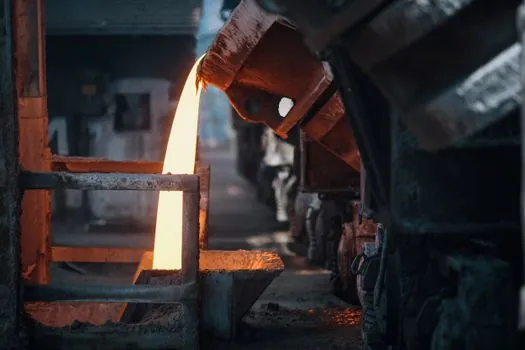
Coreless and channel induction furnaces have different physical arrangements. Coreless furnaces use a coil around a crucible and are used for melting and holding, while channel furnaces contain a core and a narrow molten-metal path for pouring and casting; channel units are generally suited to lower-melting-point metals such as aluminum and copper [S5].
Multi-section coils add process control where stronger stirring is required. A typical polyphase design uses two or three independently powered sections, with one section per phase; lower phase shift gives more heating and less stirring, while higher phase shift gives more stirring and less heating [S4]. Power-system sizing therefore affects both melt rate and bath behavior, not merely utility demand.
Crucible furnaces introduce containment decisions instead. Round and square vessels, stationary and tilting arrangements, refractory type, crucible size, and pouring method must be matched to metal volume, alloy family, and handling equipment [S1][S7]. A tilting crucible can reduce manual handling and support repeatable transfer, but the selected arrangement still depends on vessel geometry, lifting capacity, and the foundry’s downstream pouring method.
Tradeoffs and failure modes to address
Induction’s main constraints are electrical capacity, converter design, coil and crucible maintenance, and control of electromagnetic stirring. Utility input is commonly three-phase 50 or 60 hertz power, so supply availability and required kVA must be checked during specification [S4]. Excessively aggressive stirring can increase atmospheric contamination, while insufficient circulation can slow the submergence of small, light scrap [S4].
Crucible furnaces carry different constraints: refractory life, heat-source losses, vessel replacement, heat-up time, and manual handling where tilting or automated transfer is absent. Their range of vessel sizes can support small to very large batches, but large crucibles are more difficult to handle and replace [S1][S7]. Neither furnace family removes the need to control metal chemistry, temperature, slag, and transfer losses.
Failure-mode reviews should cover loss of power, coil or electrical faults, refractory cracking, crucible leakage, oxidation, alloy recovery from dross, and interruptions during transfer. For induction, the induction crucible furnace combines a coil around a metal-containing vessel; for a conventional external-heat furnace, the crucible furnace depends on the integrity of both the heat source and refractory container.
Use production requirements to set the decision
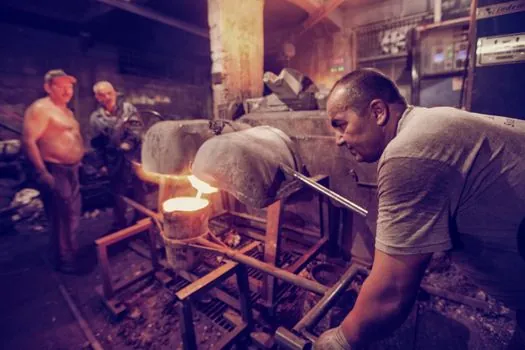
Specify induction when the foundry needs rapid melting, repeatable power control, alloy mixing, and production volumes that justify electrical infrastructure. Specify a crucible furnace when small or variable batches, multiple alloy families, manageable labor, and the ability to replace or handle refractory vessels fit the process better [S1][S3][S7].
The practical comparison is production rate and repeatability against batch flexibility and handling simplicity. A trial specification should record charge mass, scrap shape, alloy additions, target superheat, holding time, pouring route, utility limit, and required stirring before the furnace family is selected.
Track two procurement signals before approval: the supplier’s guaranteed usable charge capacity and the promised power-system duty cycle, plus the refractory or coil replacement interval and expected metal-loss target. These figures convert a generic furnace comparison into measurable operating and maintenance costs.