Industrial ceramics cover a 5-to-10x wider chemical-resistance window than 300-series stainless in acid and alkali exposure, and they hold that gap to 1000 to 1400 degC where alloys lose strength [S1][S2].
The compatibility decision is not "ceramic yes/no", it is which ceramic family (oxide, carbide, nitride, sialon) fits the specific acid, base, temperature, abrasion, and thermal-shock profile of the service [S3][S4].
Oxide Ceramics: Alumina and Zirconia in Acid, Alkali, and High-pH Service
Alumina (Al2O3) and zirconia (ZrO2) are the default oxide-class choices, offering near-universal chemical inertness in strong acids, strong bases, and oxidizing atmospheres up to their rated temperatures [S2][S3]. Fine Ceramics (Advanced Ceramics) oxide grades are documented as functionally inert in hot gases, hot liquids, strong acids, and strong bases, with no significant mass loss in standard chemical-resistance testing [S2].
CoorsTek lists chemical resistance, hardness, and compressive strength as the three primary selection drivers for technical ceramics, and recommends oxide ceramics specifically for hot acids and alkalis where metals would otherwise be consumed [S5]. A practical pitfall: zirconia can undergo tetragonal-to-monoclinic phase transformation in steam or humid hot environments, so humidity must be checked separately from bulk liquid pH when specifying ZrO2. Alumina avoids that failure mode but trades away the fracture toughness of zirconia-toughened alumina (ZTA).
Non-Oxide Ceramics: Silicon Carbide, Silicon Nitride, and Sialon for Severe Service
Sintered silicon carbide (SiC), reaction-bonded SiC, nitride-bonded SiC, silicon nitride (Si3N4), and sialons (Si-Al-O-N) extend corrosion resistance into molten-metal, sour-gas, and high-temperature oxidation regimes where oxides are adequate but slower to degrade [S3][S4].
Syalon 101 (a sialon grade) is documented for continuous service up to 1000 degC in non-ferrous molten-metal handling, with case-study data showing zero attack on exhaust gas flue detector plates after 3 months in molten-aluminum slag and Syalon 101 thermocouple protection tubes in biological-waste incinerators running past 9 months with random spikes to 1100 degC, versus a 4-month baseline life for metallic burner tubes [S4]. For downhole oil & gas, the S4 article and Calix both flag SiC as the default for sour-service brines, H2S-bearing fluids, and abrasive drilling muds where 300-series stainless suffers pitting and sulfide stress cracking [S3][S4].
The four compatibility axes that decide fit are: (1) chemistry (pH and specific ion), (2) peak continuous temperature, (3) thermal-shock cycling rate, and (4) abrasive particle loading [S3][S4][S5].
Compare the main options on the criteria that actually drive failure: alumina leads on cost and universal acid/alkali resistance but trails on toughness; zirconia adds toughness and thermal-shock margin, yet humidity sensitivity must be reviewed per case; silicon carbide is the workhorse for abrasive + corrosive slurries, HF-free strong acids, and high-temperature oxidation; silicon nitride and sialon sit in the top-right quadrant for molten aluminum, zinc, and lead, and for waste-incinerator atmospheres with thermal-shock spikes above 1000 degC [S2][S3][S4][S5]. A datasheet pass is not enough: confirm that the test coupons saw the same pH, the same dissolved-oxygen window, and the same thermal-cycle count your service will see, because ceramic failure is rarely bulk dissolution, it is usually a pitting, grain-boundary attack, or thermal-shock crack traced to one overlooked test parameter [S1][S5].
Where Industrial Ceramics Fit, and Where They Do Not
Industrial ceramics are FOR: pump and valve components in hot acid/alkali chemical processing; downhole tools, seals, and wear sleeves in oil & gas; thermocouple protection tubes in incinerators; foundry handling for non-ferrous molten metals; electroplating tank fixtures; wastewater and desalination membrane housings exposed to seawater and brines; and pressure-sensor diaphragms in aggressive media [S3][S4][S6].
They are NOT for: hydrofluoric acid at any concentration (attacks SiO2-bearing grades including most oxide ceramics); strongly reducing alkali melts at very high temperature where carbide ceramics can be etched; any service that demands high tensile ductility or impact energy absorption beyond the brittle-fracture envelope of the chosen grade; and applications where the user cannot accept the cost premium over 316L stainless (commonly 3-10x per part, depending on geometry and tolerance) [S1][S3][S6]. A secondary limit: ceramic-to-metal assemblies need careful CTE matching, or the joint will crack under thermal cycling well before the ceramic itself corrodes.
Ceramic Coatings and Hybrid Layered Systems
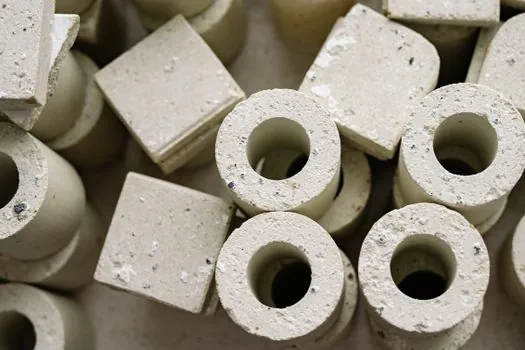
Ceramic coatings built from silicates, oxides, or nitrides extend a cheaper metal substrate into higher-corrosion regimes without going to a full monolithic ceramic part [S7].
The October 2024 Patsnap engineering post tracks coating development across silicate, oxide, and nitride systems, with the main trade-off being that any coating is only as good as its bond line: a defect or through-thickness porosity turns the coating into a galvanic cell that accelerates substrate loss, so coating choice must include a quality-control plan for coat thickness, porosity, and adhesion, not just bulk chemistry [S7].
Cross-Reference: Related Material and Equipment Selections
For industrial ceramic material families and their mechanical/thermal properties, use the property tables as the first cut before any chemical-resistance check, because thermal expansion, elastic modulus, and fracture toughness decide whether the part survives the mechanical envelope even when the chemistry is correct. [S2]
When the wetted part is a pressure sensor diaphragm and the question is which ceramic grade pairs with a 4-20 mA + HART transmitter, the diaphragm material (typically 96% or 99.5% alumina, or SiC for abrasive media) sets the chemical-compatibility boundary, while the transmitter electronics sit behind it.
For temperature sensing in the same corrosive service, the protective sheath is the compatibility question: Pt100 elements inside alumina or silicon-nitride thermowell tubes, or inside Syalon-grade sialon tubes as documented in the incinerator case study, are the standard pattern when the process is both hot and chemically aggressive [S4].
Standardization note: the U.S. Bureau of Mines Information Circular 8843 (1981) is still the most cited structured cross-comparison of ceramic families against aqueous, glass-melt, slag, and gaseous corrosion regimes, and remains the baseline reference for any chemical-resistance table that does not yet exist in OEM datasheets [S1].
Watch for: any 2026 OEM datasheet revision that adds explicit pH/temperature maps for sialon grades in molten-aluminum service, since the public case-study base still cites Syalon 101 at 1000 degC continuous with 1100 degC spikes [S4]; and any update to the high-purity alumina chemical-resistance tables from the major Japanese and U.S. technical-ceramics suppliers, whose 2026 refresh cycles are the next data drop for this material class [S2][S5].
Background reading: Stretcher vs Warning Sign: Spec, Standards, and Selection.