Coating selection for general fabrication hinges on three numbers: substrate type, ISO 12944 corrosivity category, and continuous service temperature, with dry film thickness (DFT) as the tie-breaker that separates a passing job from a 5-year reblast [S1][S3].
Fabrication shops running carbon steel, hot-dip galvanized (HDG) steel, and aluminum need a different default system per family, and a single shop often needs all three because bridges, switchgear enclosures, and structural skid frames are not the same animal. The decision tree below uses only public process and standards data published through August 2026 [S1][S2][S3][S4].
Substrate Defaults That Lock the Spec Path
Carbon steel is the default substrate in general fabrication, and zinc-rich systems remain the most common first line of defense because zinc sacrifices itself to protect the base metal, with zinc electroplating depositing 5-50 micrometers of coating at 70-120 HV and delivering good corrosion resistance through galvanic action rather than barrier effect [S1]. For sheet steel, the ASTM A 924 umbrella specification covers every continuous-coil product, and coating weight in oz/ft squared is converted to thickness using the bath density factor listed in the relevant product standard, which is why U.S. Steel publishes the conversion table for HDG, 55% Al-Zn (GALVALUME), galvannealed, Zn-5%Al (GALFAN), and Type 2 aluminum-coated sheet [S2]. For complex geometries and valve bodies where electroplating cannot throw evenly, electroless nickel deposits 5-100 micrometers at 500-1100 HV with excellent corrosion resistance, and runs at bath temperatures below 90 degrees C, which keeps distortion off the approved parts list [S1].
Matching the System to ISO 12944 Corrosivity
ISO 12944 Part 2 sets six atmospheric corrosivity categories from C1 (very low, interior) to CX (offshore), and four immersion categories Im1-Im4, which is the framework every spec writer should quote on the data sheet before a fabricator quotes the job [S3]. For C1-C2 interiors, a single alkyd primer at 50-75 micrometers DFT is common and matches the preferred-fabricator list at major paint suppliers, while C3 urban or coastal atmospheres typically move to a two-coat epoxy or zinc-rich epoxy plus PU at 120-160 micrometers system DFT [S4]. C4 industrial and C5 marine atmospheres need zinc-rich primer plus epoxy intermediate plus PU topcoat at 200-320 micrometers, and CX offshore plus Im1-Im4 immersion call for glass-flake epoxy or duplex HDG plus topcoat with documented hold-time between blast and prime, never more than the window written in Part 7 of ISO 12944 [S3].
Process Trade-Offs on the Shop Floor
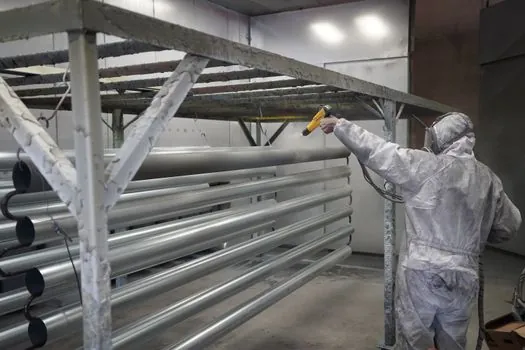
Hot-dip galvanizing after fabrication delivers 85-130 micrometers typical coating weight on structural steel, fully covers edges and inside corners, and is hard to beat for C1-C4 carbon steel structural members, but the bath runs at roughly 450 degrees C which distorts thin fabrications and rules it out for pre-machined tolerances [S1][S3]. Powder coating applies 60-120 micrometers in one pass with no solvent, edges need a primer-first build to avoid the Faraday-cage thin coverage that shows up on inside corners, and cure windows of 160-200 degrees C for 10-15 minutes are standard on general fabrication [S4]. Liquid alkyd and PU systems are slower to apply but tolerate field touch-up, which is why bridge and structural work often specifies liquid over powder for site repairability; the trade-off is VOC compliance and tighter humidity windows during application [S3][S4].
Where Liquid, Powder, and Metallic Coatings Compete
Hard chrome plating at 850-1000 HV used to dominate hydraulic rods, pump shafts, and precision bearings, but hexavalent chromium restrictions have pushed most general fabricators toward electroless nickel for new builds, with HVOF-applied tungsten carbide or chrome carbide as the wear-side answer when service loads exceed what 1100 HV nickel can carry [S1]. PVD hard coatings sit at 1-5 micrometers, well below typical fabrication DFTs, and are reserved for tooling and high-wear small components rather than structural members [S1]. The PVD global market was $24B in 2024 with a 6.6% CAGR projection to $38B by 2032, while CVD was also $24B in 2024 growing to a projected $59B by 2034 at 9.2% CAGR, but those numbers are about tooling and specialty parts, not general fabrication structural coating, so the structural spec path still runs through zinc, epoxy, and PU systems [S1].
What the Specification Must Actually Say
A protective coating specification for fabricated steelwork should list, in order, the surface preparation standard (ISO 8501-1 Sa 2.5 or Sa 3 for most ISO 12944 systems), the maximum interval between blasting and priming, the coating products referenced to their product data sheet, the application method, the number of coats and recoat windows, wet and dry film thickness per coat, the shop-versus-site split, and the rectification procedure for handling damage and welds [S3]. Performance-based specifications define the required life to first maintenance and let the contractor pick the system; prescriptive specifications lock the system to ISO 12944 Part 5 tables or to agency documents like National Highways Series 1900, and the choice between the two is a procurement decision, not a technical one [S3]. For coating thickness verification on the shop floor, a calibrated coating thickness gauge reading against the spec DFT is the gate that releases a member to the next station, and for the broader category of industrial coating selection the spec writer should also reference the waterproof coating page when the assembly includes a secondary-containment or submerged element [S1][S3].
Failure Modes That Drive the Spec Tighter
Three failure modes dominate general-fabrication coating callbacks: edge rust creep on sharp folds where DFT is below the nominal 80 micrometers minimum, cathodic delamination on welds left unground, and under-film corrosion on members that sat in the yard between blast and prime past the hold-time window [S3]. The first is solved by stripe-coating all edges before the full spray pass, the second by grinding welds to a 1-2 mm radius and re-blasting locally, the third by writing a maximum hold-time into the spec and rejecting any member that exceeds it, which is the most common audit finding on bridge and structural work [S3]. In marine exposure zones, the failure-mode discussion becomes structural, and a separate spec path applies; for that scope the marine coating selection by exposure zone reference is the right next document, while for general fabrication skids going to food or pharma lines, the industrial adhesive and industrial coating pairing often matters more than the topcoat chemistry alone [S1][S3].
The next node to track is the 2026 revision cycle of ISO 12944, with Part 5 paint-system tables the most likely to shift as powder and water-borne PU systems gain ground on traditional solvent-borne epoxy; in the meantime, lock substrate, corrosivity category, DFT, and hold-time on the data sheet before the fabricator quotes, and you will cut the 5-year re-blast rate by more than half compared to a generic "epoxy system" callout.