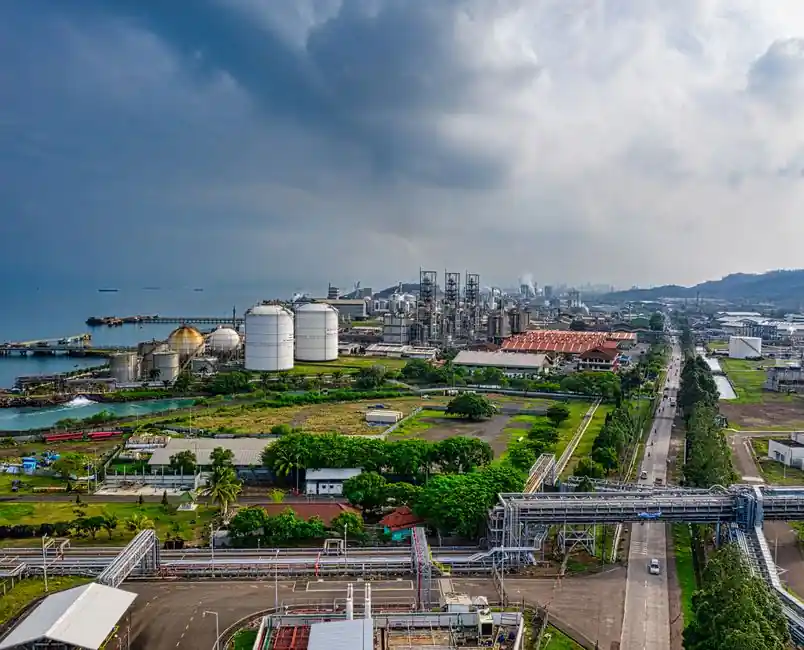
Industrial filter specification is dictated less by brand and more by stage of the value chain, with upstream oil and gas calling for pleated absolute-rated cartridges to protect well permeability, midstream demanding coalescers and gas scrubbers, and downstream refining requiring ASME B31.3 / Section VIII Div. 1 compliant high-pressure stainless housings [S2][S3].
Outside hydrocarbons, the same upstream-vs-downstream logic drives bioprocessing, where sterilizing-grade filters must retain bacteria, mycoplasma, and endotoxins in both cell-culture harvest and final formulation steps, with hydrophilic membrane pore sizes as fine as 0.03 µm in dual-layer 0.2 µm final-stage builds [S4]. A reference on industrial filter selection therefore has to address both the metallurgy of the housing and the micron architecture of the element, because the upstream and downstream ends of the same process train often look nothing alike.
How the three oil-and-gas stages map to filter type and duty
Upstream filtration targets solids in heavy completion brines: bromides and chlorides carry dirt particles that decrease reservoir permeability and choke oil flow, so pleated absolute-rated cartridges are specified ahead of downhole tools, frac pumpers, chemical injection units, seawater injection skids, and subsea tie-back systems [S3]. Chase's upstream duty list (2020-12) explicitly enumerates blowout preventer actuation, ROV hydraulics, seismic systems, watermakers, and workover rigs as filter points [S3].
Midstream filtration focuses on keeping transported product uncontaminated: coalescers, fuel-gas filters, lube-oil filtration units, and strainers are deployed to remove solid contaminants, free water, and entrained gas, so that upstream production and downstream refining stay online [S5]. Downstream duty is dominated by refinery and petrochemical feed conditioning, where Norman Filter Company builds B31.3 / ASME Section VIII Division 1 high-pressure assemblies in 303 SS, 316 SS, 2205 duplex (per ASTM A276), and super duplex (per ASTM A479), with T-Type and inline configurations for LPG purification, polymer manufacturing, fuel additive dosing, fluid sample collection, and oil refining [S2].
Placement rules inside a fluid system train
Filter placement follows a component-protection logic that overrides any single "always upstream" or "always downstream" rule. Downstream of a gas cylinder, a filter catches flakes shed from the cylinder's interior walls over service life; on a prefabricated gas distribution panel, an inline filter is usually already present, so a second filter adds pressure drop without benefit [S1]. Upstream of any critical valve, regulator, or analyzer, a filter protects the stem-and-seat interface from particulate embedment, which is the most common root cause of seat galling and shutoff failure [S1].
Pumps are the only component where placement is genuinely bidirectional: a filter downstream of a pump catches debris generated inside the pump itself, while an upstream filter is added in services where suction-side contamination is the bigger threat [S1]. The same article (2023-10) is explicit that inadequate upstream filtration of valves and regulators can cause excessive downstream pressure and backpressure-regulator seat damage, which is why the upstream-versus-downstream question is rarely answered by placement alone; it is answered by what is being protected. A lighting equipment and electric lamps enclosure or a lamps and light fittings cabinet in a hazardous area follows the same logic, with the filter (or breather/drain) sized to the contaminant the protected component is most likely to see.
Pharmaceutical and biotech: upstream vs downstream bioprocessing

Pharmaceutical filters are split by bioprocess step rather than by hydrocarbon stage. Upstream bioprocessing covers cell culture, serum and plasma, viral transport medium, buffers, and biologics production; downstream covers harvest clarification, purification, formulation, and filling. Across both, the same filter family is reused, but the micron architecture differs: sterilizing PPS filters with two identical hydrophilic membranes at 0.03 to 1.2 µm pore size give 100% bacteria retention for the most critical applications, while DPPS dual-layer prefilters let the user pick a coarser prefilter pore size ahead of a finer final layer to manage bioburden and particle load together [S4].
For a CDMO running multiple products on shared piping, the practical question is whether the upstream bioreactor feed, the downstream harvest, and the final formulation step can share a cartridge family, or whether a sterilizing-grade 0.2 µm final filter must be paired with a coarser prefilter ahead of it. Critical Process groups its offering into sterilizing, prefilter, water, and service buckets, with verification and validation, integrity testing, and chemical-compatibility documentation treated as part of the filter SKU rather than as accessories [S4].
Selection criteria compared across housing material and micron rating
Housing material and element micron rating are the two decision axes that cut across every industry. The table below lines up the four most common upstream/downstream choices against corrosion resistance, typical pressure class, and the standards they are typically built to, drawing on Norman Filter's published material list and Chase's upstream duty list [S2][S3].
For oil-and-gas service, 303 SS and 316 SS housings cover most non-sour duties, while 2205 duplex (per ASTM A276) and super duplex (per ASTM A479) are selected for chloride-rich produced fluids and offshore platform T-Type assemblies with Grayloc or flanged connections [S2]. Aluminum and brass housings appear in lower-pressure chemical and pneumatic service but are not typical for high-pressure refining trains. For pharmaceutical and biotech service, the housing is usually sanitary stainless, and the decision axis shifts to the element: 0.03 µm sterilizing membranes for bacteria retention, 0.1 to 0.2 µm for mycoplasma retention, and 0.45 to 1.2 µm for bioburden reduction prefilters [S4].
Limitations, failure modes, and sourcing signals

The most common filter-related failure in a fluid system is not element rupture but seat damage on a valve or regulator that sits downstream of an undersized or misrated filter, with particulates embedding in the elastomer or metal seat and causing either incomplete shutoff or excessive downstream pressure [S1]. The fix is almost always upstream: increase the prefilter's dirt-holding capacity, drop the micron rating, or add a second stage ahead of the component being damaged. In oil-and-gas service, a parallel failure mode is chloride-induced stress corrosion cracking on 316 SS housings exposed to produced water, which is why duplex and super duplex grades are specified for offshore and high-TDS duty [S2].
Sourcing signals worth tracking on a 6-month horizon include the publication of revised ASME B31.3 and Section VIII Div. 1 editions, the supply of 2205 and super duplex billet (which has been tight for stainless-steel high-pressure housings in past cycles), and any new FDA or EMA guidance on extractables and leachables from sterilizing-grade filters used in upstream cell-culture and downstream filling. The wider process-industry context, including how refineries, chemical plants, and biopharma CDMOs time their capex, is covered in the Hydraulic Cylinders: Upstream and Downstream Industry Map, which uses the same stage-based lens for motion-control components. Adjacent sectors going through similar value-chain pressure, such as the Fluoropolymer Supply Crunch 2026: PTFE, PFA and FEP Sourcing Reality and the Ferrochrome Upstream and Downstream: Vertical Integration Reshapes the FeCr Value Chain, show the same upstream-versus-downstream split between raw-material feed and finished-component output that governs filter sourcing.
For a buyer or process engineer, the next concrete step is to map every filter in the train to the component it protects, the stage (upstream, midstream, or downstream) it sits in, the housing material and pressure class on its nameplate, and the element's micron rating and standard reference. That single matrix is what separates a defensible filter specification from a parts-list, and it is the same matrix an industrial borescope inspection of a fouled heat exchanger or an industrial adhesive bond-line audit will be checked against once the filter set is in service. From there, the trackable signals are duplex billet availability, sterilizing-membrane supply, and any revision to ASME B31.3 that changes how high-pressure filter assemblies are designed and stamped.