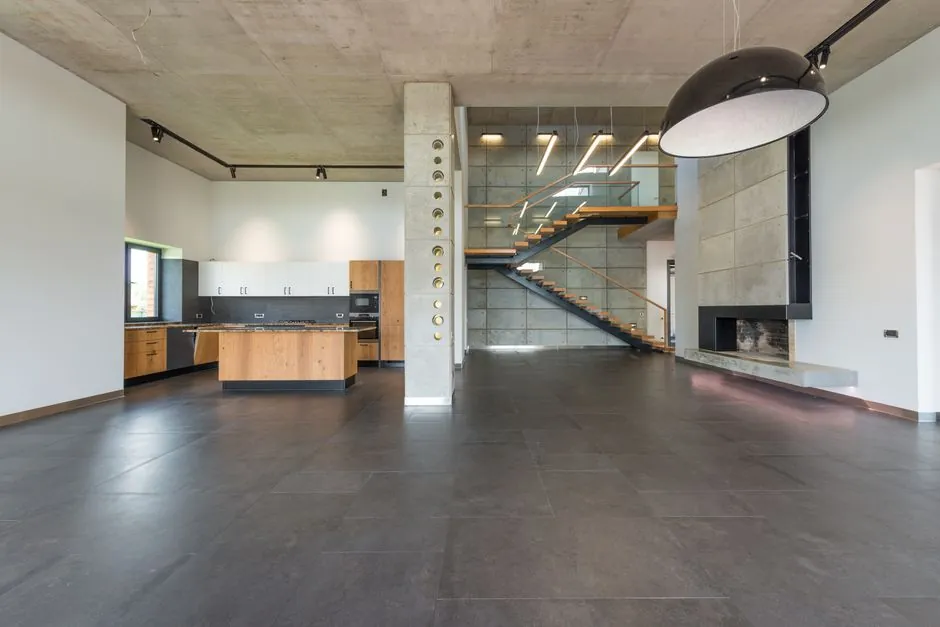
Industrial-grade resin and concrete flooring systems, long the default in factories and warehouses, are crossing over into single-family and multi-family residential construction, driven by demand for abrasion resistance, spill tolerance and a sealed, low-VOC finish [S3][S7].
Global product lines now span concrete, epoxy, polyurethane and rubber floors with anti-slip or dustproof finishes, while hardwood remains a frequent residential comparator [S1]. On the consumer side, retail industrial-look tile lines run from $2.89 per square foot for porcelain through $15.60 for patterned hex offerings, illustrating the price band homeowners actually see [S2].
Where Industrial Flooring Fits a House, and Where It Does Not
Heavy-duty industrial floors must withstand constant traffic, heavy loads, chemicals, temperature swings and impact, which is why a resin or polished-concrete system is routinely used in manufacturing and warehousing [S3]. In a residential setting, the same performance envelope matters in garages, mudrooms, basements, ground-floor kitchens and converted loft spaces where the substrate is concrete and spill exposure is high [S5].
Industrial resin floors are not the right call for upper-storey timber joists, upstairs bedrooms, or any room where a warm, quiet, foot-friendly feel is the priority; engineered wood, laminate and LVT remain the better fit there because they dampen sound, accept furniture pads and tolerate small subfloor movements without cracking [S5]. In practice, the building spec splits: industrial systems on the slab, traditional resilient or timber systems on the framing above.
The Main System Types, Compared on Real Decision Criteria
The 2025 industrial shortlist, in order of typical use, is epoxy floor coatings, polyurethane coatings, polyurethane cement flooring, seamless decorative flake flooring and slip-resistant textured systems [S7]. Epoxy is favoured for its exceptional hardness and durability in manufacturing environments [S3]. Polyurethane and polyurethane-cement variants are picked where thermal cycling or hot-water wash-down would soften a standard epoxy [S3][S7].
For the residential crossover, the same five options line up against four decision criteria: <p>Comparison snapshot for residential specifiers, drawn from current supplier guidance:
A workable rule from the resin-flooring literature: specify a heavy-duty floor only when the design loads, chemical exposure and cleaning regime actually exceed what a residential LVT or engineered-wood system can survive; otherwise the extra cost is paying for performance the house will never use [S3][S5].
Performance Criteria the Spec Sheet Has to Show

Any heavy-duty flooring system pitched for a residential project should ship with five testable attributes: durability under abrasion and wheeled traffic, impact resistance from dropped tools or cookware, chemical resistance to household oils and cleaners, temperature and thermal-shock resistance across seasonal swing, and slip resistance tuned with quartz, aluminium oxide or bauxite aggregate [S3]. Load-bearing capacity is the sixth item, and a residential garage slab typically wants a documented compressive-strength figure to back the chosen system [S3].
Slip resistance is the single attribute most often missed at residential handover: areas where water, oil or cooking fat reach the floor need an aggregate-modified topcoat, not a glass-smooth resin, because slip and trip incidents dominate industrial injury statistics and translate directly to a kitchen or entry-floor risk [S3]. For households with underfloor heating, thermal-shock resistance is the gating criterion, since repeated heating cycles can debond a resin that performs perfectly in a warehouse [S3][S5].
Substrate, Moisture and Installation Tolerances
Resin and polished-concrete systems are unforgiving of a wet or out-of-tolerance slab; moisture vapour transmission through the concrete is the most common cause of early debonding in both factory and home installs, and a moisture-tolerant primer or a vapour barrier has to be on the submittal, not added in the field [S3][S5]. Surface preparation, typically diamond grinding or shot-blasting to a defined CSP profile, is non-negotiable: a glossy finish over a poorly profiled slab will delaminate within months regardless of resin chemistry [S3].
For a residential renovation over an existing slab, polished concrete or epoxy resin offers a sleek, minimalist look that is easy to maintain, which is why both are now showing up in spec sheets for loft conversions and ground-floor open plans [S5]. For a new build, the same systems work, but the concrete mix design, joint layout and curing window must be coordinated with the flooring subcontractor before the pour, not after.
Aesthetic Direction: Industrial Look Without Industrial Cost

The "industrial" look that homeowners are buying is largely a surface story: metal-look porcelain tiles, concrete-look ceramic, and concrete-look LVT deliver the visual without any of the structural or chemical-performance demands of a real resin floor [S4]. Porcelain lines such as the Marazzi ULRW at $2.89 per square foot or the MSI HENLEY hex at $15.60 are stocked in big-box retail, which is why interior designers reach for them first on a budget-driven remodel [S2].
When the brief calls for an actual heavy-duty resin or polished-concrete floor, the cost premium is real, and the maintenance regime is different from tile or timber: no waxing, no re-sealing every few years if the system is correctly specified, but the owner must accept that a deep scratch or chemical burn may require a patch-and-recoat rather than a plank replacement [S3][S5].
Standards, Sourcing and the Documentation Trail
No single residential code governs the crossover from tile to resin, which is why the documentation burden falls on the supplier: the submittal should include the resin chemistry, the aggregate type and loading for slip resistance, the stated temperature range, the chemical-resistance table, and a reference project of similar substrate and use [S3]. For a homeowner, the practical question to ask any installer is which of those five performance attributes are written into the warranty, and which are verbal [S3].
A cross-discipline procurement discipline applies: specifiers balancing flooring, ceiling and lab-tool submittals on the same project can borrow the same evidence-first workflow used in Pharmaceutical Equipment Procurement: TCO, GxP, and Supplier Strategy for 2026, where each line item is anchored to a test certificate, not a brochure claim. For the substrate and finish choices, the Glass Fiber Grades for Construction: A Spec-Driven Selection Map approach, fix the performance target first, then pick the chemistry, transfers cleanly to a resin-floor decision.
Reference encyclopaedia reading: industrial flooring for system taxonomy, SPC flooring for the rigid-core residential comparator, and industrial adhesive for the primers and moisture-tolerant bonding layers that sit under any resin or polished-concrete system.
Trackable next signals for any specifier: (1) whether the chosen resin supplier publishes a current chemical-resistance table that covers household cooking oils and de-icing salt, not just industrial reagents; (2) whether the polished-concrete contractor can document slab moisture and surface-profile readings taken within seven days of pour, since out-of-date readings are the most common root cause of residential resin failures [S3][S5].