Industrial hose selection is driven by three variables before any brand is discussed: the medium being conveyed, the operating pressure, and the temperature envelope, per a 2026 industry guide [S8].
The category covers six dominant material families (rubber, PVC, PTFE, composite, metal, and silicone) and at least fifteen application families including air, chemical, hydraulic, food and beverage, dock, dry bulk, ducting, fire and mill, LPG, and material handling [S1][S4][S5]. Hydraulic hose itself carries its own parallel taxonomy coded to SAE 100R and DIN EN 853 series, with working pressures from light-duty return lines to multi-spiral 4-wire constructions [S6][S7]. For procurement, the practical classification is therefore a two-axis matrix: medium/function on one axis, material construction on the other.
Application-based classification: 15 functional families
Air and multi-purpose hoses cover roughly 150-1,500 psi working pressure, with high-pressure steel-braided nitrile constructions reaching 1,500 psi for mines and quarries, medium-pressure fabric-braided nitrile at 400-600 psi for shop service, and EPDM or nitrile push-on hose at 200-300 psi for shop air and water [S1]. Push-on hose uses a barbed end that requires no ferrule or clamp, allowing field repair with a knife and cold-temperature flexibility that simplifies winter maintenance [S1].
Chemical hoses use UHMW or XLPE tubes as the default, with FEP, high-purity EPDM for acids, and nylon for paint as specialty variants, and a helical wire is added for suction-and-discharge duty versus transfer-only service [S1]. For fumes and vapors, chemical fume extraction hoses are the lighter-weight sibling, typically built from coated fabric, polyethylene, polyolefin, or conductive polyurethane with surface resistivity as low as 10⁸-10¹⁰ Ω/sq for static control [S2]. Dry bulk material hoses use static-dissipating tubes to move sand, gravel, lime, cement, rock salt, glass, and fertilizer under suction, pneumatic, or gravity drive [S4].
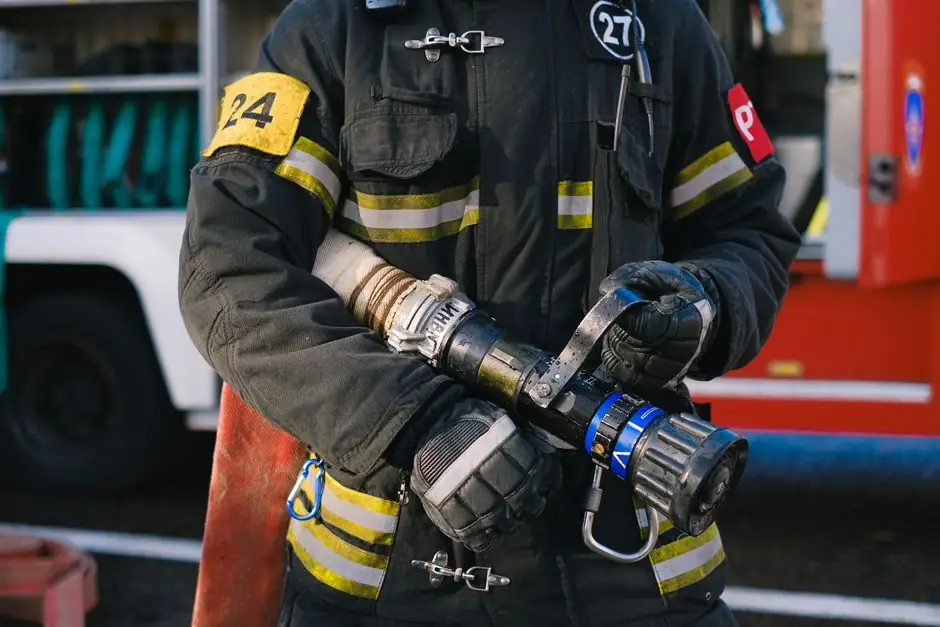
Food and beverage hoses must use USDA- and FDA-approved materials such as synthetic rubber or PVC to transfer both solids and liquids in pharmaceutical and food processing lines [S4]. Dock and barge hoses are heavy-duty suction and discharge hoses for ship-to-shore transfer, with heat-resistant variants for molten sulfur, hot tar, and asphalt service [S4]. Fire hoses carry FM approval for firefighting and can carry fire-retardant foam, whereas mill hoses handle higher water pressure in agriculture, manufacturing, and construction but are not FM-rated for fire duty [S4].
Material handling, dust collection, ventilation, and high-temperature ducts round out the lightweight end of the catalog: polyurethane (Flx-Thane LD/MD/HD/VHD families) for abrasive dust and wood chips, PVC for furnace duct cleaning and textile collection, and coated fabric rated to ~1,200 °F for aluminum refractory and mining fume extraction [S2]. LPG hose is typically listed as its own line because of the dedicated fittings and regulatory regime around flammable gas service [S1].
Material-based classification: 6 construction families
Rubber hoses are flexible, vibration-tolerant, low-cost, and easy to replace, but degrade at high pressure and temperature extremes, limiting them to general plant service rather than peak-rated hydraulic or steam duty [S5]. PVC hose handles water, chemicals, waste, food, and some gases, is corrosion- and erosion-resistant and watertight, but loses mechanical integrity above its moderate temperature ceiling, which is the principal reason it never displaced rubber or metal in hot-service or steam lines [S5].
PTFE (polytetrafluoroethylene) tubes resist heat, corrosion, and permeation and are widely used in chemical transfer, hydraulic fluid service, and automotive coolant and fuel lines [S5]. Composite hose layers thermoplastics, fabrics, and inner/outer metal wire spirals, giving chemical resistance plus the flexibility needed for ship-to-shore and tank-truck chemical transfer [S5]. Flexible metal hose, usually stainless steel with bronze and galvanized options, is the durable choice for high pressure, extreme heat, cryogenic service, and fire exposure, and it resists permeation and collapse under full vacuum [S5].
Silicone hose is colorless, odorless, UV- and IR-resistant, weatherproof, and tolerant of high and low temperature, with food, medical, construction, and power-generation as the dominant applications; silicone breaks down in contact with oil and is also permeable, which excludes it from hydrocarbon and gas service [S5]. Conductive PVC and static-dissipative polyurethane (10⁸-10¹⁰ Ω/sq) are the standard builds when dust or powder transfer demands ATEX-style ignition-risk control [S2].
Hydraulic hose subset: SAE and DIN taxonomy
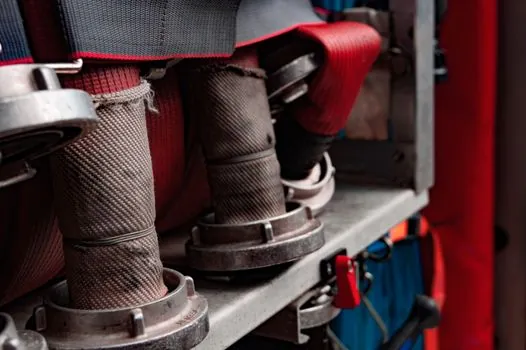
Hydraulic hoses follow a parallel coding system that plant engineers treat separately from general industrial hose, with eight common sub-types: braided, spiral, thermoplastic, transfer, return line, lock-on, fleet, and specialty [S6]. The two workhorse codes are SAE 100R1-AT / DIN EN 853 1SN, a single-steel-braid high-pressure hose, and SAE 100R2-AT / DIN EN 853 2SN, a twin-braid step up in pressure rating, both widely stocked for mobile equipment and fixed hydraulic systems [S7].
For higher working pressure, multi-spiral (4-wire/6-wire) constructions under the SAE 100R9 / 100R10 / 100R11 / 100R12 / 100R13 series cover the heavy-equipment and high-pressure industrial hydraulic niche that braided hose cannot reach [S6]. Thermoplastic hydraulic hose (SAE 100R7, 100R8) trades rubber compatibility for cleaner chemical resistance and is common in test stands and food-grade hydraulic circuits. Lock-on and fleet hose are barcoded, pre-terminated consumables sold into high-volume service-vehicle and rental-fleet channels where speed of replacement matters more than ultimate pressure [S6].
Pressure, temperature, and chemistry selection matrix
A first-pass decision tree for a non-hydraulic line: for water, air, and mild chemicals at 150-300 psi and ambient temperature, EPDM or general-purpose rubber is the lowest-cost fit; for 400-600 psi shop service, fabric-braided nitrile adds oil resistance; for 1,500 psi mine or quarry air, steel-braided nitrile is mandatory [S1]. For chemicals, UHMW or XLPE tubes handle most acids and solvents, with FEP reserved for the most aggressive media, and a helical wire is required only if the line must hold full vacuum under suction-and-discharge cycling [S1][S4].
For temperature extremes, silicone and PTFE span the widest range, with PTFE rated to roughly 260 °C continuous and silicone rated for low-temperature flexibility that rubber cannot match, while coated-fabric ducts reach ~1,200 °F (≈ 649 °C) external for refractory and welding fume service [S2][S5]. For hydrocarbons and flammable gas, antistatic requirements push the spec toward conductive polyurethane (10⁸-10¹⁰ Ω/sq) or metal hose where permeation is a concern, since silicone is permeable and PVC is not rated for hot hydrocarbon service [S2][S5].
Limitations, failure modes, and cross-reference to other components
Each material family has a defined failure mode that should drive inspection intervals: rubber degrades at temperature and pressure extremes, PVC loses integrity above its ceiling, silicone is permeable and oil-intolerant, PTFE is premium-priced and over-specified in commodity service, and metal hose is less flexible and heavier, which affects routing in tight plant layouts [S5]. The most common specification error in the field is matching hose to pressure rating without checking the chemical compatibility of the tube compound, especially in pharmaceutical and food lines where regulatory approval (FDA, USDA, 3-A) overrides pressure and temperature [S1][S4].
Industrial hose rarely fails in isolation: in flange-tco analysis, the hose run is often the shortest replacement-cycle item in a piping spool, so total-cost modeling has to include hose service life alongside gaskets and bolting. For mines and quarries where pneumatic and water lines are ubiquitous, the same harsh-service thinking shows up in needle-valve selection, where duty cycle and abrasion resistance drive the spec. The broader industrial hose category page collects the cross-vendor spec snapshot for sourcing comparisons.
Standards, sourcing, and what to verify on a datasheet
For food, beverage, and pharmaceutical hose, the standard compliance language to demand is FDA, USDA, and where applicable 3-A sanitary, paired with the tube compound callout (synthetic rubber, EPDM, PTFE, or PVC) [S4]. For chemical hose, datasheets should show the tube material (UHMW, XLPE, FEP, or EPDM), reinforcement (textile, steel wire helix), and whether the construction is rated for suction-and-discharge (full vacuum) or transfer-only (positive pressure) [S1]. For hydraulic hose, the SAE 100R or DIN EN 853 designation, working pressure, burst pressure (typically 4× the working pressure), and temperature range are the four non-negotiable fields [S7].
Specifying engineers should treat any datasheet missing the working-pressure-vs-temperature derating curve, the bend radius at rated pressure, and the chemical compatibility list as incomplete, since those three items govern the actual installed service life more than the headline pressure rating [S8].
For component-level specifications, see construction machinery and equipment, and lamps and light fittings.