
A solenoid valve is an electromechanical flow-control device in which an energized coil moves a ferromagnetic plunger to open or close a media path, with no manual operator required [S1][S2]. Specifying one correctly means matching five variables at once: actuation principle, port count and function, coil voltage class, minimum operating pressure differential, and body/seal material compatibility with the process fluid [S3][S4].
Common industrial deployments span water treatment, oil and gas processing, chemical dosing, pneumatic and hydraulic automation, refrigeration, and commercial appliances [S1][S3][S4]. Typical supply voltages cluster at 12-48 V DC and 110-220 V AC for industrial coils, with 24 V DC and 120 V AC as the most frequently quoted ratings [S3][S4].
Direct-Acting, Pilot-Operated, and Semi-Direct Operating Principles
Direct-acting solenoid valves move the plunger using the solenoid's magnetic force alone, so they open and close even at zero differential pressure across the orifice [S1][S2][S5]. This class delivers the fastest response, the most compact envelope, and reliable operation at low pressure, but the orifice size and allowable pressure are constrained by what the magnetic force can overcome, so flow rates are typically lower than other classes [S1][S2].
Pilot-operated (indirect-acting) valves use a small pilot orifice plus system pressure to actuate a larger diaphragm or piston, requiring a minimum differential of about 0.5 bar (7.25 psi) to function [S1][S2][S4]. This trade lets a small coil control a much larger flow path, making the design the default choice for high-flow water, steam, air, and gas service where line pressure already exists [S1][S2].
Semi-direct valves combine both: the plunger is mechanically linked to the diaphragm so the valve can open from zero bar yet still manage high flow rates, bridging the direct/pilot gap when line pressure may be low or intermittent [S1][S5].
2-Way, 3-Way, and 4/5-Way Circuit Functions
2-way solenoid valves have one inlet and one outlet and serve as simple shut-off devices; they ship in normally closed (NC) or normally open (NO) variants, with NC being the most commonly specified configuration [S1][S4][S5]. They are the default block valve for on/off fluid service across water, air, oil, and gas lines [S1][S2].
3-way valves have three ports (inlet, outlet, exhaust) and divert or mix flow between two paths, a configuration used for pneumatic cylinder piloting, diverting water, and small-appliance dosing such as coffee machines and dishwashers [S1][S4].
4-way and 5-way valves are the standard in pneumatic automation: 5-port 2-position and 5-port 3-position bodies direct compressed air to double-acting cylinders, with the 2-position being the most common pneumatic layout [S1][S6]. NAMUR-mounted solenoid valves are a pneumatic-specific sub-type that bolts directly to a rotary actuator pad for standardized mounting on ball and butterfly valves [S2].
Coil Voltage, Duty Cycle, and Response Time
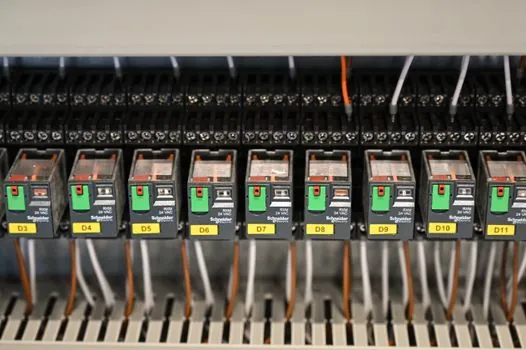
Common DC supply ratings are 6, 12, 24, and 240 V; common 60 Hz AC ratings are 24, 120, 240, and 480 V, giving specifiers four to five stocked options per polarity [S3]. Industrial coils are most often 24 V DC and 120 V AC, while process panels are migrating toward 24 V DC for safety and battery-backed control [S3][S4].
Proportional solenoid valves form a distinct sub-category: instead of binary open/closed, the plunger position is held in equilibrium between the spring force and a variable electromagnetic force, so a continuously adjustable current gives smooth, repeatable flow or pressure modulation [S3]. This class is used where accurate metering and process stability matter more than on/off isolation.
Buyers typically compare coil voltage, response time, pressure rating, flow rate, orifice size, and duty cycle to confirm the coil matches the application [S3].
Body Materials, Seal Materials, and Approvals
Valve bodies are commonly supplied in brass, stainless steel (including 304 and 316 grades for corrosion service), and engineering plastics; stainless variants dominate food, pharmaceutical, and chemical exposure [S1][S2][S4]. Internal seals, diaphragms, and plunger tips are typically NBR, EPDM, FKM (Viton), or PTFE, and the seal must be chemically compatible with the media at operating temperature [S1][S3].
AC coils include a shading ring, a small conductive loop embedded in the pole face that prevents the armature chatter and hum that would otherwise occur at line frequency [S1]. Without a properly installed shading ring on a 50/60 Hz AC coil, the valve buzzes, the plunger chatters, and seal life drops measurably.
Common approvals for solenoid valves include general-purpose, weatherproof (IP65 and higher), and explosion-proof or intrinsically safe ratings for hazardous-area use [S1][S3]. For zone-classified plants, matching the approval to the area classification (gas group, temperature class, zone) is non-negotiable; a solenoid valve listed for general duty cannot be installed in a Class I Div 1 location regardless of mechanical fit.
Application Matrix: Where Each Type Earns Its Keep
Direct-acting 2-way NC valves are the workhorse for instrument air, low-flow water shut-off, and gas analysis sample lines where pressures are modest and response must be fast [S1][S2]. Pilot-operated 2-way valves take over for larger line sizes in water treatment, steam, and compressed air, where 0.5 bar differential is guaranteed and energy savings from a small coil matter [S1][S4].
3-way valves handle cylinder piloting on small pneumatics, dispenser switching, and pilot duty on larger actuated valves; 5/2 and 5/3 valves control double-acting pneumatic cylinders in discrete parts manufacturing and construction machinery and equipment cabs [S1][S2][S6]. Proportional valves are reserved for closed-loop flow or pressure control such as hydraulic actuator positioning, fuel metering, and analytical instrument gas regulation [S3].
Selection criteria in practice: media and temperature, minimum and maximum operating pressure, required flow (Cv or Kv), coil voltage and duty cycle, port size and connection type, and approvals for the installation area [S1][S3][S4]. Industrial users commonly install air solenoid valve variants on pneumatic control panels where 24 V DC coils, NBR seals, and 1/4 to 1/2 inch NPT ports are the default stock SKU [S4][S6].
Limitations, Failure Modes, and What to Watch
Solenoid valves are fundamentally on/off devices; using a binary valve for throttling destroys the seat and seal within a duty cycle measured in weeks, not years [S1][S3]. For modulation, a proportional valve is the only correct choice, with the understanding that friction and hysteresis must be specified out by the manufacturer [S3].
Pilot-operated valves will not function below their minimum differential pressure, a hard limit that surfaces in dead-head pump loops, vacuum service, and depressurized startup conditions [S1][S2]. A related failure: pilot valves can stick open if the diaphragm becomes fouled or the media carries particulate, so strainers upstream are cheap insurance.
Coil burnout is the most common electrical failure and is almost always traced to a stuck plunger, an over-voltage supply, or an AC coil run on DC; the solenoid coil itself is consumable, and stocking a spare per critical valve is the standard practice in continuous process plants [S1][S5].
Sourcing and Standards
Solenoid valves are sourced from broad-line industrial automation catalogs and from specialized fluid-control manufacturers; OEM product naming varies (2/2-way, 3/2-way, 5/2-way, 5/3-way), so the port count and position count must be confirmed in writing before purchase [S1][S6]. Body material, seal material, and coil voltage are the three fields that most often get misordered and most often cause field failure [S3][S4].
For hazardous-area installations, verify that the certification mark on the nameplate matches the area classification, gas group, and temperature class of the plant; nameplate markings and certificate files should be retained for the asset register [S1][S3]. For lighting equipment and electric lamps in adjacent panel assemblies, the same area-classification discipline applies, as covered in the lighting equipment and electric lamps reference.
Trackable signals: 24 V DC coil migration across new pneumatic panel builds, proportional-valve adoption in hydraulic actuator positioning, and the continued replacement of 120 V AC coils in retrofit hazardous-area work.
This topic is covered further in Cutting Tools Demand Forecast 2026-2030: Capacity, End-Users, and Material Mix.