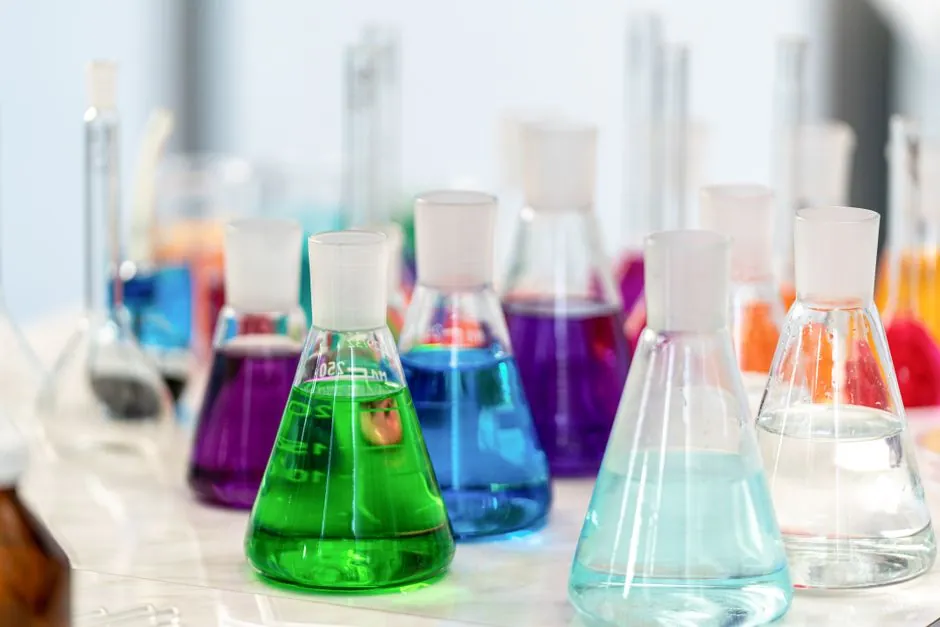
Industrial solvents are broadly grouped into four structural families: hydrocarbon, oxygenated, halogenated, and terpene/bio-based, each with distinct polarity, solvency, and evaporation behaviour [S3]. The global industrial solvents market exceeded $38 billion in 2024, underlining how deeply these fluids are embedded in coatings, pharma, electronics, and cleaning operations [S3].
Common workhorses cited across technical literature include ethyl acetate (CAS 141-78-6, BP 77.1 C), xylene (CAS 1330-20-7), toluene, methyl ethyl ketone (MEK), isopropyl alcohol (IPA), acetone, mono-ethylene glycol, and mono-propylene glycol (MPG) [S6][S10]. Selection almost always reduces to four decision axes: polarity, evaporation rate, regulatory/VOC status, and operator exposure limit.
Classification by chemical structure: the four-family view
Reference guides consistently partition solvents into hydrocarbon, oxygenated, halogenated, and terpene/bio-based families, with each class defined by its functional group and resulting polarity profile [S3]. Hydrocarbon solvents (toluene, xylene, hexane) are derived from petroleum and dominate paints, coatings, adhesives, and rubber formulations because their non-polar character dissolves alkyd and bituminous resins effectively [S3][S5].
Oxygenated solvents split into alcohols (methanol, ethanol, IPA), ketones (acetone, MEK), esters (ethyl acetate, butyl acetate), and glycols (MEG, MPG); they carry higher polarity and are typical choices for pharmaceutical extraction, printing inks, and electronics cleaning [S3][S5][S9]. Halogenated solvents such as perchloroethylene, methylene chloride, and trichloroethylene remain in service for vapour degreasing and dry cleaning but face the tightest VOC and worker-exposure controls [S2][S3]. Terpene and bio-based solvents (d-limonene, ethyl lactate, bio-ethanol from lignocellulose or starch) are positioned as higher-cost, lower-toxicity substitutes [S2][S3].
Classification by polarity and evaporation rate
Polarity is the second axis engineers use: polar solvents (water, ethanol, methanol) dissolve ionic and polar solutes and dominate pharma and food processing, while non-polar solvents (hexane, toluene, xylene) dissolve oils and hydrocarbon resins and are the default in industrial coatings [S4]. This split mirrors the broader polar protic / polar aprotic / non-polar taxonomy used in lab references [S2].
Evaporation rate drives coating and ink performance: fast-evaporating solvents such as acetone shorten drying time but risk blush or surface defects, medium-rate solvents balance speed and flow, and slow-evaporating solvents like butyl acetate improve levelling in high-grade finishes [S4]. For butyl acetate and ethyl acetate specifically, the slow/medium evaporation profile is what makes them preferred carriers for spray and wipe-on wood finishes [S1]. A useful cross-check is the Kauri-Butanol (KB) value, which quantifies solvency power; higher KB numbers correspond to stronger resin dissolution and are a standard spec-line item in coatings formulation [S3].
Criteria-based comparison: which family fits which job
On a cost-versus-regulatory-versus-solvency matrix the four families line up predictably: hydrocarbons deliver the lowest cost and strongest resin solvency for paints and adhesives but carry the heaviest VOC and flammability burden; oxygenated solvents offer balanced polarity and evaporation control at moderate cost and dominate pharma, inks, and electronics; halogenated solvents give unmatched degreasing power and fast drying but are increasingly restricted by VOC and exposure rules; terpene and bio-based solvents trade higher unit cost for lower toxicity and better biodegradability, fitting enclosed cleaning and fragrance applications [S3][S5][S7].
For a quick rule of thumb when reading a PDS: hydrocarbon or ester for resin dissolution in coatings, alcohol or glycol ether for polar residue in electronics, ketone (acetone, MEK) for fast-evaporating cleaning, halogenated only when no oxygenated substitute meets the solvency target, and terpene/bio-based when operator exposure or sustainability metrics are weighted heavily [S3][S7][S9]. Engineers comparing across these options should always read the OSHA permissible exposure limit (PEL) line, the flash point, and the KB value together, because no single number captures the trade-off [S3].
Typical use cases by industry
Coatings and paints consume the largest solvent volume, with toluene, xylene, ethyl acetate, and butyl acetate specified across industrial wood, automotive refinish, and protective-coating lines [S1][S3]. Pharmaceutical and nutraceutical extraction uses ethanol, methanol, ethyl acetate, and MPG, where USP/EP grade and residue limits drive selection more than evaporation rate [S3][S8].
Electronics and semiconductor manufacturing rely on IPA for flux removal and final wipe, acetone for precision cleaning, and specialty fluorinated or hydrocarbon fluids for vapour-phase degreasing, with electronics-grade purity and low particle count as gating specs [S3][S9]. Printing and packaging use ethanol, methanol, and ester/alcohol blends to control ink drying and adhesion on films and foils [S4][S5]. Across all of these, the industrial solvent reference page consolidates the structural taxonomy, while related engineering material selection for industrial hose types and classifications frequently cites solvent compatibility tables for inner-liner and seal selection.
Limitations, failure modes, and safety constraints

Most organic solvents share three failure modes: flammability (flash point drift with temperature), VOC-driven regulatory exposure, and chronic toxicity via inhalation or skin contact, so OSHA PELs and local VOC rules (US federal framework plus state rules such as California) drive day-to-day handling [S3]. Acetone is sometimes mistakenly called VOC-exempt: under US federal rules it remains a VOC, though it is exempt under specific consumer-product categories, a nuance worth confirming against the current EPA definition [S3].
Storage must follow flash-point class, with separate cabinets for flammable versus combustible classes, bonded containers for dispensing, and RCRA-compliant disposal of spent solvent and contaminated rags [S3]. Substitution is increasingly a documented step: d-limonene for petroleum degreasers, ethyl lactate and bio-ethanol for halogenated carriers, and water-based or glycol-ether blends for high-VOC solvent systems, though each substitute must clear a solvency and compatibility test before being dropped into an existing formulation [S2][S3][S7].
Sourcing, standards, and signals to track
Engineers specifying solvents should anchor decisions to OSHA 29 CFR PELs for exposure limits, the Kauri-Butanol (KB) value for solvency power, evaporation rate relative to n-butyl acetate (1.0), and flash point per ASTM-style closed-cup methods; purity grade (industrial, solvent, USP/EP, electronics) is the gating line item between pharma, electronics, and general manufacturing use [S3]. INRS classification by chemical structure, polarity, and industrial use is the standard reference framework cited in European occupational-safety guidance [S7].
Trackable signals for the next planning cycle: state-level VOC rule updates in the US, EPA VOC exemption list revisions, OSHA PEL revisions, and incremental bio-based capacity announcements from terpene and ethyl-lactate producers. For adjacent material-compatibility work, a Glass Fiber Selection for Automotive Manufacturing reference can sit alongside solvent specification because automotive paint-shop fluid exposure is a shared constraint. Confirm current regulatory text against OSHA 29 CFR 1910 and the latest EPA VOC list before issuing any PDS that names a specific exemption.
For component-level specifications, see construction machinery and equipment, and lamps and light fittings.