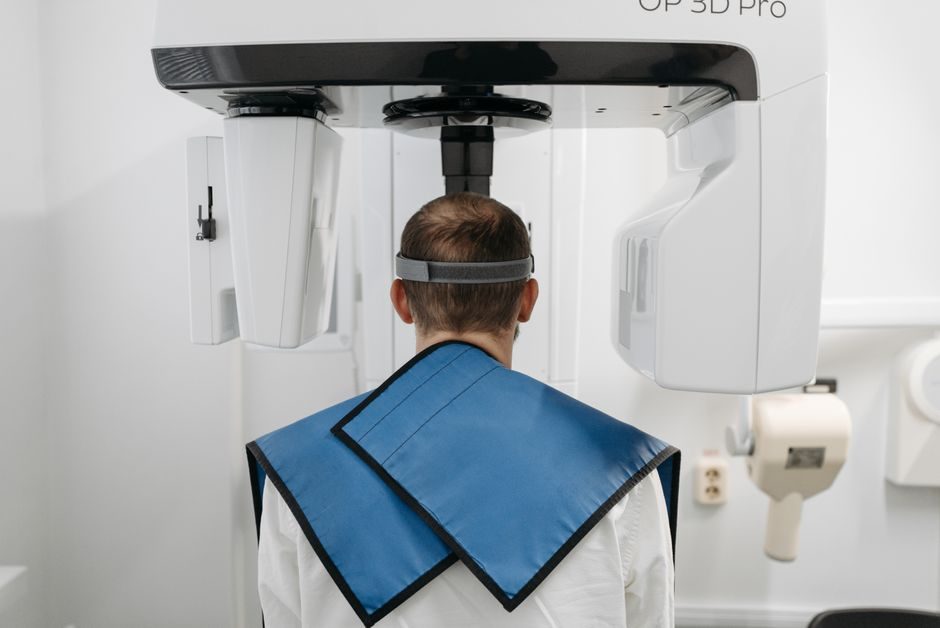
An industrial X-ray system is selected by matching tube voltage (kV), power envelope (W), detector pixel pitch, and part-handling geometry to the smallest defect size and the densest material on the line, with food-packaging systems operating between 20 kV and 160 kV at 160 W to 315 W and NDT/CT platforms extending to 9 MeV linear-accelerator energies [S3][S2].
The market for X-ray inspection systems lists 41 manufacturers and 130 product lines across DirectIndustry's industrial catalogue, with food/CPG (Antares Vision, Thermo Fisher), NDT/CT (North Star Imaging, Comet Yxlon, Balteau), and high-voltage generator supply (Spellman DXM/DXM-SS series) forming three distinct procurement tracks [S1][S3][S2][S4].
Spec gates that filter the variant list
The first gate is tube voltage and power, because penetration capability scales with kV and exposure time scales with W. Spellman's industrial X-ray generator family covers 20 kV to 160 kV with 300 W, 600 W, and 1200 W models, supports both hot-anode and hot-cathode tubes, and ships with USB, Ethernet, and RS-232 standard interfaces plus CE, UL, and RoHS compliance [S4]. For high-energy NDT, the MeVX Series linear-accelerator platform delivers energies up to 9 MeV, which is the threshold regime where steel sections above roughly 50 mm thickness become inspectable in reasonable cycle times [S2].
The second gate is detector resolution and inspection area. The NextGuard C330 inspects 13.4 in. × 7.3 in. (340 mm × 185 mm) at 0.8–1.5 mm stainless-steel sensitivity, while the NextGuard C500 doubles the area to 19.7 in. × 9.8 in. (500 mm × 250 mm) at 1.5–2 mm SST sensitivity and lifts maximum X-ray power from 160 W to 200 W [S3]. The Xpert C-series pushes power to 315 W and ships with IP65 standard ingress protection, with IP69K optional for high-pressure washdown environments, which is the threshold food processors should require for any line exposed to daily caustic cleaning [S3].
Variant map: food-packaging vs NDT/CT vs high-voltage generator
Food and pharmaceutical X-ray systems are conveyorised, IP65-rated, and optimised for stainless-steel/glass/contaminant detection in cardboard, pouches, plastic bottles, cans, and bulk flow. Belt-speed ranges sit between 5 m/min and 120 m/min depending on the model, with the NextGuard Pro reaching 5–120 m/min and the C500 capped at 5–50 m/min for the heavier 24 lb (10.9 kg) payload envelope [S3]. Beam orientation is a hard spec: vertical bottom-up with no blind spot is the default for cartons, while the Xpert S-series fires horizontally rear-to-front to inspect flow-wrapped pouches without re-orienting the product [S3].
NDT and computed-tomography systems are cabinet- or vault-format, modular, and oriented around the part envelope and source-to-detector distance (FDD). North Star Imaging's X Series spans the X25 (submicron resolution, fits a standard door), X3000 (compact dynamic), X5000 (large envelope, ergonomic load), and X7000 (largest envelope, longest focal distance) [S2]. The efX 3.0 software release from 4nsi re-imagined the user interface across the entire efX product family, which is a direct signal that the procurement differentiator at this tier is software stack and reconstruction algorithm rather than raw tube hardware [S7].
High-voltage generator supply is its own procurement lane, because integrators building custom cabinets typically buy the generator separately from the tube, detector, and motion stage. The Spellman DXM sub-systems series is rated 0.3 kW to 1.2 kW, ships as a turnkey plug-and-play assembly with tube, generator, HV cable, and cooler pre-matched, and carries a 2-year system warranty that exceeds the prorated X-ray-tube warranty most OEMs quote [S6].
Selection criteria: defect size, throughput, environment, and software
Translate the smallest defect that must be caught into a sensitivity spec, then back-solve to power and detector pitch. Food-line specs land in the 0.8–2 mm SST range and 2–7 mm glass range, which the NextGuard C330, C500, Pro, and Xpert families all hit at 160 W to 315 W beam power [S3]. For electronics, weld, casting, or aerospace inspection, sensitivity targets shift to sub-millimetre porosity and inclusion detection, which the X25 cabinet addresses with submicron X-ray resolution in a footprint that fits a standard 800 mm door [S2].
Throughput gates the conveyor architecture. Belt speeds of 5–120 m/min cover most packaged-food lines, but heavy-product inspection at 110 lb (50 kg) per part forces the NextGuard Pro envelope and the slower 5–50 m/min profile of the C500 [S3]. For batch unmanned inspection, the X25 RobotiX, X3000 RobotiX, X5000 RobotiX, and X7000 RobotiX variants add robotic loading and unloading, which is the configuration most aerospace and EV-battery cells are buying for 24/7 lights-out CT scanning [S2].
Environment and ingress protection rule out food-grade units for outdoor or washdown-heavy sites unless they carry IP69K. The IP65 standard rating on the C330/C500/Xpert B/C families is sufficient for splash zones, while IP69K on the Xpert C-series handles high-temperature, high-pressure cleaning cycles [S3]. Radiation safety is governed by cabinet shielding and interlock design — every North Star Imaging cabinet system, every Thermo Fisher Xpert, and every Spellman-integrated source is sold as a fully enclosed, interlocked unit that does not require the buyer to obtain a site radiation-safety licence for operator use, which is the procurement shortcut most first-time buyers miss.
Who should NOT pick the mainstream food-line X-ray
A food-packaging conveyor X-ray is the wrong tool for any inspection requiring more than roughly 25 mm of steel penetration, because the 160 W to 315 W beam power ceiling and the 160 kV tube ceiling on the food line cap useful contrast at low densities [S3][S4]. A buyer specifying turbine-blade core inspection, thick-wall castings, or large aerospace composites must move to a 9 MeV linear-accelerator system such as the MeVX Series, not a higher-power food unit [S2]. Likewise, anyone needing 3D volumetric reconstruction, porosity quantification, or wall-thickness metrology at sub-100 µm voxel size must specify a CT-class system with the efX 3.0 software stack rather than a 2D radiography cabinet [S7].
For agricultural inspection, X-ray imaging of seeds exposes insect infestation inside kernels and germinated-seed viability, but that is a low-energy bulk application typically handled by the Xpert Bulk conveyor with the 19.4 in. × 2 in. inspection window, not the C-series vertical-beam unit [S3][S5]. Specifying the wrong beam geometry is the most common cause of X-ray CAPEX waste, because the hardware is identical but the reject rate diverges immediately on first production run.
Standards, sourcing, and 2026 market signals

Industrial X-ray equipment used in the EU must carry the CE mark and, for cabinet-class systems, comply with machinery-safety directives covering interlocked access panels, emergency stops, and radiation-shielding integrity [S4]. Generator subsystems like the Spellman DXM line ship with UL certification and RoHS compliance, which is the shortlist filter for any North-American OEM integrator who must pass end-product UL listing downstream [S4][S6]. Food processors should additionally require IP65 minimum, with IP69K on any zone exposed to high-pressure caustic cleaning [S3].
Two 2026 sourcing signals are worth tracking. First, 4nsi released the efX 3.0 software update, which signals that software-stack lifecycle is now the dominant obsolescence vector for CT-class platforms — the tube and generator are commoditised, but the reconstruction and AI-defect-detection software is the line item that ages fastest [S7]. Second, the Spellman DXM/DXM-SS sub-system approach continues to bundle tube, generator, HV cable, and cooler as one warranty, which is the procurement model most custom-cabinet integrators now default to because it eliminates the four-vendor finger-pointing on field failures [S6].
A short procurement logic for 2026: specify tube voltage and power first, then inspection area, then IP rating, then software stack; for a general industrial X-ray system spec, the smallest reasonable food-line is a NextGuard C330-class 160 W unit with 0.8–1.5 mm SST sensitivity, while the smallest reasonable NDT unit is an X25-class cabinet with submicron resolution; for a machine vision system buyer crossing over into X-ray, expect a 2–3× higher CAPEX per metre of line and budget for shielded-room or cabinet installation; and for high-energy NDT, plan a 9 MeV linear-accelerator line item plus a 2-year generator warranty, which is the segment where industrial ceramic high-voltage insulators and Spellman-class HV engineering dominate the supplier shortlist.
Trackable next nodes: the next efX software revision from 4nsi (quarterly cadence), any expansion of the Spellman DXM wattage envelope above 1.2 kW, and any new IP69K-rated food-line models from Thermo Fisher's NextGuard/Xpert families, all of which are the data points that will reset this selection map inside 12 months. For comparison on the broader NDT-instrument shortlist, the ultrasonic flaw detector 2026 buyer's map covers the complementary non-X-ray inspection lane, and the ultrasonic flaw detector vs hardness tester piece is the right cross-check when the buyer is undecided between X-ray and ultrasonic NDT for a given defect class.