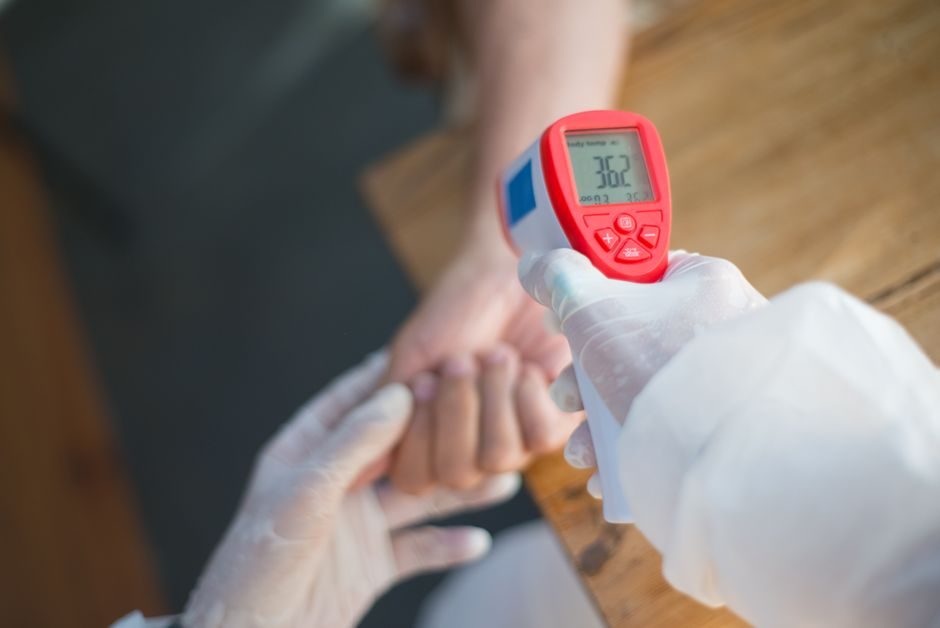
Across 24 product listings and market reports published between January and June 2026, non-contact infrared thermometers split into three distinct price tiers: consumer/medical forehead units at US$0.80-1.50 [S9], low-cost handhelds at US$6-10 [S9] and US$23-28 [S3], and industrial dual-laser or data-logging models at US$374 [S1] and US$398 [S2], with high-temperature IT-950-class instruments specified to 950 °C [S4].
The total addressable market is forecast to grow from US$870.87 million in 2025 to US$1,274.28 million by 2030 at a 7.91 % CAGR [S6], so price benchmarks established in mid-2026 are useful for specifiers budgeting 2027 capex, not for 2025 retrofits.
Three pricing tiers and what drives the spread
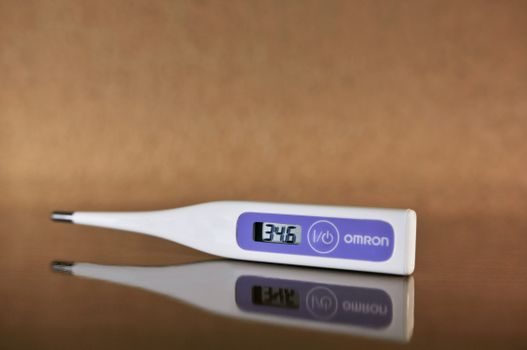
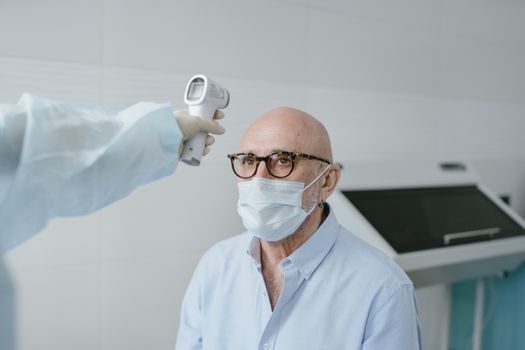
The lowest tier covers medical and personal-care forehead/ear thermometers, where Made-in-China listings show FOB pricing of US$0.80-1.50 per piece for digital baby thermometers [S9] and equivalent personal-use models [S7]; these units typically read 32-42 °C, communicate over USB on higher-end medical SKUs [S3], and are sold with MOQs of 600-5,000 pieces [S7].
The mid tier covers general-purpose handhelds: the DISTRIMESURE IM30IR lists at €23-€28 ex-tax with a -50 to +650 °C range and a laser pointer [S3], while Contec TP500-style industrial probes sit at US$6-10 FOB [S9]; the IT-950 LCD series extends range to -50 to +950 °C with 0.1 °C resolution [S4], and the Kapro 398 Thermoscan adds dual-laser aiming in a 398-euro housing [S2]. The widest gap is below the industrial premium tier, where CENTER TECHNOLOGY's 374-euro dual-channel data logger (16,000 records/channel, 60 V DC input protection, -10 to 50 °C operation) sits [S1].
Selection criteria that justify the price step
Range and optics justify the jump from US$23 to US$398: medical units are locked to a narrow 32-42 °C skin window, mid-tier handhelds cover -50 to 650 °C, and the IT-950 reaches 950 °C at 0.1 °C resolution [S4]. Engineers specifying for furnace, kiln, or molten-metal work should reject any unit rated below 1,000 °C, regardless of how cheap it looks on a Made-in-China listing [S9].
Aiming method and accuracy discipline separate the tiers: single-laser pointer models (IM30IR [S3]) cost less than dual-laser units (398 Thermoscan [S2]) because the second beam defines a true distance-to-spot ratio rather than an aiming dot. Data-logging and bus output are the next step up: the CENTER 374 records 16,000 samples/channel with Min/Avg/Max and runs on a 9 V battery weighing 285 g [S1] - useful for commissioning walk-downs, redundant to a fixed pressure transmitter only on thermal-survey work, not on permanent process loops.
Where the cheap units fail: calibration drift and emissivity
Fluke's step-by-step calibration procedure makes the point that IR thermometer accuracy collapses without a known emissivity target, stable source, and correct distance-to-spot ratio [S5] - a US$0.80 forehead unit [S9] cannot meet that workflow, and neither can a US$6 probe. Buyers in food, pharma, and electronics reflow must budget for a calibration blackbody plus a service contract, not just the gun.
For continuous inline measurement on tanks, reactors, or linear guide bearing housings, an IR handheld is the wrong instrument class - specify a fixed pyrometer or RTD loop, not a US$23 laser pointer [S3]. A bimetal thermometer remains the low-cost local indicator, and an infrared level sensor is the right non-contact choice for bulk solids, not a hand-held IR thermometer with a 950 °C ceiling [S4].
Comparison: four reference SKUs against four decision criteria
For spec-side comparison, the following four 2026-listed units line up against the criteria that actually move a purchase order: DISTRIMESURE IM30IR (€23-28) [S3], Kapro 398 Thermoscan (US$398) [S2], CENTER 374 (US$374) [S1], and GESA IT-950 (price on request) [S4]. On range, the IM30IR and 398 cover -50 to 650 °C, the CENTER 374 is rated for -10 to 50 °C ambient operation, and the IT-950 reaches 950 °C - the only one of the four usable above 650 °C.
On aiming, the IM30IR ships with a single laser pointer, the 398 Thermoscan adds dual-laser targeting, the CENTER 374 has no aiming laser listed, and the IT-950 spec sheet omits aiming detail. On data output, the CENTER 374 records 16,000 records per channel [S1], the IM30IR adds USB [S3], and the 398 and IT-950 are display-only. On certification, none of the four lists ATEX/IECEx, so none of them is suitable for Zone 1 hazardous areas without a third-party assessment.
Who should and should not buy at each tier
HVAC technicians, home inspectors, and food-service auditors can standardise on the US$23-50 mid-tier with confidence; the IM30IR's -50 to 650 °C span [S3] covers almost all building and kitchen work. Electrical and mechanical maintenance crews who need logged data for trend reports should jump to the CENTER 374 class [S1] - the 16,000-record buffer pays back inside a single commissioning campaign.
Process and metallurgical engineers should refuse any sub-US$100 unit for furnace work; specify the IT-950-class device [S4] with documented 0.1 °C resolution and a known distance-to-spot ratio, and budget for a crossed-roller guide-mounted fixed pyrometer for permanent installation. Buyers chasing US$0.80-1.50 forehead thermometers [S9] are purchasing single-use screening stock, not calibrated instrumentation, and should not route that SKU into a metrology inventory.
Trackable signals for the next 90-180 days
Two signals are worth watching: the 7.91 % CAGR forecast to 2030 [S6] will pressure mid-tier ASPs downward as Chinese OEM capacity expands [S9], and any 2026 IEC 60079-series amendment covering handheld IR use in Zone 1 would invalidate today's lack of certification on the CENTER 374 [S1], Kapro 398 [S2], and IT-950 [S4] - track the next IECEx test-house bulletin before specifying any of these four in a hazardous-area walk-down kit.