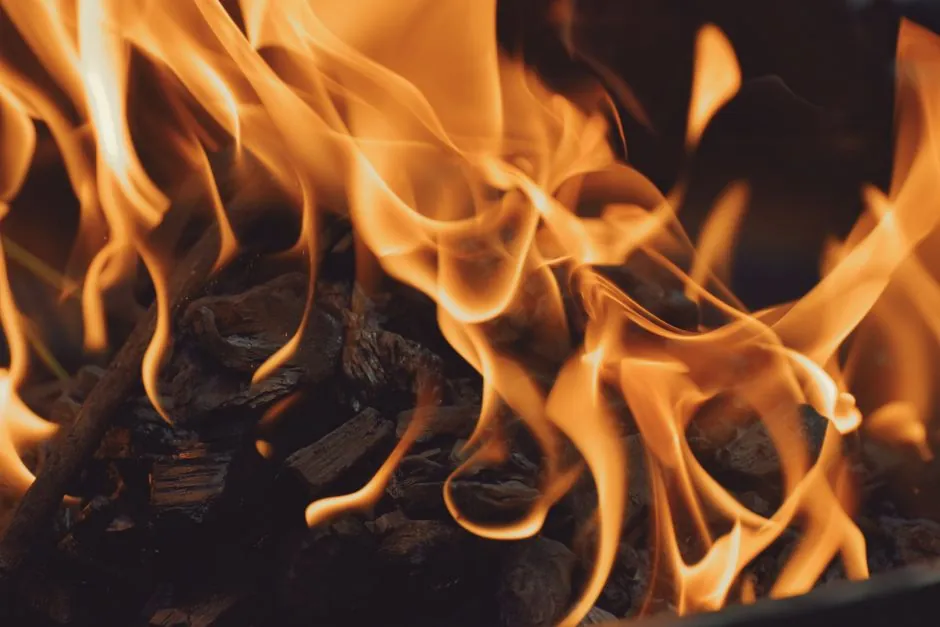
Inside a fuel-fired crucible furnace, the metal never sees a flame: combustion gases spiral around the outside of the crucible, the refractory wall conducts inward, and the glowing inner skin re-radiates to the charge [S2][S4].
That three-step path (flue gas convection and radiation to the outer wall, conduction through the wall, then radiation plus conduction from the inner skin to the metal) sets the real melt rate and the upper limit of furnace efficiency, which typically lands between 8% and 30% in field practice for a 25 kg brass charge on a 250,000 BTU/hr burner [S4].
The three thermal resistances in series
From the burner port to the molten bath, heat must cross three resistances in series: a gas-side convective plus radiative resistance on the outside of the wall, a conductive resistance through the wall itself, and an inside radiative plus conductive resistance from the hot inner skin to the charge [S1][S2].
FoSeco and Vesuvius both flag the same bottleneck: without metal against the upper wall, the wall is no longer clamped at a fixed inner temperature and it superheats, because its only sink is radiation downward into the bath and conduction into the support plinth [S1]. That is why partial-charge operation costs disproportionate fuel per kilogram melted, and why a tightly filled crucible is the cheapest efficiency upgrade any foundry can make.
How hot gas delivers energy to the outside of the wall
A tangential burner in a gas-fired furnace drives a swirling flow that wraps hot gas around the crucible, so the dominant outside-wall mode is forced convection from a recirculating flue-gas stream, with a smaller but non-trivial radiation share from the luminous flame and the glowing chamber lining [S2][S4]. The 30 lb propane foundry unit in the firgelli reference case delivers about 250,000 BTU/hr, melts 12 kg of brass per hour, and operates with an overall efficiency near 8.9% in the cited worked example, which is consistent with this convective-plus-radiative outer path carrying roughly a quarter of the burner output into useful wall heat flux [S4].
For methane-fired designs, 3D CFD studies using K-epsilon turbulence modelling and 1,001,367-cell meshes on a two-burner geometry show that exhaust location, burner count and air-fuel ratio all move the mean cavity temperature and shift the local heat flux around the wall, confirming that gas-side convection and radiation are tunable design variables rather than fixed numbers [S3]. For the foundry floor, the practical lever is the air-fuel ratio: a propane venturi running near stoichiometric at 24:1 by mass gives the hottest neutral flame, while running rich fouls the crucible with soot and running lean dissociates water vapour that hydrogenates aluminium and drives porosity in the casting [S4].
How heat conducts through the wall itself
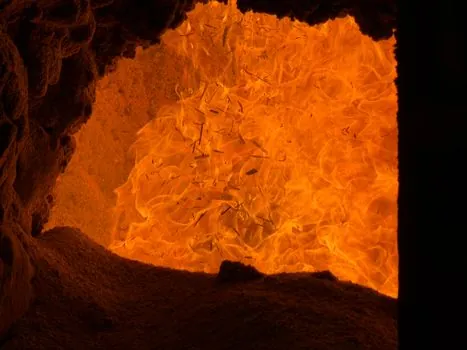
The wall between the hot gas and the melt is a castable refractory or insulating firebrick, typically 75-100 mm thick, rated to at least 1400°C for brass work and 1650°C for bronze, with a 25-50 mm standoff gap between the wall and the crucible on every side [S4]. Tighter than 25 mm and the flame chokes; wider than 50 mm and the burner spends more of its output heating empty chamber volume rather than the crucible [S4].
Foseco's matching guide for gas, oil and propane furnaces requires the flame to circulate around the crucible from bottom to top so heating is even, which keeps the conductive path through the wall closer to one-dimensional and avoids the through-thickness thermal gradients that drive spalling [S6]. The Vesuvius multivariate model links crucible thermal conductivity, specific heat capacity and geometry directly to melting efficiency and to thermal stress, so conductivity is the property to watch when a wall is changed, not the surface finish [S1].
How the inner skin finally delivers heat to the metal
Once the wall is hot, the inner skin of the crucible reaches roughly 1100°C in a steady brass melt, and from that point the dominant mode into the charge switches to radiation from the inner skin plus direct conduction at points where solid charge rests on the wall [S2][S4]. The skin is a silicon-carbide or clay-graphite crucible selected from the Morgan A-series (A6 to A40, where the number is approximately the brass capacity in kg) and it is deliberately chosen to have a high emissivity so this radiation step is efficient [S4].
Kintek's indirect-heating description makes the same point from a different angle: hot gases and glowing elements radiate to the crucible walls and furnace interior while convection in the chamber keeps the wall temperature uniform around the circumference, and the inner skin then passes energy to the charge by radiation and conduction, which is why a flame must never be aimed at the wall directly, since a tangential hot spot cracks the crucible in 20-30 heats and dumps the bath [S2][S4].
Side effects that change the heat-flow picture
Three side effects are loud enough to flip which resistance dominates. First, an undercured castable such as Mizzou or Kast-O-Lite 30 traps water that flashes to steam on first firing and spalls the lining, so the curing schedule is 24 hours at room temperature followed by an 8-hour ramp before any real heat load is applied [S4]. Second, the same Vesuvius work warns that the upper-wall region without a metal sink can superheat and shed heat only by radiation downward, which is one reason why partial-charge melts are expensive and why ingot preheating before charging is a real efficiency gain, not folklore [S1].
Third, switching the combustion mode from steady to oscillating has been shown experimentally and numerically to raise the heat-transfer rate, shorten processing time and improve furnace efficiency, with visibly cleaner emissions, on a gas-fired self-regenerative crucible geometry [S3]. For someone specifying a new build, the practical reading is: pick a wall thickness and standoff that keep the gas-side resistance dominant, hold stoichiometric combustion, run the crucible full, and consider regenerative or oscillating firing for any installation above about 100 kW burner input.
Sourcing, standards, and what to verify on the next pull
The mechanical side of this analysis is anchored in the Foseco/Vesuvius technical literature on crucible thermal efficiency and in the open CFD literature on methane-fired crucible furnaces, while the operational numbers and geometry limits come from manufacturer-published propane-furnace references and the Firgelli worked example for a 25 kg brass charge on a 250,000 BTU/hr burner [S1][S3][S4][S6]. On the next data pull, the two signals worth tracking are (a) any revised thermal-conductivity or emissivity data for bonded silicon-carbide crucibles at 1100-1400°C, since that is the single property that moves the inner-skin radiation step, and (b) any new CFD or field measurements of the gas-side heat-flux split in oscillating versus steady combustion, since that is where the largest single efficiency gain in the public literature sits today [S3].
For the relevant spec sheets and selection criteria, see crucible furnace, heat treatment furnace, and fired brick.
Background reading: How to Build a Chemical Transfer Hose Spec: STAMPED Method, Tube Polymers, and Ratings.