Medium-frequency induction heating applied to hot-box core boxes brings tool warm-up from typical 20-40 minute resistance-element ramps down to 1-3 minutes at the same 180-250°C target mould temperature, according to foundry-process references [S2][S3].
The hot-box process hardens resin-bound sand cores directly inside a preheated metal core box, with phenolic, furan, and urea resins cured at 180-250°C and shooting pressures around 6 atm [S2].
Why hot-box tooling is a good fit for induction
Hot-box core boxes are machined from cast iron or mild steel with wall thicknesses typically in the 20-60 mm range, a bulk mass that induction couples to efficiently because heat is generated inside the steel rather than transferred through a heating element [S3].
Induction delivers 80-90% electrical-to-heat conversion efficiency at the workpiece, with heating rates 2-4x faster than gas-fired or radiant-electric boxes when coil geometry is matched to the tool footprint [S3][S6]. That response time is what matters on a foundry floor: the box reaches cure temperature before the sand mix is even transported to the shooter, so the operator stops waiting on the tool and starts waiting on resin chemistry. For aluminium and grey-iron foundries running engine blocks, manifolds, and fittings, this collapses the long pre-shift warm-up that traditionally penalises small-batch hot-box jobs.
Process windows and resin compatibility
The hot-box process requires a preheated core box held at 180-250°C, with sand-to-binder ratios of 100 parts sand to 1.4-2.3 parts resin and 0.25-0.45 parts hardener, and a minimum 2-3 hour post-cure rest to prevent gas-related casting defects [S2].
Phenolic resins polymerise at the higher end of the window and suit thin or high-hardness cores but resist shakeout; urea resins cure faster at lower temperatures with easier shakeout but weaker cold strength; furan resins sit between, with intermediate cold strength and cure speed [S2][S4]. Faster warm-up matters most for urea and furan systems, where the resin's pot life is short and a 20-minute heat-up wastes a meaningful share of working time. Urea-modified phenolic grades (Resital) are widely used for engine block and head cores where short cure time and thermal stability both matter [S4]. In practice the resin picks the temperature, and induction's tight control keeps the box within ±5°C of setpoint, the kind of stability that reduces the over-curing which makes phenolic cores brittle and hard to shake out.
Comparison: induction vs resistance vs gas for hot-box boxes
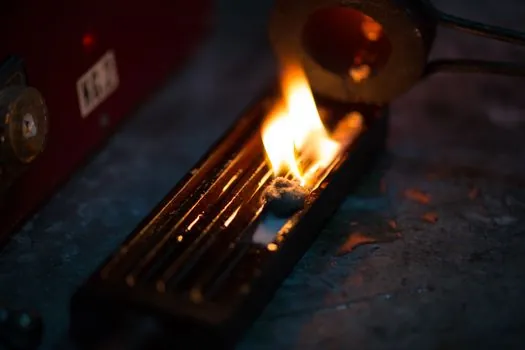
Across the three common heating modes, induction wins on warm-up time and footprint but trails on simplicity and per-kW installed cost, with no single option dominating every foundry profile [S3][S6].
Decision criteria for a hot box core machine retrofit or new build:
- Warm-up time to 200°C: induction 1-3 min, resistance cartridge 20-40 min, gas burner 15-30 min [S2][S3].
- Steady-state efficiency at the tool: induction 80-90%, resistance 50-65%, gas burner 30-45% (system-level, with flue losses) [S3][S6].
- Temperature uniformity across the box face: induction ±5°C with multi-zone coils, resistance ±10-15°C, gas ±15-25°C depending on burner placement.
- CapEx per kW at the tool: induction highest (power supply, coil, cooling), resistance moderate (elements + controls), gas lowest (burner + train).
- Footprint and integration: induction compact, fits inside an existing platen; resistance and gas both need external routing and clearance for hot elements or flue.
For high-mix job shops running 20-60 minute cores, the OpEx savings on energy and the throughput gain on warm-up typically pay back an induction retrofit in 6-18 months at 2026 European industrial electricity prices; for captive foundries on continuous three-shift hot-box cells, the case is weaker because the box is rarely cold.
Coil design and electrical sizing
Typical hot-box induction installs use 10-50 kW medium-frequency supplies at 10-30 kHz, with a multi-turn copper coil wrapped around the box platen or clamped to flat faces for uniform flux coupling [S3][S6].
Coil-to-box standoff is usually 3-8 mm to keep coupling high without arcing, and water cooling carries station heat away at 20-30 L/min per 50 kW of power. Foundries running multi-cavity boxes for cylinder-head cores report total tool masses of 80-200 kg, which is a deliberate match for the power supply: enough thermal mass to buffer shot-to-shot transients, but not so heavy that the box itself becomes the bottleneck. The same physics is used in induction furnace melting, but at 5-10x higher frequency and an order of magnitude lower power density per square centimetre.
Integration with sand mix and gassing
Hot-box tooling cures sand cores by stored heat alone, with no amine gas purge; the resin hardener is a latent catalyst mixed into the sand before shooting, and the 180-250°C box wall completes polymerisation in 10-30 seconds of contact [S2][S4].
This is a critical distinction from cold-box and cold box core machine cells, which use vaporised triethylamine or dimethylethylamine to cure phenolic-urethane resin at ambient temperature; induction heating is irrelevant to that chemistry because there is no hot tool to drive. Shell-core and shell core machine workflows sit closer to hot-box, using 200-280°C boxes to fuse a phenolic-bonded sand skin, and several foundries have retrofitted induction onto shell tooling with the same warm-up gains. Within a mixed cell, the induction supply can be shared via a quick-disconnect coil head, so the same 30 kW unit heats a hot-box box, a shell box, or a small warm-box platen across a shift.
Limits, failure modes, and what not to retrofit
Induction heating does not suit aluminium or copper-beryllium core boxes, non-ferrous tool materials, or boxes with thin walls below ~10 mm that overheat at the surface before the bulk reaches cure temperature [S3][S6].
Edge effects concentrate flux at corners and thin webs, and a poorly designed coil can create ±30°C gradients that produce soft spots in the cured core. Foundries with very long cure cycles above 45 seconds per shot see less benefit, because the steady-state heat-up savings matter less than the warm-up savings; conversely, very short cycles under 8 seconds need a tightly regulated supply with sub-second response to avoid temperature overshoot on idle. Gas-fired boxes remain competitive where foundry gas is cheap and warm-up cadence is once per shift, and resistance-heated boxes still dominate small job shops because the cartridge elements are cheap, replaceable in minutes, and need no water cooling. For process-energy work, heat treatment furnace kW sizing from load weight and ramp time is a useful parallel reference, since the same 1-3 kW/kg of steel rule-of-thumb applies when sizing the induction supply for a new box.
Selection checklist for a 2026 retrofit
Specify the supply at 1.5-2.0 kW per kg of core box mass, with medium-frequency at 10-30 kHz, water cooling at 20-30 L/min per 50 kW, and a multi-zone coil for ±5°C face uniformity [S3][S6].
Confirm the tool material is ferromagnetic steel or cast iron with 20-60 mm wall thickness, the resin system is phenolic, urea, or furan rated for 180-250°C cure, and the existing platen has clearance for a 3-8 mm coil standoff and water manifolds. For foundries weighing induction against newer core machine platforms, the key question is cell duty cycle: above 60% utilisation induction almost always wins on total energy and throughput; below 30% utilisation the CapEx premium is hard to amortise. The next node to watch is the 2026-2027 release of compact 30-80 kW solid-state supplies with integrated PLC interlocks, which are already cutting the panel space required for an induction retrofit by roughly half compared with 2022-2023 MOSFET/IGBT generations.