
Internal climbing tower cranes sit inside the building's lift or stair core and are jacked upward one floor at a time with hydraulic cylinders and guide rails, while external climbing tower cranes stand on a ground/base anchor outside the structure and are tied to the building at intervals as the structure rises [S1][S4]. The choice is driven by site footprint, building height, lift capacity, and weather exposure, not by the crane model alone [S6].
For tall, footprint-constrained cores the internal method usually wins on programme: Amrose Associates reports an internal climbing system for a 37-storey London tower that climbed in hours versus 2–3 days for traditional external climbs, and a Potain MR 415/MR 418 A pair installed in the core of Boston's 43-storey One Congress tower (~565 ft / 172 m) let lower floors lease while upper floors were still under construction [S2][S3]. External climbing, by contrast, tops the comparison for raw lift capacity and inspection access, but every tie adds facade coordination and weather risk [S1].
What each method actually is, and where it fits
The internal climbing method positions the crane mast inside the building core (typically the elevator or stair shaft) and raises the entire tower in single-floor increments using hydraulic jacks and temporary collars anchored to the core walls; the Amrose three-beam climbing frame for Hawthorne House, integrated into the core shaft, is a representative custom solution [S2]. The external climbing method fixes the crane base to a concrete slab beside the building, then extends the tower upward along the outside using steel collars or tie-rings, with anchors added every 20–30 m as the structure rises [S1][S4].
The two systems answer different constraints, and a project often picks before ground-break. A free-standing tower crane tops out around 80 m (≈265 ft) before wind and sway govern, which is why virtually all buildings above that height use either a tied-in external crane or an internal climber [S4]. For very tall work, internal climbers "can reach heights equal to or even beyond traditional tied-in cranes" because the core itself provides the stiffness, not wall ties [S4].
Comparison matrix: internal vs external on the four decision criteria
Across the dimensions a process or planning engineer actually weighs, the data lines up as follows. (1) Site footprint: internal climbing requires zero external footprint, the crane stays inside the property line; external climbing needs clear space beside the building for the mast and tie braces [S1][S2]. (2) Climbing cycle time: internal climbing at Hawthorne House completed each lift in hours versus 2–3 days for traditional methods; external climbs are typically staged over a shift with a jacking crew [S2]. (3) Weather sensitivity: external climbing is directly exposed to wind, rain, and UV, with documented interruption risk and accelerated corrosion; internal climbing is sheltered inside the core and is largely unaffected by wind at the working platform [S1]. (4) Programme integration: One Congress used internal climbing specifically so floors 6–25 could be fitted out and leased while the upper structure was still being built, a sequence external climbing normally blocks [S3].
On capacity and inspection the picture flips. External climbing accepts the largest luffing-jib and hammerhead models with the heaviest lift charts, and the mast is accessible from the outside for routine inspection, bolt torque checks, and slewing-ring service [S1]. Internal climbing is constrained by the core opening, so projects specify compact luffing-jibs such as the Potain MR 415/MR 418 A whose bases are interchangeable with MD/MDT models to widen installation options in tight cells [S3]. For inspection, internal climbers usually need a planned shutdown or a small auxiliary hoist because the mast is buried in finished shaft walls as the core closes around it [S2].
Use-case mapping: pick internal, pick external, or hybridise

Internal climbing is the right call when the site is boxed in, the building has a concrete slipform core that leads the floor cycle, and the developer wants simultaneous vertical and horizontal work below the crane. The One Congress case is the textbook example: the core grows faster than the surrounding floors, so the crane rides inside the core and the floors below stay free for fit-out [S3]. For very tall residential blocks like Hawthorne House (37 storeys) where the lift/stair core is the only continuous vertical void, the three-beam internal climber lets the structure close around the crane without ever stepping outside the boundary [S2].
External climbing is the right call when the lift requirement exceeds what a compact luffing-jib can deliver, when there is no usable core shaft, or when the project needs the crane visible and accessible for daily maintenance. Tall commercial towers with heavy steel erection, or buildings with non-continuous cores, typically stay on external climbing with ties every 20–30 m and a climbing formwork cycle running in parallel [S1][S4]. A crawler crane is then used at the end of the job to dismantle the external tower crane from the roof, a standard rooftop strike pattern on high-rise projects [S1][S4].
Hybrid configurations are common on very large footprints. On One Congress the contractor initially wanted the cranes outside the core but moved them inside after the concrete sub pushed back on lost workspace, an MR 415 inside four connected core cells with an MR 418 A added to the outside of the westernmost cell once the western steel frame could take it, demonstrating that "internal and external climbing configurations" can coexist on a single asset [S3]. For slab-edge logistics such as formwork striking and rebar landing, a crane scale on the internal hoist hook is a practical add-on that protects lift charts from being silently exceeded on either side of the decision.
Limitations, failure modes, and what to watch on site
External climbing has three recurring failure modes: wind interruption above the operating envelope, tower splice accumulation on very tall buildings (each splice is a stability test), and long-term corrosion from UV and rainwater exposure on the exposed mast [S1]. The CPA climbing best-practice guide treats these as the dominant planning risks, with mandatory pre-climb checks on steel-sleeve wear, metal-sheath condition, bolt torque, and base-anchor capacity, plus real-time verticality and wind-speed monitoring during the lift [S1][S6].
Internal climbing has its own failure modes. The core walls must be designed to take the climbing frame's thrust loads, the shaft opening must stay clear of MEP risers that would block the jacking path, and the concrete sub's rebar-shake-out platforms compete for the same footprint as the crane base, which is why One Congress's contractor initially resisted putting the cranes inside the core [S2][S3]. Removal at top-of-structure is the other pinch point: a tower crane that climbs inside the building has to be dismantled in sections through the roof, often with a smaller derrick or crawler crane assist, and the lift-core opening has to be sized for the largest piece [S1][S4].
Standards, sourcing, and the engineering bench data
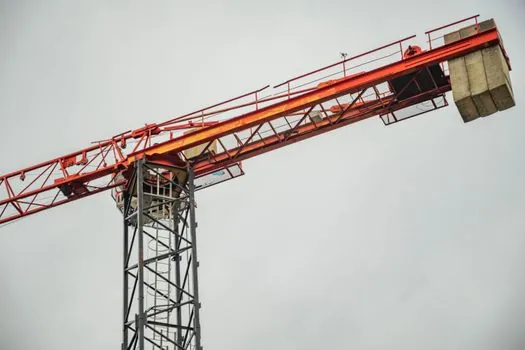
The governing industry reference is the CPA Best Practice Guide for the Climbing of Tower Cranes, which codifies the external vs internal climbing decision and the pre-climb inspection sequence [S6]. Manufacturer installation guides (Sany, Manitowoc/Potain) provide the model-specific freestanding, tied-in, and internal-climbing height tables that planners use to size the first mast section; the One Congress MR 415, for example, was freestanding at just under 197 ft of mast and a similar jib length in Phase 1 before any climbing [S1][S3]. Patent literature (e.g. CN201901539U) describes combined internal-and-external jacking frames with foundation embedments and lower-end climbing structures, confirming that the dual-configuration hardware is a mature, documented family [S7].
Plan the climb in three numbers a procurement engineer should write on the drawing: (a) the core opening clear dimension versus the largest crane base section, including the base interchangeability option (MD/MDT/MR family bases on Potain, for example) [S3]; (b) the tie or thrust-frame spacing in metres, with 20–30 m as the typical external tie interval and floor-by-floor (≈3–4 m) for internal hydraulic lifts [S1][S4]; (c) the cycle time per climb, with internal climbing quoted at hours and traditional external climbing at 2–3 days per lift [S2]. If a project can't meet any of those three benchmarks without redesign, the wrong climbing method has been chosen, and the lift-chart, weather, and dismantling consequences will surface within the first ten floors.
Related analysis: Polyester vs Epoxy Resin Cure Chemistry: Spec Decision Guide.