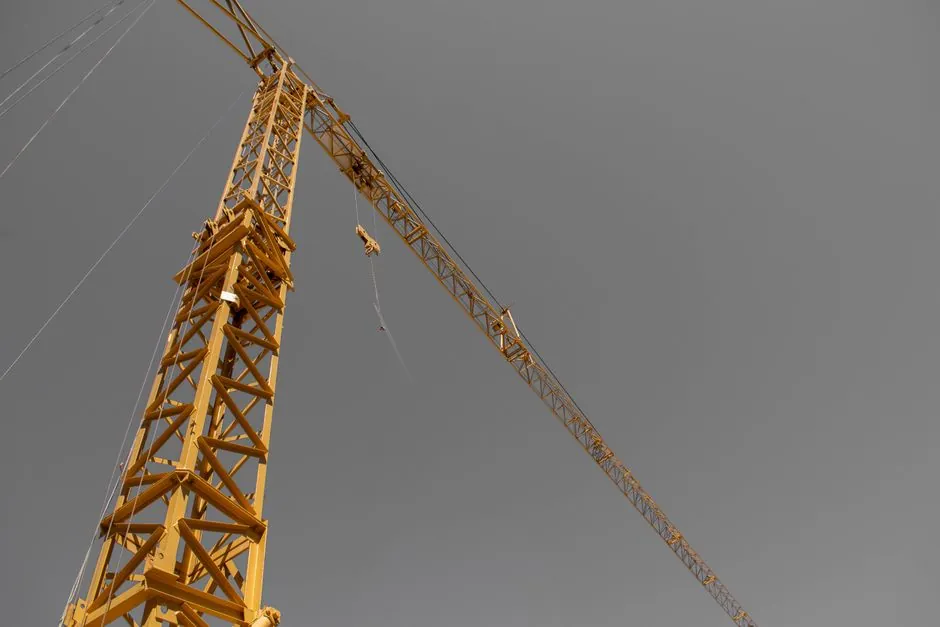
Hydraulic luffing tower cranes replace the conventional rope-and-drum mechanism with hydraulic cylinders, delivering jib movements in under 90 seconds and a markedly smaller out-of-service radius, per Liebherr's 195 HC-LH launch brief [S3]. Rope-luffing designs remain the default in most urban fleets, using a luffing drum and pulley system to raise and lower the jib through a near-90-degree arc [S5].
The choice is rarely about raw lifting capacity, since both architectures are available from 125 tm up to 1250 tm in WOLFF's luffing-jib line, with hoist winches ranging from 28 kW to 132 kW [S1]. It is about how the crane moves between parked and working positions, and what that movement costs in energy, footprint, and erection labour.
How Each Luffing System Actually Works
A rope-luffing crane tensions the top end of the jib with a luffing rope routed over a pulley and wound onto a luffing drum, so the jib pivots on its bottom pin as the drum pays rope in or out [S5]. The rope path runs back through the counter-jib structure to the slewing platform, and the motor that drives the drum typically draws more power than a hydraulic cylinder would for the same motion [S2].
A hydraulic-luffing crane substitutes that drum and rope with one or more hydraulic cylinders mounted between the tower-top frame and the jib, so jib angle is set by cylinder extension rather than cable tension. Bennetts Cranes notes this gives hydraulic luffers a smaller out-of-service radius and lower power draw, since hydraulic rams need less energy than a rope-luffing motor [S2]. Liebherr's 195 HC-LH takes the same principle and rates a full jib-up cycle in under 90 seconds, with safe luffing possible with a load on the hook [S3]. For background on the actuation principle itself, see the hydraulic actuator reference page.
Footprint, Airspace, and Urban-Site Suitability
Both luffing architectures beat a fixed saddle jib on airspace, because the jib can be parked close to vertical and clear of neighbouring property [S4]. Within the luffing family, hydraulic systems shrink the out-of-service radius further because the cylinder can fold the jib tighter than a slack-rope configuration allows, making hydraulic luffers the better fit on tightly bounded urban plots [S2].
Rope-luffing cranes still lead on multi-crane sites where hook time matters more than cycle time, since they can slew up and jib down to pass under an adjacent crane's load and resume work without waiting for a hydraulic repositioning cycle [S5]. For an overview of the broader machine category, see the tower crane encyclopedia entry.
Selection Criteria: Cost, Speed, Maintenance, Skill
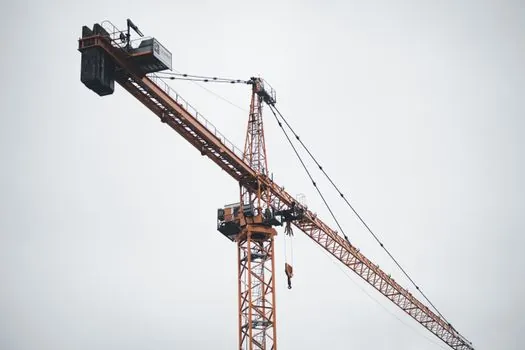
Four criteria dominate the buy-or-hire decision between hydraulic and rope luffing: capital and hire cost, jib cycle time, maintenance load, and operator skill requirement. On cost, rope-luffing cranes are consistently cheaper to hire and erect, and Bennetts places them as the default unless a saddle jib would oversail a neighbour or multiple close hooks are required [S2]. Construction Cogs corroborates that luffers in general carry a hire premium relative to saddle-jib machines, with hydraulic variants on top of that [S5].
On speed, hydraulic luffing wins by a clear margin: Liebherr's 195 HC-LH completes a full jib movement in under 90 seconds, against the multi-minute cycle typical of a rope-luffing drum on a comparable-capacity machine [S3]. On maintenance, the luffing mechanism itself adds complexity versus a fixed jib, and hydraulic luffing adds a fluid-power subsystem on top of that, so rope-luffing tends to win on spares inventory and service intervals [S4]. On operator skill, both architectures require luffing-specific training because the jib moves in an arc of almost 90 degrees rather than purely horizontally [S5].
Capacity Ranges and Tower-System Compatibility
Luffing-jib models now span from compact 125 tm machines up to 1250 tm heavy-lift units, so capacity is no longer a discriminator between the two actuation methods [S1]. Liebherr's rope-luffed 440 HC-L and 620 HC-L, and the hydraulic-luffed 195 HC-LH, all share the 24 HC 630 tower system, allowing internal and external climbing without changing the tower fleet on a project that needs both machine types [S3].
WOLFF's B-series luffers (166 B, 235 B, 275 B, 355 B, 700 B, 1250 B) use a patented central connecting frame that links the tower top, counter jib, and jib into one unit, reducing individual component weights and shortening the counter jib compared to a traditional layout [S1]. For buyers standardising hydraulic components across a fleet, the hydraulic cylinder and hydraulic motor reference pages list the typical operating envelopes that a luffing cylinder would be specified against.
Safety, Controls, and Energy Profile

Hydraulic luffing adds a fail-safe consideration: the cylinder must hold load on loss of pressure, and the control loop must limit jib speed under load. Liebherr's 195 HC-LH specifically advertises safe luffing with a load on the hook, with cycle time under 90 seconds, and integrates the move through its Litronic control system that continuously monitors operating parameters [S3]. Rope-luffing systems achieve load-holding through the drum's mechanical brake and the rope's static friction, with no pressurised fluid to contain.
On energy, Bennetts states directly that hydraulic rams need less power than the motor that luffs a conventional rope-luffing jib, which matters on sites with limited generator capacity or where diesel-hour costs are tracked [S2]. Rope-luffing machines do retain an advantage in cold-weather start-up, since they have no hydraulic fluid to warm to operating viscosity before a full-speed luff is attempted. For designers sizing the prime mover and hydraulic supply, the hydraulic overview page covers pump and circuit selection basics. Operators comparing these machines against other machine classes should also review the broader signal tower light standards used to indicate crane status on multi-crane sites.
When Each Architecture Is the Wrong Choice
Hydraulic luffing is the wrong pick when the project cannot absorb the higher hire and erection cost, or when the site is in a cold climate where hydraulic warm-up eats into the cycle-time advantage. Rope luffing is the wrong pick when the airspace is so tight that even a vertical-parked jib oversails a neighbour, or when the project needs fast repositioning under load on a confined footprint [S2][S3].
Neither luffing architecture is the right answer when a saddle jib will do, since saddle jibs lift vertically and then horizontally and are stable in higher winds, with simpler erection and lower hire cost [S2]. The decision should be re-checked on every project: a site that needed a luffer last year may be a saddle-jib site this year if the boundary set has changed.
The two watch items for 2026 procurement are Liebherr expanding the HC-LH hydraulic-luffing range around the 195 HC-LH platform, and WOLFF extending its B-series luffers with the same central-frame design philosophy, both of which will tighten the cycle-time and footprint gap between hydraulic and rope luffing over the next product cycles [S1][S3]. Buyers should also track whether the rope-luffed HC-L range adopts Litronic load-plus capacity boosting on the larger 620 HC-L chassis, since that would re-open the capacity-per-tonne gap between the two architectures.
This topic is covered further in Excavator Hydraulic Pump: Flow Rate, Pressure Specs, and Sizing Rules.