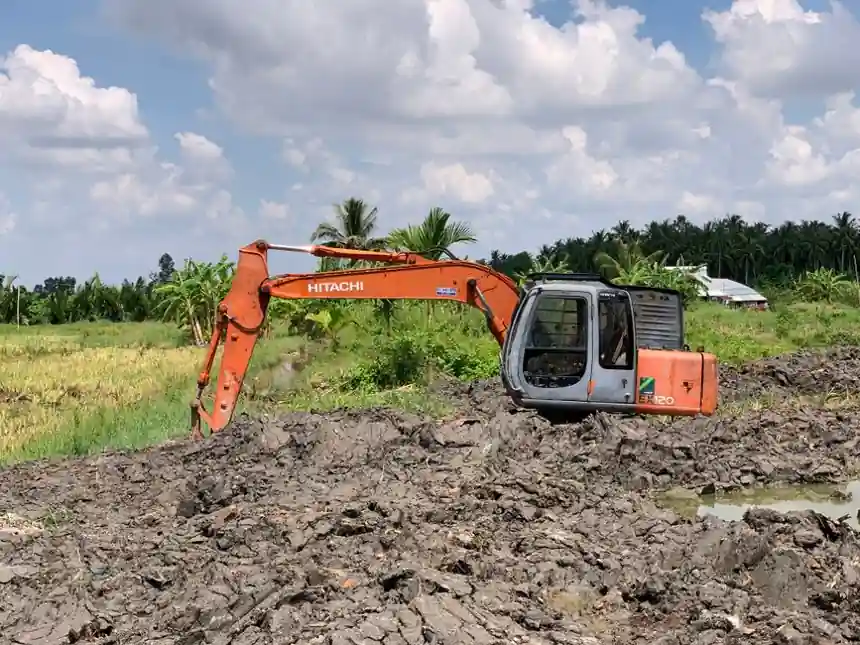
Excavator piston pumps in the 1–10 ton class typically run at 2,000–2,500 psi during normal work cycles, with boost circuits pushing to 5,260 psi for 10–15 seconds on heavy lifts [S2]. Piston designs such as the Rexroth-Uchida AP2D line can reach 42 MPa (6,091 psi) with up to 98% volumetric efficiency, well above the ceiling for gear or vane units [S5].
Flow rate, measured in L/min or GPM, sets actuator speed, while pressure sets actuator force. An excavator hydraulic circuit has to balance the two, because driving one parameter harder trades the other off under fixed input power [S1].
Operating Pressure Bands by Machine Class
Working pressure on a standard excavator settles between 2,000 and 2,500 psi for normal dig, lift, and swing functions [S2]. Compact 1-ton machines use gear pumps rated at 3,130–3,555 psi, while larger excavators rely on piston pumps pushing beyond 4,980 psi [S2].
Boost pressure, active for roughly 10–15 seconds at a time, peaks at 5,260 psi (≈380 bar) on compact and mid-size models, giving the extra breakout force needed for hard ground or heavy lifts [S2]. Sustained boost operation damages seals and hoses, so relief-valve setting typically sits 150–300 psi above working pressure to keep a safety margin [S4].
Flow Rate, Displacement, and Actuator Speed
Flow is the volume a pump moves per minute: Q (L/min) = displacement (cc/rev) × speed (RPM) × volumetric efficiency [S4]. In fixed-displacement circuits, pump speed and flow scale together, and a higher GPM number directly speeds up cylinder rod travel and motor RPM [S4].
A motor with 3 CID (≈49 cc) displacement turning at 1,000 RPM needs 3,000 cubic inches of oil per minute, equal to about 13 GPM after dividing by 231 in³/gal [S4]. That same 13 GPM stream should ride through 5/8-inch working hose, 3/4-inch return hose, and 1-1/4-inch suction line to keep oil velocity inside the 4–20 fps rules of thumb for pressure, return, and suction lines [S4].
Pump Type Comparison for Excavator Service

Gear, vane, and piston pumps each cover a different niche. Gear units are cheap and quiet but lose efficiency above ~3,000 psi; vane pumps handle medium pressure and tolerate viscosity swings; piston pumps dominate excavator duty because they sustain the 4,000+ psi working range and stay efficient at high load [S5]. The hydraulic pump article background confirms the same family split for general construction machinery and equipment duty cycles.
For sizing a 20–30 ton class machine, the matched-flow output has to feed swing, arm, boom, and an auxiliary circuit simultaneously, so the pump bank is usually two variable piston units plus a fixed pilot pump. Pumping the full hydraulic system is a balance between the engine power curve and the combined demand of all actuators working at once [S1].
Pilot Pressure and Control Loops
Pilot pressure runs the joystick and pedal logic, held at roughly 400–500 psi on most modern excavators, including the VOLVO 200 series reference design [S2]. This low-pressure circuit lets a few pounds of hand force shift the big spools that meter the high-pressure main flow, which is why pilot-pump output must be confirmed before chasing any swing or arm complaint.
The hydraulic motor displacement vs torque sizing rules are a useful second read for matching motor output to pump flow, because a mis-sized swing motor will starve or overspeed before the main pump ever shows a problem on a gauge.
Sizing Rules and Common Failure Modes
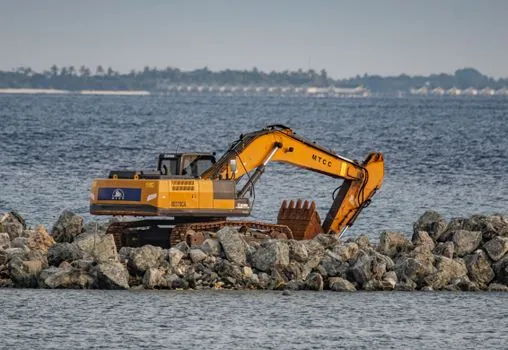
To stay inside safe operating limits, relief valves are commonly set 150–300 psi above the rated working pressure; for a 2,500 psi system that means a relief near 2,650–2,800 psi [S4]. Running too long above 80°C thins the oil, accelerates seal wear, and causes internal pump leakage that drops volumetric efficiency long before a catastrophic failure [S2].
Fluid-change intervals on excavator hydraulic circuits land at 2,000–4,000 hours, and contaminated oil is the single biggest reason piston pumps lose their high-pressure rating well before the published service life [S2]. Undersized hoses compound the issue: a 1/2-inch line where a 5/8-inch line is needed raises oil velocity above 21 fps and burns extra input power as heat [S4].
Application Fit and Sourcing Signals
Piston pumps in the Kayaba PSVD, Nachi PHK/PVD, Kawasaki K3SP, and Rexroth-Uchida AP2D families are the proven fits for 1–10 ton excavator hydraulic systems [S5]. AP2D units in particular push to 42 MPa with up to 98% volumetric efficiency, making them the go-to swap for rebuilds on mid-size machines running hot at 4,000+ psi duty cycles [S5].
Trackable signals for spec work: published maximum pressure on the nameplate versus real measured working pressure, oil-temperature trend under load, and pump noise profile after warm-up. The single most cited failure mode on a worn unit is the combination of low working pressure plus hot oil, which usually points to internal pump leakage rather than a valve or cylinder fault [S2][S4].