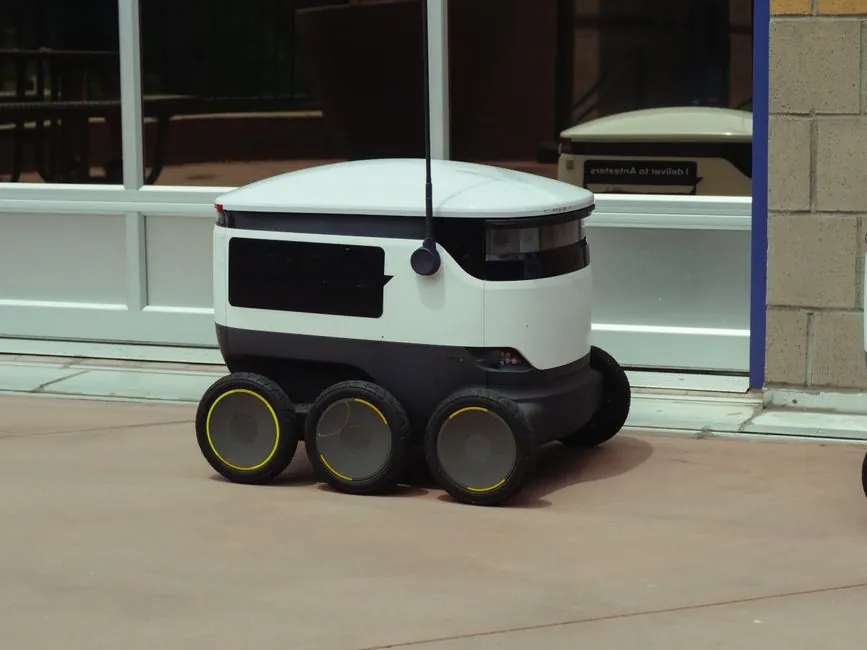
ISO 3691-4:2023 is the international safety standard whose scope names "automated guided vehicle" and "autonomous mobile robot" as examples of driverless industrial trucks, per the ISO catalogue entry [S1][S2].
AMRs and AGVs both fall in scope regardless of navigation method, so a tape-guided tugger and a free-navigating AMR are treated identically when they perform truck functions such as towing, carrying, or lifting loads [S3].
What the standard covers on an AMR
The 2023 edition of ISO 3691-4 runs 82 pages across six sections and five annexes, and sections 4, 5, and 6 carry the enforceable design, verification, and information-for-use requirements [S5].
Section 4 codifies safety-related design: prohibited sharp edges, ground clearance rules that prevent foot entrapment, obstacle detection and avoidance logic, safety-bumper geometry, and E-stop placement [S5]. Section 5 sets out the verification methods, including the "Test for the Detection of Persons" used by OEMs and third-party auditors to validate that a robot reliably senses a human in its path [S5]. Section 6 fixes the instruction-manual contents, listing required PPE, maximum speed, slope, capacity, and intended environmental conditions the integrator must respect [S5].
How ISO 3691-4 fits alongside ISO 13849-1 and IEC 61496
ISO 3691-4 is not a standalone document; it explicitly points to ISO 13849-1 for the performance level (PL) of safety-related control functions, and to IEC 61496 for electro-sensitive protective equipment such as safety laser scanners [S3].
Personnel-detection functions are typically engineered to PLd under ISO 13849-1, with redundant controllers, fault detection, and independent monitoring, which means the AMR's safety logic must be designed as a two-channel architecture rather than a single safety CPU [S4]. Safety laser scanners that meet IEC 61496 type 3 or type 4 are the most common way the standard's "Test for the Detection of Persons" is satisfied in practice, though the standard itself does not mandate a specific device [S3][S5].
Zones, speed limits, and protective fields

ISO 3691-4 organizes the shared workspace into zones with explicit behavior: an operating zone with full detection and restart protocols, a restricted zone with speed-limited operation and warning signals, and a confined zone relying on physical barriers and interlocks [S4].
The 2020 edition of the standard was a major rewrite of the earlier EN 1525 guideline, turning it into a full safety architecture with zone management, protective fields, and speed supervision built in [S4]. A typical protective field around a moving AMR is sized using a combination of the robot's stopping distance, the scanner's measurement error, and a margin for floor conditions; the Fabrico field-sizing example uses those three inputs as the basis for the minimum detection distance required by the standard [S3].
ISO 3691-4 vs ANSI/RIA R15.08 vs B56.5
ANSI/ITSDF B56.5 was the historical U.S. AGV standard, but ISO 3691-4 has effectively displaced it for intelligent mobile robots (IMRs) and is increasingly demanded by U.S. buyers for its stricter provisions [S4][S7]. ANSI/RIA R15.08 is the U.S. companion standard split into three parts: R15.08-1 base robot requirements, R15.08-2 system integration and traffic management, and R15.08-3 application-specific requirements such as environmental and safeguarding strategies [S4].
Three standards now divide the global mobile-robot safety map. B56.5 is suitable for legacy AGVs in the U.S. [S8]. ISO 3691-4 covers AGVs and most AMRs globally and is the only one harmonized under the EU Machinery Directive [S3][S8]. R15.08 governs Industrial Mobile Robots in North America with a finer four-tier severity scale (S1 minor, S2 reversible, S3 permanent, S4 fatal) instead of the simpler S1/S2 model in ISO 13849-1 [S4][S8]. For an AMR that performs truck functions, ISO 3691-4 is the common denominator; an integrator deploying the same robot in the U.S. will often layer R15.08 on top, while in Europe the EN ISO 3691-4 harmonized version delivers a presumption of conformity under the Machinery Directive [S3][S4].
CE marking, the Machinery Regulation, and integrator responsibility
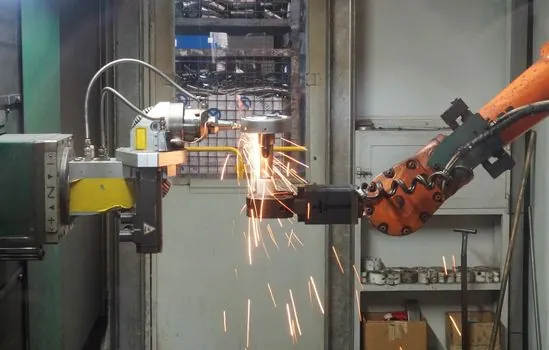
Driverless trucks placed on the EU market are machinery and must carry CE marking, with the EN version of ISO 3691-4 harmonized under the Machinery Directive 2006/42/EC and providing a presumption of conformity with the relevant essential health and safety requirements [S3]. From 2027 the Machinery Regulation (EU) 2023/1230 replaces that directive, with explicit attention to autonomous mobile machinery as a category, which tightens the documentation chain for AMR manufacturers [S3].
Responsibility is split between manufacturer and integrator: the OEM certifies the truck against ISO 3691-4, while the operating company owns the site-specific risk assessment for routes, zones, and shared spaces, typically structured with FMEA and HAZOP [S3]. The 2025 update to ISO 10218 explicitly defers mobility behavior in mobile manipulators to ISO 3691-4, so a robot arm mounted on an AMR inherits the 3691-4 zone and detection logic instead of being judged only against the manipulator standard [S4].
What ISO 3691-4 does not cover
The standard excludes a defined list of hazards, and integrators are expected to layer additional standards on top: noise, vibration, ionizing or non-ionizing radiation, operation in explosive atmospheres, operation on public roads, military environments, transport of hazardous loads such as molten metals or strong acids/bases, and trailers towed behind the truck [S5].
That exclusion list matters when an AMR is repurposed for a job it was not designed for; for example, an AMR that handles molten metal in a foundry needs ATEX or IECEx evaluation on top of ISO 3691-4, and a unit that tows a public-road trailer needs road-vehicle homologation that the standard does not provide [S5]. Buyers evaluating AGV robot fleets should therefore treat ISO 3691-4 as a floor, not a ceiling, and ask the OEM which adjacent standards were applied for the specific duty cycle. The standard's instruction-manual requirements under section 6 also make the integrator's residual risk visible: if the OEM manual is thin, the standard's checklist is the leverage to demand more [S5].
Risk assessment and verification on the integrator's side
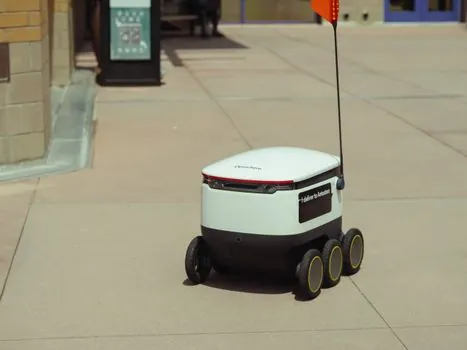
Risk reduction on a deployed AMR follows the same hierarchy used across ISO 12100: elimination by design, then substitution and engineering controls, then protective devices, then administrative controls, and finally validation and continuous improvement [S4].
R15.08-1 formalizes the hazard set the integrator has to walk through: intentional interactions (teaching, loading, tool change), unintentional interactions (pedestrian safety, path conflicts), environmental hazards (floor grates, tight corners), failure modes (loss of localization, control-system faults), and foreseeable misuse (unauthorized software changes, operator errors) [S4]. For fleet-level deployments, the additional concerns are coordinated E-stop response, traffic orchestration across robots, and compatibility with the customer's fleet manager, all of which ISO 3691-4 touches but does not fully prescribe [S4][S6]. A practical audit will trace each AMR's safety case back to a specific clause in section 4 of the standard, a PLd claim under ISO 13849-1, and a documented test record from section 5 [S3][S5].
The most common audit failure mode is treating the OEM's CE file as sufficient evidence; in practice the integrator must produce its own site-specific verification, because the OEM only certifies the truck in its tested configuration. A second near-universal miss is sizing protective fields from the AMR's nominal stopping distance without adding the scanner's measurement error and a margin for wet or dusty floors, which is the exact failure the standard's "Test for the Detection of Persons" is built to catch [S3][S5]. Track these two signals on every new site: the integrator's own verification report number, and the dated field-sizing calculation that supports the configured protective distance.
The underlying component specifications are covered under mobile crane, and pressure transmitter.
Related analysis: Borescope DoF and 90° vs 120° FOV: how to pick the right optical tip.