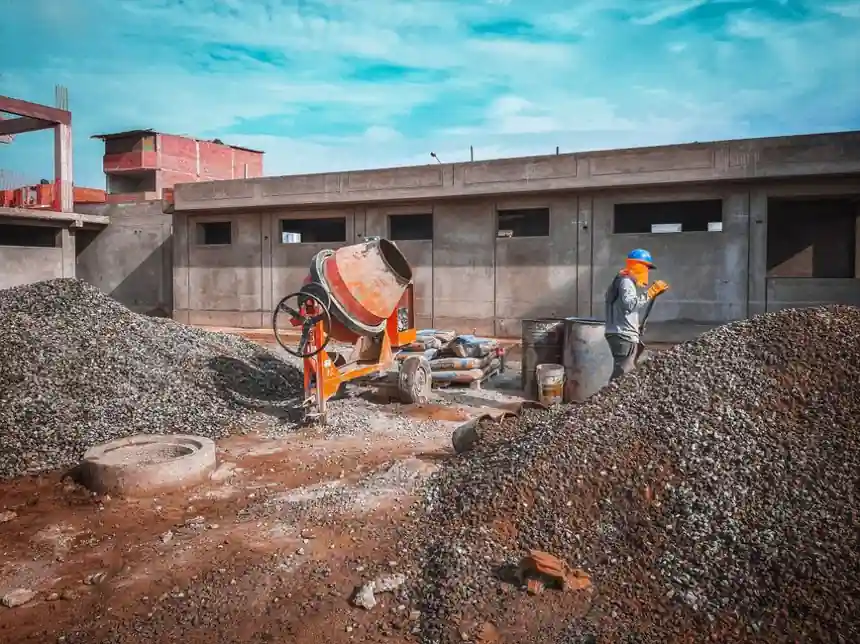
A pitless truck scale, by definition, sits flush with the surrounding grade and is therefore built on a slab foundation, not a pier foundation. The classification is structural: pitless means the driver drives onto a platform that is level with the ground rather than onto an elevated deck supported on discrete piers, so the load path goes through a continuous concrete mat [S6].
The three foundation families used under truck scales are pier, floating slab, and pit, and the slab option breaks out into two variants: a beam-slab (deep foundation beams) and a true monolithic floating slab [S2][S3]. Minnesota's Weights and Measures rule 7601.4010 codifies this by defining separate "concrete pier foundation" and "floating concrete slab foundation" categories for aboveground scales, with no overlap [S1].
Why a Pitless Scale Cannot Use a Pier Foundation
Pier foundations hold the weighbridge at deck height above the ground surface using reinforced concrete columns under each load point, with the surface slabs between piers poured independently and graded to shed water [S1][S2]. A pitless (flush) scale cannot use that geometry because the deck elevation is, by definition, at grade: there is no air gap to span between piers, and a raised weighbridge would create a 6-12 in. driving lip that defeats the purpose of the pitless layout [S1][S6].
Pier construction is also coded for aboveground scales that need under-deck access for cleaning, inspection, and freeze-line protection. Minnesota rules require pier foundations to extend below the local frost line, slope the inter-pier slabs for drainage, and maintain a minimum 6 in. clearance between the bottom of the weighbridge and the slab surface for vehicle scales [S1]. None of those conditions apply to a flush deck, which is why a pier is mechanically and legally wrong for a pitless installation. For a broader look at the truck scale equipment family that sits on these foundations, the platform-to-foundation relationship is the key selection filter.
What the Slab Foundation Must Look Like
A floating slab for a pitless scale is a monolithic, reinforced concrete mat at least 12 in. thick, poured on a uniform, compacted, permeable aggregate base at least 24 in. deep [S1]. The soil below must deliver a uniform natural or engineered bearing capacity of at least 1,500 PSF, which is the floor for legal-for-trade vehicle scale foundations and roughly half the 2,500-3,000 PSF that pier foundations typically demand [S1][S2].
The top of the slab must be installed above the surrounding grade so water flows away from the foundation and away from the permeable aggregate base; the weighing elements are grouted and bolted to this continuous mat, the same anchor rule that governs all three foundation types [S1]. Rice Lake's foundation guide notes the slab is generally stronger than a pier layout but more vulnerable to frost heave, which is why beam-slab variants add deep foundation beams under the load points for cold-climate sites [S2][S3]. For a deeper look at how the foundation vehicle class interacts with site prep, the slab choice is essentially a soil-bearing and frost-line decision.
Pitless Slab vs Pit Foundation: Direct Comparison
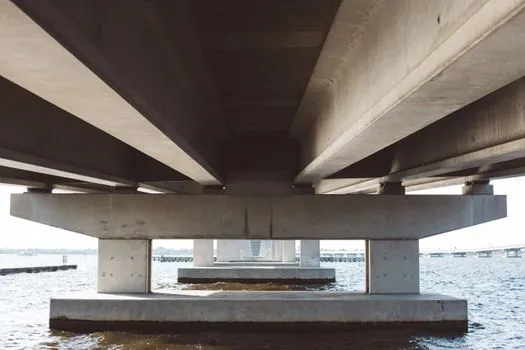
The four decision criteria that matter most are cost, corrosion risk, service access, and site footprint, and the slab wins three of four against the pit: [S2]
Cost: a pitless slab needs less excavation, less rebar, and less concrete than a flush pit wall, because there are no pit walls, footings, or 48 in. under-deck clearance to build [S1][S2]. Corrosion: pit foundations sit in a basin that traps standing water and accelerates rust on the under-deck structure; the pitless slab keeps the under-deck area open to air and drainage, so the weighbridge and load cells stay drier over a 20-30 year service life [S2]. Service and clean-out: a pit requires confined-space entry, gas detection, and harnesses for technicians, plus manual "bucket by bucket" debris removal; a pitless slab is hosed or air-blown from the side and inspected by walking the perimeter [S2]. Site footprint: a pitless slab can use a shorter approach because no ramps are required, and the surface is flush with the surrounding yard, which is why ACC Scale's 2026 site-selection guide treats slab as the default pitless option [S2][S6]. The pit wins only where the site is so constrained that approach length is the binding constraint, since pit installations are shorter end-to-end than aboveground ramps [S2].
When a Pier Foundation Is the Correct Choice Instead
Pick a pier foundation when the truck scale is an aboveground deck, not a pitless flush installation. Shallow piers are the least expensive option and are well-suited to warmer climates without frost-heave risk, while deep piers are placed partially below the frost line in cold regions to isolate the structure from freeze-thaw movement [S2][S5]. Pier sites need 2,500-3,000 PSF soil bearing, higher than the 1,500 PSF floor for slabs, because the load is concentrated on fewer bearing points [S2].
A pier foundation is also the right call when the operator needs under-deck access for washdown, when the deck height doubles as a weather break, or when the weighbridge must be replaced on existing pier footings. Replacement is straightforward when the new scale matches the existing foundation dimensions, but legacy low-profile pits and beams often force a custom replacement or a low-profile model like Rice Lake's OTR-LP that fits common existing foundations [S4]. A flush pitless scale, by contrast, has no under-deck void, so under-platform brush seals and perimeter air-seal details used on other equipment, such as the dock leveler perimeter brush seal sizing spec, do not apply.
Limits, Failure Modes, and Spec Boundaries
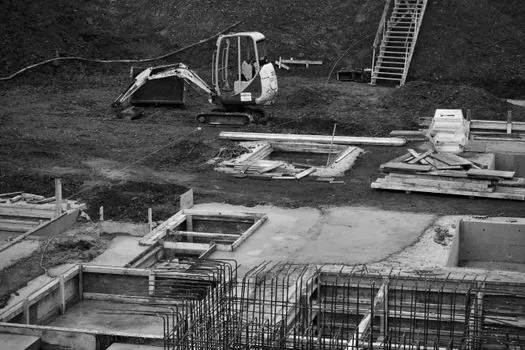
The slab foundation fails when the soil cannot hold 1,500 PSF uniformly, when the aggregate base is contaminated with fines and loses permeability, or when the slab is poured at or below grade so water ponds against the perimeter [S1]. Drainage is the dominant failure mode: standing water in the aggregate base pumps fines into the slab and erodes bearing, which is why the rule demands a permeable aggregate base of at least 24 in. and a slab surface that is above surrounding grade [S1].
Beam-slab variants trade that weakness for cold-climate tolerance, but the beam excavation still has to clear the local frost line or the entire mat will heave; the same frost-line requirement that forces piers below the frost line applies to any monolithic slab in a freeze zone [S1][S3]. In practice, the slab is the right call only when the soil report confirms uniform 1,500 PSF bearing, the site can be graded to drain, and the operator accepts a flush deck that is harder to snow-plow around in winter [S2][S6]. Where any of those conditions fails, the decision flips to a pier foundation on an aboveground deck, not to a pit. A separate spec, the mechanical dock leveler spring tension adjustment procedure, shows how other load-bearing equipment also relies on the same "match foundation to deck geometry" logic.
Sourcing and Standards Anchors
The benchmark regulatory text is Minnesota Rules 7601.4010, which separates aboveground scales into "concrete pier foundation" (Subpart 3) and "floating concrete slab foundation" (Subpart 4) and fixes the 12 in. slab thickness, 24 in. aggregate base, 1,500 PSF soil bearing, and the frost-line extension for outdoor piers [S1]. The 2026 ACC Scale site-selection guide re-states the slab option as the default pitless foundation and frames it as flush-to-grade by design [S6].
Rice Lake's 2025 foundation article provides the pier-vs-pit service comparison and the 2,500-3,000 PSF pier bearing target, and American Scale's 2020 type guide confirms the three-family taxonomy (pier, beam slab, pit) still used across the industry [S2][S3]. Track these two signals over the next planning cycle: state Weights-and-Measures rule revisions to 7601.4010's slab and pier subparts, and any manufacturer updates to beam-slab reinforcement details for frost-line sites, since those two changes will move which foundation a pitless spec defaults to in cold regions.
Detailed specification references: dump truck.