
Jib crane selection is driven by four numeric gates: working load (50–1,000 kg typical for pillar and wall-mounted units), arm span (2–5 m), rotation degree (270°, 300°, or 360°), and hoist speed (commonly 16 m/min for the electric models now in catalogue) [S2].
Pillar-mounted, wall-mounted, and free-standing modular jibs cover roughly 90% of workshop duty; articulating jibs serve the remaining 10% where a building column, machine, or low ceiling blocks a straight radial sweep [S1][S3]. For a buyer's first filter, the choice between a pillar jib crane and a wall bracket comes down to floor plate area, foundation work, and whether the swept arc must reach around a fixed obstacle.
Capacity and Span: The 50–1,000 kg / 2–5 m Working Envelope
COMEGE's PFSAM pillar jib crane catalogues a 50–1,000 kg (110–2,205 lb) working load range across 2 m, 3 m, 4 m, and 5 m spans (6'06", 9'10", 13'01", 16'04") with 300° rotation and articulated geometry [S2]. The 1,000 kg upper limit is consistent with light-duty workshop jibs, while anything above 5 t typically shifts the buyer to a gantry crane or overhead bridge crane instead [S4][S7].
Theoretical deflection under nominal load on the PFSAM is given as approximately 1/250th of the span plus height, capped at 1/100th of the span itself; this is a useful sanity check when comparing hollow-section vs. overbraced jib geometries [S2]. Buyers specifying tighter deflection (e.g. for vacuum-lift or precision-loading cells) should look at the PFTC ALU overbraced aluminium hollow-section variant, which is built to keep the boom lighter and stiffer [S2].
Mount Type Decision: Pillar vs. Wall vs. Free-Standing vs. Articulating
Four mount families dominate the 2026 catalogue space. Pillar (column-mounted) jibs require a foundation base plate and chemical anchor kit, give 270°–300° rotation depending on model, and cannot be motorized in the articulated PFSAM configuration [S2]. Wall-mounted jibs save floor space but transfer full moment into the host column or wall bracket, so the substrate must be rated. Free-standing Gorbel-style jibs use a mast braced back to the floor for high-cycle heavy-duty work without a building column [S3]. Articulating jibs (PFSAM, PFA, PFAM) use two arms with separate rotation joints, reaching 350° on arm 1 and 300° on arm 2, ideal for folding around machinery [S2][S3].
A practical decision rule: choose pillar for greenfield floor with foundation budget; wall for retrofit where the column can take the moment; free-standing for high-cycle workstations needing 360°; articulating when an obstacle sits inside the swept arc [S2][S3]. For a side-by-side comparison, see the criteria table below.
Rotation Degree and Hoist Options: 270°, 300°, 360°, and 16 m/min
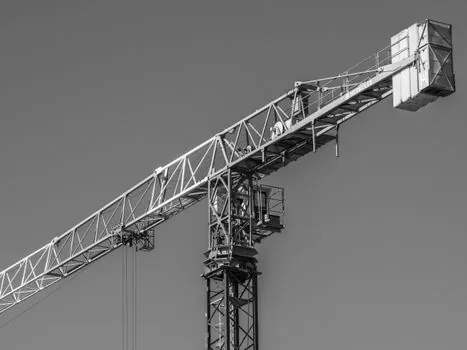
Standard pillar jib rotation is 270° in most models (PFT, PFI, PFICL, PFTCmob) [S2]. The 300° figure appears on the PFSAM articulated line and the PFA family, while 360° free-standing units are sold as "full rotation" work-station jibs [S2][S3]. Maximum hoisting speed on the PFSAM is 16 m/min, with manual or electric hoist options and a lockable main switch as standard [S2].
For higher duty classes (FEM 2m, 3m, 4m) or faster cycling, buyers should step up to motorized rotation jibs, which are designed from the ground up as motorized products rather than retrofits [S3]. Pneumatic pillar jibs (PFTL 270°) are available for ATEX-classified or spark-free environments, and hydraulic height-adjustable manual units (PFSD) cover ergonomic workstation lifts [S2].
Surface Protection, Finish, and Corrosion Gates
Standard protection on the PFSAM is polyester powder painting at 60 microns, C2 corrosion category, in RAL 1028 yellow [S2]. For outdoor, wash-down, or coastal sites, hot-dip galvanizing is offered as an upgrade on the same product line [S2]. C2 is appropriate for dry indoor atmospheres with low pollution; C3 and C4 environments (humid, coastal, light industrial) require either a thicker powder coat, galvanized finish, or stainless hardware depending on the spec [S2].
Buyers should also confirm that any third-party jib (Chinese or otherwise) is offered with documentation against the relevant crane design standard. Yuantai, for example, lists CE/ISO/EX compliance on its single-girder, double-girder, and jib crane lines covering 1 t through 550 t [S7]. Capital Cranes & Hoists in Australia also flags custom manufacture to local lifting-equipment codes for heavy-duty service [S5].
Duty Class, Deflection, and Field Spec Gates

Selection does not stop at capacity. The Maximum Moment (MM) is a rough guide under nominal load, and deflection under that load should stay within roughly 1/250 of span + height, not exceeding 1/100 of the span alone on the PFSAM geometry [S2]. For precision work, look for servo-driven bridge cranes with repeat positioning accuracy on the order of 1 mm using rack-and-pinion and linear guide drives, a spec range several jib families cannot match and a sign to step up to a bridge or gantry instead [S8].
For underground or tunnel-lift scenarios, truck-mounted crane selection follows a different spec gate map than stationary jibs, and the two should not be conflated. Buyers in process plants running high-cycle picking should also confirm FEM/ISO duty class (often C2D or C3M for jibs) and verify the hoist's starts-per-hour rating, not just peak load.
Who Should NOT Buy a Standard Pillar Jib
A standard 270° pillar jib is the wrong pick when the swept arc must reach three or more workstations arranged in a U-shape around a fixed machine, when the host floor cannot take a chemical-anchor foundation, or when the building column is structural steel not rated for the full overturning moment [S2][S3]. Buyers in this situation should look at articulating jibs (PFA, PFAM), free-standing mast jibs, or a gantry crane running on a floor rail. For very light tooling or vacuum-lift duty, the Gorbel Pivot Pro or Tool Solutions jib is the lighter, less expensive alternative to a 1,000 kg pillar unit [S3].
Buyers specifying above 5 t, above 5 m span, or in ATEX/IECEx Zone 1 or 2 should step out of the standard jib catalogue and into explosion-proof overhead or mobile crane territory, where the design, certification, and price band are different. The same applies to any installation requiring continuous duty above FEM 2m, where bridge or gantry cranes are a better match than articulated jibs.
Shortlist Logic: From Spec Sheet to PO

A defensible shortlist in three steps: first, fix capacity and span from the heaviest regular load (not peak); second, choose mount type from floor and column conditions, picking 270° pillar for the simplest case, 300° articulating when an obstacle sits inside the arc, and 360° free-standing for high-cycle workstation duty [S2][S3]; third, lock the finish and hoist option to the environment (C2 polyester for dry indoor, hot-dip galvanized for outdoor or wash-down, pneumatic for spark-free zones) [S2]. Confirm that deflection stays inside roughly 1/250 of span + height, and that the supplier can ship CE/ISO/EX documentation if the site requires it [S7].
Trackable signals to watch before issuing the PO: (1) whether the supplier confirms FEM/ISO duty class in writing, not just peak load, and (2) whether chemical anchor kit and base plate are quoted as a matched set for the local floor slab thickness. For a wider heavy-lift comparison including gantry crane selection and overhead bridge options, the spec gate map differs in span and duty but follows the same capacity, rotation, and protection logic outlined above [S4][S5][S7].