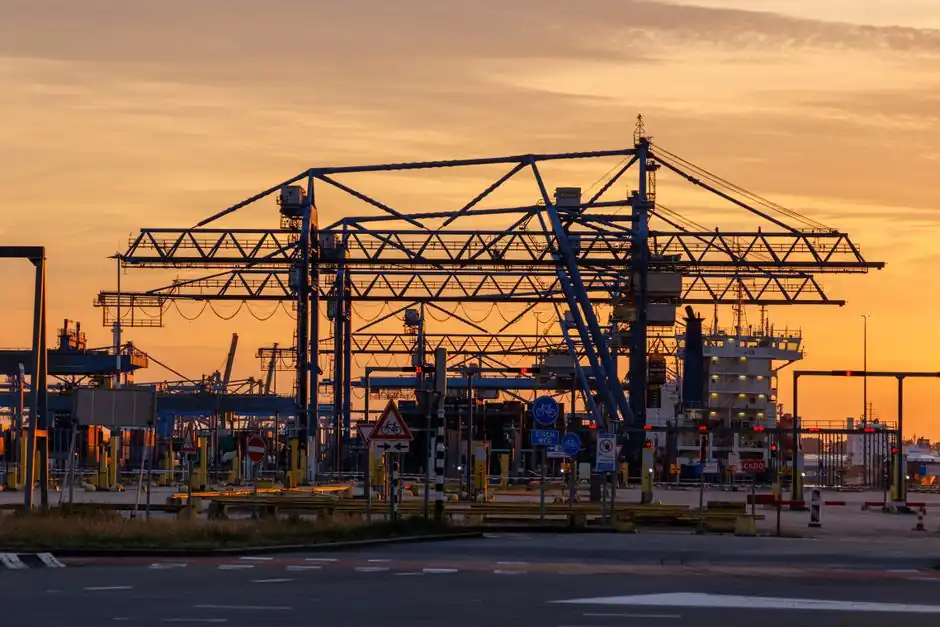
Gantry crane selection turns on five hard gates: rated capacity, span, lift height, FEM/ISO duty class, and power/control architecture; every other spec is downstream of those five [S1][S2][S8]. For 2026 sourcing runs, Chinese OEM catalogues list 0.5-10 t single-girder units from US$320-3,800 per piece and 32 t double-girder yard cranes at US$15,000-75,000 per set, with 1-550 t full-range coverage across Henan Mine, Yuantai, Weiying, and Nante lines [S4][S6][S8]. Buyers specifying rubber-tired gantry (RTG) or rail-mounted gantry (RMG) container handlers should expect a separate electrification decision: cable reel, busbar, battery-hybrid, or full diesel-to-electric conversion, each with distinct ROI and infrastructure profiles [S2].
The reference frame is industrial, not residential: a gantry crane is a ground-supported, wheeled or rail-borne lifting structure with its own A-frame legs and end trucks, used where an overhead building runway is absent, uneconomical, or has to be mobile. Single-girder and double-girder are the two structural branches; portal, semi-portal, truss, and box-type are the leg/boom variants that fall out of those branches [S1][S5]. Inside a gantry, the linear guide on the trolley and the crossed roller guide on the slewing joints are the precision elements that determine how cleanly the hook tracks under partial load.
Variant Map: Single-Girder, Double-Girder, Truss, Box, and Mobile Gantry
The 2026 OEM line-up converges on six physical variants, each with a different capacity/span envelope. Single-girder gantries dominate the 0.5-20 t light-duty segment with spans commonly 5-30 m and self-weight roughly 30-50% of an equivalent double-girder unit, making them the default for machine shops and small stockyards [S1][S8]. Double-girder gantries take over from 16 t upward, with 32 t yard cranes explicitly listed in the Made-in-China 2026 catalogue at US$15,000-75,000 per set, and heavy double-girder bulk-loading units at US$15,000-56,000 per set for open-air material handling [S4].
Leg topology splits into box-type (welded steel plate, higher stiffness, preferred for heavy/dynamic duty) and truss-type (lighter, lower wind load, preferred for tall outdoor lifts and crane-hire fleets) [S5]. Mobile variants include rubber-tired gantry (RTG) for container terminals, rail-mounted gantry (RMG) for fixed-path container and steel-coil yards, and portable/Adjustable gantries for workshop jobs under 10 t. For a one-station outdoor lift where the crane never has to travel, a mobile crane is sometimes the wrong tool: a wheeled gantry with rails or pinned feet gives better hook repeatability and lower tire wear than driving a telescopic truck crane in for each lift [S1][S5].
Duty Class, FEM/ISO Mapping, and Cycle Calculation
FEM 1.001 / ISO 4301 duty classification is the single most common spec gate that buyers skip and then pay for in premature structural fatigue [S2]. The FEM 9.511/ISO 4301 pair rates cranes by load spectrum (light, medium, heavy) and hours of daily operation, producing classes A1-A8 (FEM) or M1-M8 (ISO); a single-girder workshop crane picking one load per hour is typically FEM A3/A4, while a precast yard running two shifts lands at FEM A6/A7 [S2]. The 2026 Nante Crane engineering guide lays out a four-step cycle calculation: count load events per hour, multiply by average load/safe working load to get the load spectrum factor, then cross-reference with daily operating hours to land on the correct FEM/ISO class before selecting hoist and motor size [S2].
Misclassification shows up as hoist motor overheating, brake wear, and end-truck wheel spalling well before the design 25-year service life. Buyers should request the duty class on the nameplate and the calculation sheet, not just the maximum safe working load (SWL). For a yard handling steel coils at 25 cycles/hour, two shifts, FEM A6 minimum is the realistic floor; specifying A4 to save 5-8% on hoist cost is a known failure pattern in 2024-2026 field service reports [S2].
IP Rating, Motor Enclosure, and Outdoor Duty
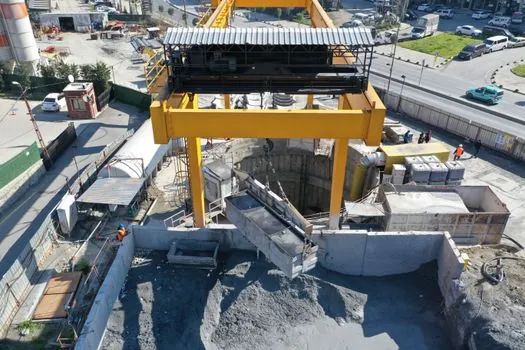
Outdoor gantry service forces an IP rating decision that indoor cranes can usually defer. Nante Crane's 2026 motor IP guide positions IP55 (dust-protected, water-jet resistant) as the default for sheltered outdoor use and IP65 (dust-tight, water-jet resistant) as the minimum for open-yard, wash-down, or coastal installations, with the IP65 step typically adding 3-7% to motor cost and meaningfully longer bearing life in salt-fog environments [S2]. This is a direct port-logistics concern, which is why a related port-shuttle spec gate map treats salt-fog, vibration, and load-securing as parallel filters to IP rating.
For coastal container terminals and steel-coil yards, IP65 on hoist and trolley motors plus stainless or hot-dip galvanized cable sheaves is the de-facto 2026 standard. VFD panels should sit in IP54 cabinets with filtered cooling, since salt-laden air drawn into an IP20 panel is a top-three field failure cause in 2024-2026 warranty data [S2]. Buyers in tropical and offshore wind-logistics sites should also consider tropicalized motor windings and corrosion-resistant pendant cables; both are line items, not options, on the better OEM quotations.
Power Supply: Cable Reel, Busbar, Battery, or Diesel
Power architecture is a four-way decision, and on RTG container handlers it is the single largest cost variable after the steel structure itself. The 2026 Nante Crane electrification guide lays out the four paths: cable reel (lowest capex, suited to short travel distances under 200 m, vulnerable to cable wear on long traverses), busbar (medium capex, suited to fixed-path RMG yards with consistent traffic, very low maintenance), battery-hybrid retrofit (mid capex, suited to RTG fleets on 8-12 hour duty cycles with midday opportunity charging), and full diesel-to-electric conversion (highest capex, best ROI on RTG fleets running 16+ hours/day) [S2].
For a 32-50 t precast yard gantry running 6-8 hours/day on a fixed rail, busbar is the 2026 default. For an RTG container terminal running 20+ hours/day, the diesel-to-electric conversion payback in 2024-2026 evaluations sits in the 2-4 year range once diesel fuel, DEF, and Tier 4 aftertreatment service are counted [S2]. Buyers should ask vendors for a side-by-side 10-year TCO sheet that includes cable replacement, busbar brush wear, battery replacement at year 7-8, and energy unit costs; a vendor that will not produce one is signalling that the electrification economics do not close on its preferred architecture.
Control Architecture, Safety, and Smart-Crane Cybersecurity

Control architecture is now a 2026 spec gate in its own right, not a checkbox. Three architectures are in play: contactor-relay (lowest cost, suited to FEM A1-A3 light duty), PLC + VFD (the de-facto 2026 standard for FEM A4 and above, with anti-sway, load limiting, and zone protection baked in), and PLC + VFD + IoT gateway (for fleets where the OEM or operator wants remote monitoring, predictive maintenance, and over-the-air fault logging) [S2]. PLC-based panels are typically 15-30% more expensive than relay logic at the same duty class, but the spare-parts and troubleshooting cost advantage over a 10-year horizon reverses that ratio in the buyer's favour for any crane above FEM A4 [S2].
Once an IoT gateway is in scope, cybersecurity stops being optional. The 2026 Nante smart-crane guide lists five mandatory controls: network segmentation between the crane VLAN and the plant LAN, role-based access control on the HMI, VPN-only remote access (no port-forwarding), encrypted backups of PLC logic with a tested restore procedure, and centralized logging of all remote sessions [S2]. Buyers should reject any quote that ships the gateway with default credentials or that exposes the HMI web server on the plant LAN; both are 2024-2026 incident patterns in industrial-CNC and crane deployments.
Who Should NOT Buy a Single-Girder, and When to Go Custom
Single-girder gantries are the wrong choice in three common scenarios: lift heights above ~12 m where the hoist must sit on a high-profile trolley and hook approach suffers, capacities above 20 t where the girder section size forces impractical shipping splits, and outdoor heavy-cycle duty where end-truck fatigue dominates the maintenance budget [S1][S8]. In all three, a double-girder or box-type heavy gantry is the correct call, even at 30-50% higher first cost. Custom design (versus pre-engineered) is justified when span, capacity, lift height, or duty class falls outside the OEM standard table, or when the site has non-standard rail gauge, cantilever extension, or special interface to a workstation [S3].
For OEM sourcing in 2026, the shortlist logic is straightforward: lock the five hard gates (capacity, span, lift height, FEM/ISO class, power/control), discard any line that does not publish a nameplate duty class, and require IP65 or better on any outdoor unit. A crawler crane or truck-mounted crane is the better tool for short-term, long-reach, pick-and-move jobs; a gantry wins when the hook has to repeat the same trajectory thousands of times with low ground pressure and no setup cycle. Next signal to track: any 2026 Q4 vendor announcement of a 100+ t electric RMG with regenerative hoisting, which would re-baseline the busbar-versus-battery TCO for inland container depots [S2].