
For a rectangular building footprint, the working jib length is normally sized at 1.2 to 1.5 times the longest plan dimension of the structure, then validated against the crane's load chart, the required hook height, and any slewing obstruction zones [S7]. A crane selected on radius alone will under-deliver on tip capacity and lift height; both are coupled to jib length in the manufacturer's chart [S1].
Standard catalog jib lengths on common tower cranes run 131-262 ft (roughly 40-80 m), with maximum boom reach between 112 and 264 ft and maximum lift capacities from 4.4 to 35.3 US tons [S1]. Matching those three numbers against the project envelope is the entire selection problem.
Why coverage, not reach, drives jib length
Coverage means every pickup point the crane must serve lies inside the radius swept by the jib minus a safety margin for trolley travel, slewing, and outrigger swing [S7]. A crane on a single side of a 60 m by 30 m building therefore needs a minimum working radius of about 30 m plus offset, pushing jib length into the 40-45 m range; placing the crane inside the footprint allows a shorter jib but complicates the foundation [S4].
The NUS teaching reference frames coverage as a hard gate: the jib must reach 100% of the required building area before any other selection criterion is checked [S7]. On tight urban sites, luffing jibs trade a fixed horizontal arm for a variable-angle arm, which lets one crane cover a dense footprint without over-swinging neighbouring structures or sharing airspace with a second crane [S2].
Capacity and jib length are linked, not independent
Residential buildings typically need 5-8 t maximum capacity with 50-60 m jib length, while commercial buildings run 8-10 t and industrial or high-rise projects push above that, often with 60-80 m jibs [S6]. The 50-60 m residential band lines up with the 131-262 ft (40-80 m) catalog span on most hammerhead and flat-top models [S1][S3].
Capacity at the jib tip is the binding constraint, not the headline maximum. Every meter added to the jib reduces tip capacity because the load moment grows linearly with radius; a hammerhead with 70 m jib may still lift 10 t at 20 m radius but only 2.5-3 t at the tip [S1][S3]. For a fuller treatment of reading the load chart, see this load chart walkthrough.
Type-by-type coverage behaviour

Hammerhead (saddle jib) cranes give the widest horizontal coverage per meter of free-standing height, which is why they dominate mid-rise work from 12 to 40 stories where a trolley running along a fixed horizontal jib places loads precisely across a wide radius [S2][S3]. Flat-top variants deliver the same coverage with a lower head profile, useful where multiple cranes share airspace or an airport obstruction surface limits tip height [S2].
Luffing jibs reduce the swept radius during part of the cycle, so they cover a smaller working area than a hammerhead of equal boom length but fit congested sites where a fixed horizontal arm would over-swing a street or a neighbour [S2]. Self-erecting tower cranes (SETCs) are restricted to low-rise work, usually up to 10-12 stories, with shorter jibs matched to a compact site footprint and rapid setup [S3].
Selection criteria compared across the four types
The four main tower-crane types each score differently on coverage, height, airspace, and setup time, and a quick side-by-side makes the trade-off visible. The table below draws on Maxim's type comparison and Vertikal's height-band guidance [S2][S3].
Type; horizontal coverage; typical building height band; airspace impact; setup. Hammerhead (saddle jib): widest, fixed horizontal jib with running trolley; mid-rise 12-40 stories; high (long fixed arm); mobile assist crane required, multi-day [S2][S3]. Flat top (topless): same coverage as a comparable hammerhead, lower head; mid- to high-rise where shared airspace or overhead clearance matters; moderate, lower profile; quicker to erect than hammerhead [S2]. Luffing jib: variable radius via luffing angle, smaller swept area; high-rise 40+ stories and tight urban sites; low (jib raised between lifts); more involved setup [S2][S3]. Self-erecting: limited, fold-up jib; low-rise up to 10-12 stories; very low; hydraulic self-setup in hours, no assist crane [S2][S3].
Height, ties, and the second-axis constraint
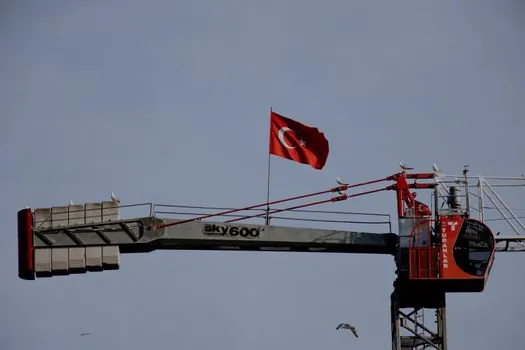
Jib length alone is only half the envelope. The crane must also reach the top of the structure under hook, and once free-standing height is exhausted the mast is tied back to the building, a topic detailed in this free-standing vs tied-in height field note. A long jib at the top of a tall mast amplifies overturning moment, so the foundation, tie spacing, and counter-jib ballast all have to be re-checked every time jib length grows [S4].
For very tall structures, mast seismic and rail-anchoring practice follows similar logic; see this stacker crane mast seismic and rail-anchoring field practice for the structural-side detail, even though the equipment class is different.
Fatigue and the lower-chord failure mode behind jib length
A tower-crane jib is not a static beam. The lower chord carries tensile stress from lifted loads and also acts as the running surface for the luffing trolley, so it sees sustained cyclic rolling contact loads on top of the bending cycle [S5]. Statistical data in that study put crane-related accidents at roughly 28.17% of all special-equipment accidents, with a 27.54% fatality rate, and a significant share traced to fatigue of critical load-bearing components such as the jib lower chord [S5].
Pin-connected segmental jibs (six segments b01-b06 in the reference study) concentrate wear and crack-initiation risk at the joints, and adding jib length typically means more segments and more joints, which raises the inspection burden over the crane's service life [S5]. Selection should therefore include the maintenance cost of the chosen radius, not only the procurement cost of the longer jib.
Layout and site-side checks that close the loop

Tower crane layout planning (TCLP) covers both crane selection (number and type) and the siting of each unit, including radius, clearance to adjacent structures, and material flow paths on the ground [S4]. The plan must also respect airport, transit, and overhead-line exclusion zones; a crane that technically covers the footprint but breaches an obstruction surface is non-compliant regardless of capacity.
Where heavy prefabricated loads have to be flipped between a delivery vehicle and the hook, reach is only one variable; lifting-device selection on the load side, such as a crane scale for load verification, sits downstream of the jib-length decision rather than upstream of it. The same logic applies to the tower crane itself: pick the envelope, then pick the spreader below it.
Trackable signals for the next planning cycle: (1) any update to OEM load charts that extends 80 m+ jib capacity at 4 t tip load, since the current 131-262 ft catalog band runs 40-80 m [S1]; (2) project-specific TCLP studies that combine BIM-derived footprint geometry with multi-crane airspace rules [S4]; (3) fatigue-inspection interval guidance tied to lower-chord wear geometry on pin-connected jibs [S5].
For component-level specifications, see building stone.