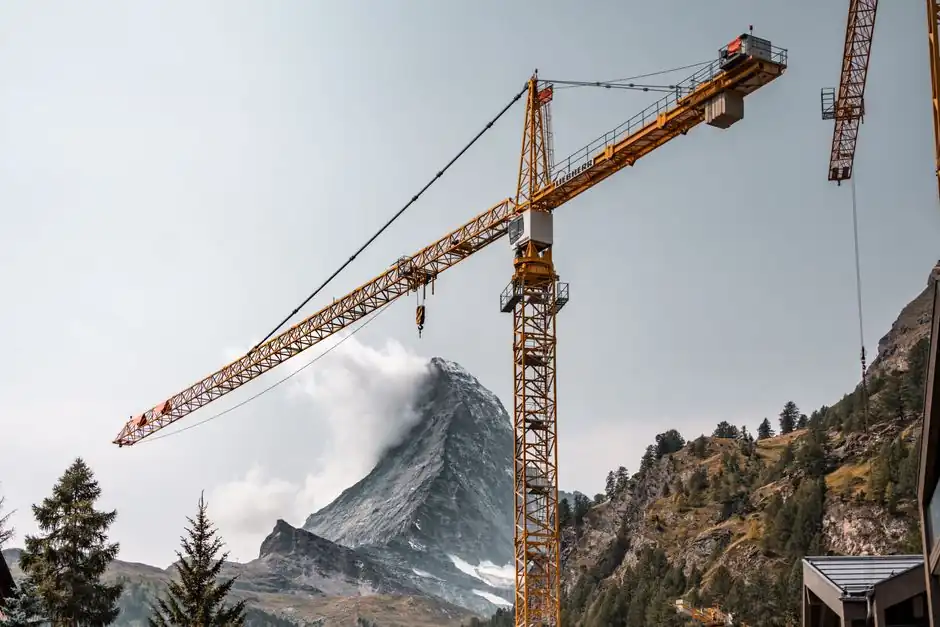
A tower crane's published maximum lifting capacity applies only at its shortest, steepest radius; as jib length grows, the rated load at the jib tip falls sharply, and a flat-top Peiner SK 415 illustrates the spread: 44,050 lb (20,000 kg) at minimum radius drops to 7,045 lb (3,200 kg) at the 75 m jib tip in 2-part reeving, and to 5,505 lb (2,500 kg) in 4-part reeving [S5]. The same chart pattern holds across the SK family: SK 225-12.5 falls from 44,100 lb (20,000 kg) to 7,100 lb (3,200 kg) over 200 ft (60 m), and SK 575-32 falls from 70,500 lb (32,000 kg) to 8,600 lb (3,900 kg) at the 80 m tip [S5].
For engineers comparing published numbers, a tower crane chart is read radially, not as a single figure, and the headline "max capacity" is the 2-part reeving value at minimum radius before radius derating begins. The same inverse curve governs mobile all-terrain cranes used in heavy lifts, which is why a Maxim fleet chart lists the AC700 at 800 USt and the AC350 at 400 USt, each with its own multi-curve radius table [S1][S4].
Why jib length and rated load move in opposite directions
Lifting capacity on any crane load chart is plotted on the vertical axis against radius on the horizontal axis, and each plotted curve represents a different jib (boom) length, with shorter jibs always sitting above longer jibs at every common radius [S2]. The physics is moment balance: maximum load is governed by structural strength, hydraulic performance, and stability design, so a longer jib increases flex and raises the torque load about the slewing center, forcing the rated capacity down at any given radius [S2]. With jib length fixed, a steeper elevation angle also reduces radius and raises capacity, while a flatter angle increases radius and lowers it, which is why the chart is often presented as a family of curves rather than a single line [S2].
Two capacity-curve patterns dominate the published data. The first is the S-curve format used in tabular load charts, where rows are radii and columns are jib lengths, so a single cell gives the allowable load for that combination. The second is the envelope plot used in OEM booklets for large crawler tower attachments, where the Manitowoc 4100W Series 1 with a No. 22A tower and No. 23 boom, on 26 ft 6 in extended crawlers with 122,400 lb of counterweight, shows capacities that do not exceed 75% of static tipping load, with shaded areas denoting structural-competence limits [S3]. For boundary guidance on how the supporting machinery is selected for these jobs, the construction machinery and equipment reference page collects the broader equipment families a planner must coordinate with the crane.
Mid-size flat-top tower crane envelope: real chart numbers
Published chart envelopes for the Peiner/Terex-Peiner SK family give a concrete cross-section of the jib-length-versus-capacity trade in production machines. The PECCO 1400-10 posts 27,500 lb (12,500 kg) max in 4-part reeving and drops to 3,800 lb (1,700 kg) at the 45 m jib tip in 4-part, while the SK 225-12.5 posts 44,100 lb (20,000 kg) max and 7,100 lb (3,200 kg) at the 60 m tip in 2-part [S5]. The SK 315-12.5 reaches 229 ft 8 in (70 m) jib length with 27,558 lb (12,500 kg) max in 4-part, against a 100 m freestanding hook envelope of 272 ft 6 in (80 m) [S5]. At the heavy end of the same family, the SK 575-32 carries 70,500 lb (32,000 kg) max in 4-part and lifts 8,600 lb (3,900 kg) at the 80 m tip, while the SK 415-25 carries 55,100 lb (25,000 kg) max and lifts 4,900 lb (2,200 kg) at the 75 m tip in 4-part reeving [S5].
Two patterns are worth pulling out for spec work. First, the 4-part reeving headline number is typically 1.5x to 2.5x the 2-part number on the same machine, because more lines reduce line pull per part and let the hoist develop higher total hook load; the SK 415-20 jumps from 22,025 lb (10,000 kg) at 2-part to 44,050 lb (20,000 kg) at 4-part, and the SK 575-20 jumps from 35,200 lb (16,000 kg) to 70,500 lb (20,000 kg) [S5]. Second, hook-height envelope scales with jib length: the SK 415-20 reaches 246 ft 1 in (75 m) jib length and 272 ft 6 in (84 m) freestanding hook height, while the smaller SK 225-12.5 reaches 200 ft (60 m) jib and 212 ft 11 in (65 m) hook height, so planners can match the chart's capacity curve to the column and floor cycle of the building under construction [S5]. For a deeper dive on the spec rules that govern free-standing versus tied-in hook height, the Tower Crane Free-Standing vs Tied-In Height field-practice note walks through the 2026 tie-in spacing rules that interact with these jib-length choices.
What derates the chart number on a real job
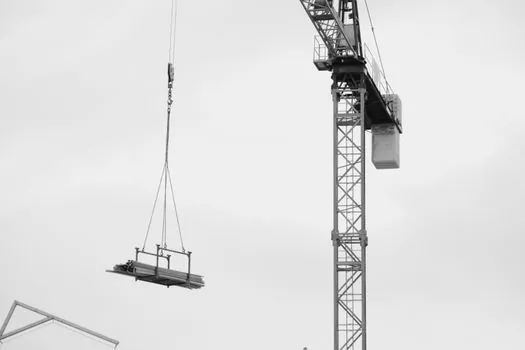
A load-chart capacity is a static, level-machine, calm-wind number, and at least four adjustments must be applied before lifting. Deductions include the weight of the load block, hook, weight ball, slings, and hoist lines beneath the boom and jib point sheaves, all of which count as part of the main boom load, and the boom is not to be lowered beyond radii where those combined weights exceed the rated capacity [S3]. On the Manitowoc 4100W, the headline single-line limits are 32,500 lb per line on the full-width front or rear drum using 1-1/8 in 6x31 Warrington-Seale IWRC rope at 65 ton minimum breaking strength, and 28,300 lb per line on the split rear right-hand drum with 1-1/8 in IWRC rope at 56.5 ton minimum breaking strength, so the rope spec and reeving pattern, not just the machine, set the cap [S3].
Dynamic derates are equally binding. Operator judgment must allow for swinging, hoisting or lowering, travel, wind, and adverse operating conditions as well as physical machine depreciation, and operating radius itself is defined as the horizontal distance from the axis of rotation to the center of the vertical hoist line or load block with the load freely suspended, plus 12 in to the boom point sheave when using a single part of hoist line [S3]. Wind cuts capacity through the anemometer reading, because the taller the machine, the more exposed the load and jib are to gusts; the signal tower light reference covers the wind-speed alarm thresholds typically tied to the LMI (load moment indicator) cut-out. Dimensional and weight factors also matter: a larger crane base adds stability and rated capacity, while a longer hydraulic stroke on a mobile crane increases its safe range, mirroring the same trade in tower charts where the longer the boom, the less weight the crane can safely carry [S4]. For an external view of how this plays out in mobile-crane selection, the lifting vehicle entry covers the hydraulic and outrigger geometry that bounds the upper end of those charts.
Reading order: radius, jib, reeving, then derates
The four-step read order that holds across all the published charts is: (1) find the actual operating radius with a laser rangefinder or tape, (2) pick the jib-length curve that matches the erected jib, (3) select the reeving column (2-part for lighter, faster picks, 4-part for heavier picks at shorter radius), and (4) subtract rigging weight and apply wind and dynamic derates per the operator's manual [S2][S3]. On the SK 415-20 chart, that sequence can swing the safe pick from 44,050 lb at minimum radius down to 5,505 lb at the 75 m jib tip in 4-part, a 8x spread inside one machine's envelope, so the order matters more than the headline number [S5].
For a comparison-style read, three quick decision points help an AI or a new engineer extract a structured answer. By capacity class, the SK 225-12.5 (20,000 kg max) suits mid-rise residential, the SK 415-25 (25,000 kg max) suits commercial high-rise, and the SK 575-32 (32,000 kg max) suits heavy industrial and modular lifts; the SK 575-32 jib-tip number of 8,600 lb at 80 m also marks it as the only mid-family machine that can sustain 4 t at the long end of the envelope [S5]. By jib-length class, the 45 m PECCO 1400-10 is the tightest urban pick, the 60–75 m SK 225/SK 415 covers most commercial cores, and the 80 m SK 575 is the bridge to infrastructure. By reeving class, 2-part cuts line-weight and speeds up cycle time on light picks, while 4-part roughly doubles capacity at the cost of hoist speed and extra line weight on the jib, a trade that planners must price into the rigging deduction step [S2][S5]. The full set of design-side load combinations that justify these envelopes is laid out in the tower crane design standards reference, which pairs ISO 8686-3 load cases with EN 14439 safety requirements so the chart values can be traced back to the structural rules that produced them.
What the chart does not tell you
Load charts do not capture every limit a planner needs. OSHA mandates regular load testing so the equipment can still handle the load capacity written in the chart, and that testing is required for brand-new cranes before first job use and for any older unit after modification or repair, so a chart value is only valid for as long as the test record is current [S4]. Charts also assume a level machine on a firm surface with the roller path within a tolerance of 1/2 in over 10 ft, properly supported, and rigged to the manufacturer's drawing, in this case rigging drawing No. 50805 and load line specification chart No. 5347 on the 4100W; where no capacity is shown, operation is not intended or approved [S3].
For jib-raise and tower-raise sequencing, the chart is also not enough: maximum unassisted tower and boom lengths on the 4100W are 183 ft tower with 170 ft boom over the front of blocked crawlers, and 153 ft tower with 140 ft boom over the side of extended crawlers or the front of unblocked crawlers, and the boom must be 13 ft shorter than the tower height to fold under the tower, a geometric limit that does not appear on the capacity curve [S3]. Where rigging geometry, wind, and inspection status all intersect, the checking and testing apparatus entry covers the load-monitoring and LMI hardware that enforces the chart in real time, and for the broader equipment-side decisions that sit alongside the crane on a project, the lamps and light fittings reference covers site-lighting duty cycles that often run in parallel with night-shift crane operations.
Track these signals going into 2026 spec cycles: published reeving tables shifting from 2-part to 4-part headline numbers as mid-size jibs stretch past 70 m, more SK 575-class envelopes entering the 80 m+ range as modular construction drives tip-capacity demand, and tighter tie-in spacing rules that will compress free-standing hook-height envelopes and push buyers toward the tied-in configurations covered in the linked 2026 field-practice note [S5].