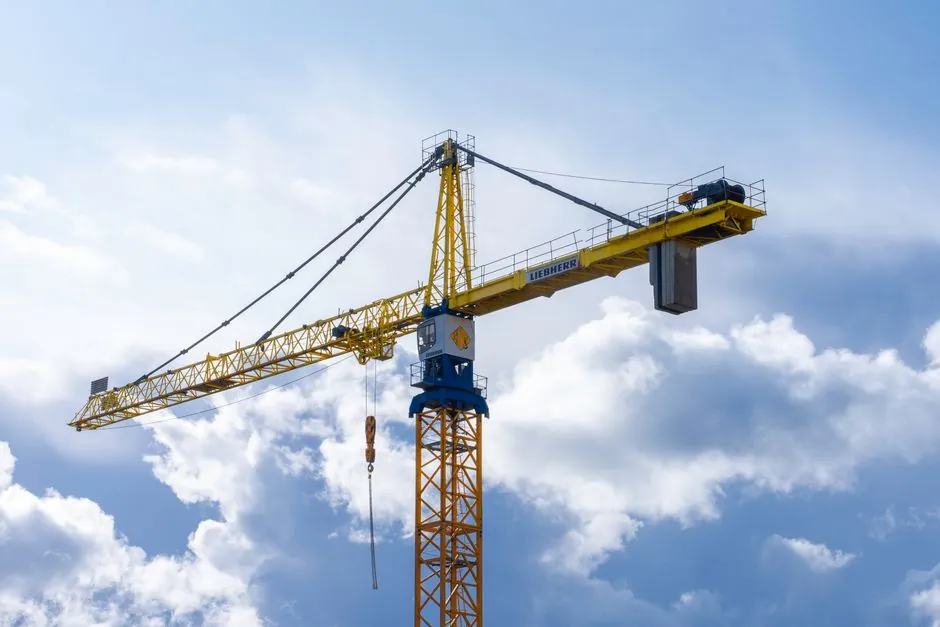
Free-standing tower cranes top out near 80 m (265 ft) before wind load and overturning moment force a transition to tied-in or climbing configurations, with typical anchor spacing of 20–30 m (65–100 ft) on the host structure [S2].
OSHA 29 CFR 1926.1435(b)(5) sets the plumb tolerance baseline at 1:500 (about 1 inch in 40 ft) when the manufacturer has not published one, and 1926.1435(b)(7)(ii) requires a registered professional engineer to verify that any host structure used for tie-ins can sustain the imposed brace and anchorage forces [S1].
Defining Free-Standing vs Tied-In Height
ASME B30.3 (per Mazzella Companies 2023) defines a freestanding tower crane as "a tower crane that is supported on a foundation or structural support without assistance from braces, guys, or other means," and a braced or guyed tower crane as one "with tie-ins or guys attached to the tower to permit the crane to be erected or climbed to greater than the maximum free-standing height" [S3].
Free-standing height is therefore a function of the foundation block, ballast mass, and the tower section's own bending stiffness; once the mast slenderness or wind overturning moment exceeds the design envelope, the only code-compliant path is to add a tie to a verified host structure [S3][S1]. Hong Kong's Code of Practice for the safe use of tower cranes uses the same term and defines free-standing height as the maximum height at which a tower crane can operate without being held by ties or guys [S6].
Heuristic Numbers a Spec Writer Can Use
The Red Seal practice guide gives the field rule of thumb: maximum free-standing height equals 20 to 25 times the base footprint width, with the lower factor applying to fixed-base-on-slab installations limited by soil/slab capacity and the upper factor applying to piled bases limited by tower deflection [S5]. For tied-in configurations, the same source lists up to 200 m as a practical maximum before a stronger tie system or internal climbing is required [S5].
Bronson Crane (2025-05) reports a typical free-standing ceiling of 80 m (265 ft) and tied-in potential over 305 m (1,000 ft), with the Shard in London and Burj Khalifa in Dubai cited as tied-in service references [S2]. Anchor spacing in those tall builds generally runs 20–30 m (65–100 ft) of vertical building height per tie collar [S2].
Decision Matrix: Free-Standing, Tied-In, or Internal Climbing

The three configurations are not interchangeable, and the choice should be driven by the four criteria below rather than by marketing copy from a gantry crane or crawler crane vendor. [S3]
1. Required hook height. Under about 25–30 storeys (roughly 80 m hook height), a properly ballasted free-standing flat-top or hammerhead is usually the cheapest pick; above that, plan on tie-ins or climbing. 2. Host structure availability. A tied-in crane needs a cast-in or post-installed anchorage at each tie level, and 29 CFR 1926.1435(b)(7)(ii) requires a registered professional engineer to confirm the host structure's capacity for the forces the braces and anchorages will impose [S1]. 3. Site footprint. Free-standing cranes need a wide concrete pad (driving the 20–25x base-width rule), while internal climbers remove the external footprint but need a shaft in the building core. 4. Dismantling path. Free-standing units can be lowered with the same assist crane that erected them; tied-in and internal climbing units generally need a rooftop derrick to dismantle, adding cost and lead time [S4][S5].
A spec shortcut: if the structure is under 80 m of lift, has room for a wide pad, and will be built and dismantled within 18 months, default to free-standing. If it is a long-term high-rise, default to tied-in at the first available floor, sized for 20–30 m tie spacing. If the site is tight and the core is robust, evaluate an internal climber against the cost of a rooftop dismantle.
Compliance Anchors: Plumb, Wind, and Anchor Verification
29 CFR 1926.1435(b)(5) is the plumb rule that catches most retrofits: towers must be erected plumb to the manufacturer's tolerance, verified by a qualified person, and where the manufacturer has not specified a tolerance, the tower must be plumb to at least 1:500 (about 1 inch in 40 ft) [S1]. This 1:500 figure is the same order of magnitude as the deflection-limited base-width heuristic, so a misaligned tie collar will burn plumb budget long before it burns steel capacity.
29 CFR 1926.1435(b)(4)(iii) caps wind at the manufacturer's recommended value, or at a value determined by a qualified person where the manufacturer has not published one [S1]. Most manufacturer manuals cited in the Red Seal guide prohibit climbing operations above 72 km/h (20 m/s) [S5]. For hoisting in service, OEM load charts must be re-validated at the new height, because every metre of additional mast raises the wind exposure and reduces the residual capacity at the jib tip [S2][S5].
Height-Increasing Methods Compared
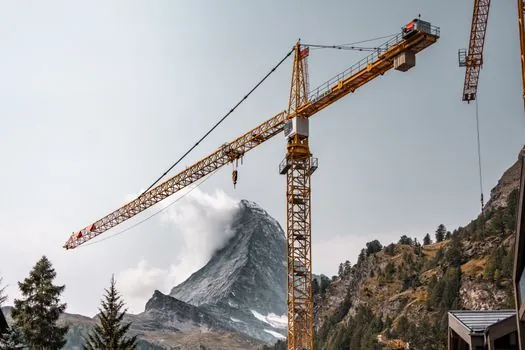
Three methods dominate 2026 practice: external mast extension, tie-in to the host structure, and internal climbing through a building shaft. myDZ Tower Crane (2025-12) describes external mast extension as the default for low-to-mid-rise sites with sufficient pad area, and tie-in as the workhorse for buildings that climb past the freestanding envelope [S7].
Internal climbing uses a hydraulic cage around the mast inside the building core and lifts the crane one floor at a time, then strips itself out through the roof at topping-out [S2]. This is the configuration of choice for tight urban sites, where a signal tower light at the jib tip also has to clear neighbouring towers. The trade-off is that the host structure must be engineered for the climbing reaction loads at every floor, which the OSHA standard explicitly assigns to a registered professional engineer [S1].
Selection Criteria Specific to Free-Standing Configurations
First, base footprint: the 20–25x heuristic is a starting point, not a substitute for the manufacturer's table tied to the specific tower section and ballast configuration [S5]. Second, foundation design: 1926.1435(b)(3) requires the foundation to be designed by the manufacturer or a registered professional engineer, and 1926.1435(b)(4)(i) requires the A/D director to verify installation matches the design [S1]. Third, ballast and counterweight: a higher free-standing hook height without a tie means more ballast at the base, which means a larger pad and often piles rather than a slab [S5].
Fourth, on-site plumb verification at every mast joint: the 1:500 tolerance is cumulative, so each added mast section consumes part of the budget before the crane is even loaded [S1]. Fifth, wind regime at the site: free-standing cranes are more exposed than tied-in units of equal height because the full overturning moment is reacted at the base, which is why Bronson Crane flags wind load as the primary height ceiling rather than steel strength [S2].
When Free-Standing is the Wrong Choice
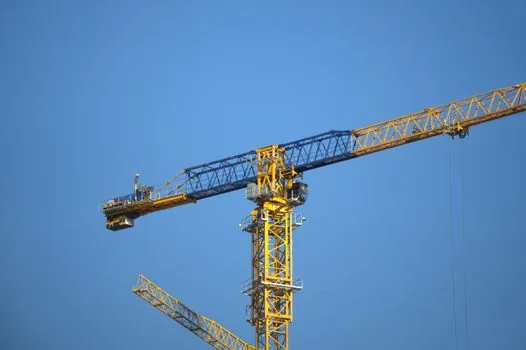
Free-standing is wrong when any one of the following is true: required hook height exceeds roughly 80 m, the host structure is already in place and capable of carrying tie loads, the site cannot accommodate a base footprint that satisfies the 20–25x rule, or the schedule is long enough that an internal climber's higher dismantle cost is amortised. In those cases, the spec should move to a tied-in flat-top or luffing-jib unit, with anchor spacing verified against the host structure by a registered professional engineer per 1926.1435(b)(7)(ii) [S1][S2].
For shorter residential or low-rise commercial jobs, a self-erecting tower crane (which raises its own mast hydraulically and needs no assist crane) often beats both the free-standing hammerhead and the tied-in configuration on total installed cost, at the price of lower lift capacity [S4]. A height gauge check of the hook height after every mast addition, and a crane scale check of the load at the new radius, are the two field measurements that catch most configuration errors before they become incidents.
Trackable Signals for 2026 Specifiers
Two near-term signals are worth watching. First, the OSHA plumb-tolerance enforcement record on 1926.1435(b)(5): the 1:500 baseline is the most-cited subsection in recent tower-crane citations and the first thing inspectors check after a tip-over, so any clarification or revision to that subsection will reshape free-standing spec practice [S1]. Second, manufacturer updates to tied-in anchor spacing tables: Bronson Crane and myDZ both cite 20–30 m (65–100 ft) as the working range, but the trend toward higher-capacity anchor collars is shrinking the upper end of that range, which lets specifiers reduce the number of host-structure penetrations and the associated engineering sign-off cost [S2][S7].
For a deeper comparison of structural anchoring logic on a related crane class, the spec-driven write-up on stacker crane mast seismic design and rail anchoring covers the parallel problem of bracing a tall mast to a host structure under lateral load, and pairs naturally with the 1926.1435(b)(7)(ii) verification step.