
Label registration accuracy is the machine's ability to put every label in the same X/Y/θ position on the container, cycle after cycle, and is normally quoted as a plus/minus tolerance in millimetres at nameplate conveyor speed [S5][S6].
The number is driven almost entirely by the registration loop: a sensor reads a mark on the label web or belt, the controller offsets the dispense timing to match the arriving container, and the result is the figure you see on the data sheet [S8]. On a well-tuned servo line that loop is held to ±0.5 mm; on an entry-level stepper line the same parameter drifts to about ±1.5 mm once the machine has been running for any length of time [S6].
Where the ±0.5 mm Figure Comes From
Three independent industry sources converge on the same servo-class tolerance, which is why procurement specs keep circling back to it. A US food and pharma OEM that re-engineered its top/bottom labeler with a Trio Euro404 motion coordinator reported accuracy improving from ±1.0 mm to ±0.5 mm while throughput rose by more than 25% [S5]. A 2026 bottle-labeling buyer's guide states that "servo driven label applicator systems are accurate to 0.5 mm at nameplate speed," with stepper entry units drifting to 1.5 mm [S6]. Quadrel's high-accuracy product line is built around the same ±0.5 mm envelope for pressure-sensitive applications where regulators or brand owners demand tight placement [S1].
The lever inside that loop is electronic gearing: a line encoder tracks the conveyor, the controller runs 64-bit floating-point math on an ARM11-class processor, and the label feed is triggered off a registration capture rather than off a fixed timer [S5]. Remove any one of those three elements and the tolerance widens; that is why two machines at the same nominal speed can sit on opposite sides of the 0.5/1.5 mm line.
Registration vs. Placement: Two Different Numbers
Engineers frequently conflate two specifications that buyers need to keep separate. Registration accuracy is the dispersion of label-edge position relative to a reference on the web, usually measured at the dispense head; placement accuracy is where the label actually lands on the container, which also depends on container handling upstream [S2][S9]. A vial labeler with a precision star-wheel and servo back-pressure can hit ±0.3 mm placement even when the dispenser itself is only ±0.5 mm, because container-position variance is removed mechanically; the opposite is also common, where a sloppy infeed destroys a good dispenser [S9].
Container shape, surface texture, and curvature all shift the placement number independently of the registration number. IQS Directory notes that modern systems are specifically chosen for "superior placement accuracy and repeatability" on "textured, curved, or non-[standard] substrates," which is placement talk layered on top of the registration number [S2]. When a vendor publishes a single accuracy spec, ask whether the test was done with a controlled rigid container or with the real product mix; the two figures can differ by a factor of two or more.
Servo vs. Stepper vs. Pneumatic: A Criteria-Based Comparison

The drive package decides the registration envelope before any other design choice is made, and the rest of the line is then engineered around that envelope. The three common classes line up as follows on the criteria that show up on RFQs: [S4]
Servo-driven label applicators hold ±0.5 mm at nameplate speed, maintain that figure under variable conveyor loading, and support electronic registration-mark tracking with closed-loop feedback; they are the default for food, beverage, pharma, and cosmetics lines running above roughly 100 containers per minute [S5][S6]. Stepper-driven entry-level systems are spec'd at roughly ±1.5 mm once warm, are sensitive to voltage fluctuation and mechanical drag on the web, and drift further when conveyor speed varies; they fit short-run or low-speed packaging where absolute placement is not regulatory [S6]. Pneumatic and basic mechanical dispensers have no active registration loop, depend on timed dwells, and are typically limited to simple flag or top-label applications on uniform containers where ±2 mm or wider is acceptable.
The throughput ceiling scales with the registration tolerance in a non-obvious way. A high-performance 360a Model Y applicator can reach 3,000 inches per minute of label web, which translates to roughly 500 shipping-label applications per minute or 750 glass-bottle applications per minute when the labels are sized for those containers [S4]. The Trio-controlled OEM line cited above places up to 3 labels per second, or 180 per minute, while holding ±0.5 mm [S5]. Semi-automatic benchtop units cap at about 1,800 bottles per hour against manual wrap labeling at roughly 300 bottles per hour, so the jump in throughput is large but the registration story still favors the servo path for any line that needs to ship cosmetic or pharmaceutical product [S4].
What Actually Limits the Number in Production
Five factors erode registration accuracy on a running line, and most of them have nothing to do with the labeler itself. Web tension variation on the unwind changes the spacing between registration marks, so a stable dancer or load-cell-controlled unwind is the cheapest accuracy upgrade on any line [S7]. Conveyor speed variance from upstream loading or motor voltage fluctuation forces the controller to re-trace the registration curve every cycle, which is exactly the failure mode the Trio upgrade was designed to remove [S5]. Container geometry, particularly tapered bottles and oval cross-sections, shifts the contact point at the wipe-down station and can break a ±0.5 mm dispenser down to ±1.0 mm at the actual placement point [S4][S9].
Label stock quality is the fourth factor and the easiest to overlook. Pre-printed registration marks must stay within the printer's dot-placement tolerance, the laminate must have a consistent slip coefficient so it releases cleanly from the liner, and the unwind direction has to match what the applicator was designed for; mixing the two directions without re-slitting is a common cause of intermittent mis-registration [S7]. The fifth factor is operator setup: peel-plate geometry, wipe-down brush tension, and the timing of the dispense trigger relative to the registration sensor are all mechanical adjustments that drift with changeovers and that the registration spec assumes are already dialled in [S8].
Industries Where the Spec Is Non-Negotiable
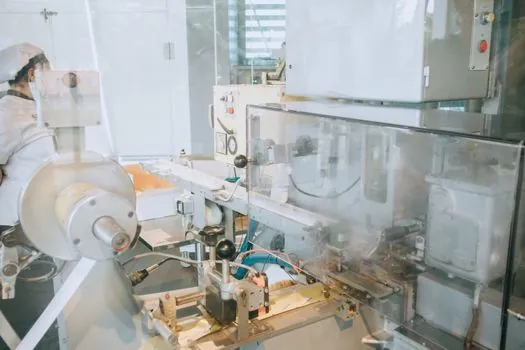
Pharmaceutical and cosmetics lines are the canonical drivers of tight registration, and the failure mode in those sectors is regulatory rather than cosmetic. Cosmetics labels must carry the INCI ingredient list in descending order of concentration along with usage precautions and manufacturer identity, and a label that wraps a curved bottle at an angle that clips the ingredient panel is a recall event, not a quality issue [S3]. Food labeling carries parallel obligations for allergens, net weight, and best-by dates; the same CDA analysis notes that "the absence of bubbles, wrinkles, or misalignment, often caused by manual or imprecise labeling, improves the visual impact of the packaging" and that poor placement "can lead to penalties or products being removed from the market" [S3].
Chemical and hazardous-product lines add a third layer: GHS pictograms, handling instructions, and signal words have to land inside defined print zones on the label so they remain visible at the point of use, which forces registration and placement tolerance to be specified together rather than separately [S3]. Across all three sectors, the practical spec on the RFQ has converged on ±0.5 mm for new servo lines, with stepper and mechanical systems only accepted where the label content is not safety-critical and the throughput is below the threshold where drift becomes visible [S1][S5][S6]. For lines that are already running print-and-apply systems rather than dedicated labelers, the same registration logic shows up in adjacent packaging automation, which is why the same engineering controls recur in strapping band and case-handling setups and in the multi-camera vision cells that verify label position downstream of the applicator.
How to Spec It on a Real RFQ
Three rules keep the registration spec honest. First, name the tolerance as ±X mm at Y containers per minute, measured on the actual product mix, not on a reference test bottle; the Trio case study shows that the same hardware drops from ±0.5 mm to a wider figure the moment conveyor loading changes [S5]. Second, separate dispenser registration from placement-on-container in the line layout, because the only way to know the second number is to run the real containers through the star-wheel or puck handling section [S9]. Third, tie the registration spec to a verification method, whether that is a vision cell with a defined pixel resolution, a manual go/no-go gauge, or a periodic pull-and-measure on the production line, because a tolerance that is not measured is a tolerance that will drift.
For most non-pharma FMCG lines, ±0.5 mm at nameplate speed is the procurement target on a servo line, ±1.0 mm is the warning threshold at which scrap rates start to bite, and ±1.5 mm is the stepper-class floor that should be specified only with eyes open [S5][S6]. Anything wider is acceptable only on a dedicated wrap line for uniform cylindrical containers where label content is not regulated, and even then the smart move is to budget for a servo retrofit once the line crosses roughly 100 containers per minute.
Trackable signals over the next procurement cycle: servo-drive pricing on entry-level labelers, which sets the crossover point between stepper and servo for small lines; encoder and vision-integration options shipping as standard on new machines rather than as upcharge modules; and the first widely cited registration numbers published for multi-label print-and-apply systems running above 200 containers per minute.
Spec-level background on the components involved: labeling machine, coding machine, and core machine.