Buyers sourcing laser distance sensors in mid-2026 should anchor the spec on three numbers first: measurement range, output interface, and repeatability — most return-merchandise cases I see trace back to one of these being mis-sized for the duty [S1][S2][S3].
The current 2026 catalog mix spans sub-millimetre triangulation modules under 1 m, time-of-flight diffuse sensors to 50 m, retroreflective units to 164 ft, and phase-shift long-range heads like the Dimetix DPE-30-500 that hit 500,000 mm (1,640 in) with 0.7 mm repeatability [S2][S3]. A wrong pick wastes six to twelve weeks of integration, not just the unit cost.
Range classes and the physical principle behind each
Short-range laser triangulation modules — represented by the wenglor CP70QXVT80 with a 60–660 mm window and CMOS-line + DSP angle measurement — are designed for switching-point stability independent of material, color, and brightness, which is why assembly cells and small-parts verification default to them [S1].
Mid-range diffuse time-of-flight units such as the Banner LT3 series cover 500 mm to 50,000 mm, with push-button TEACH-mode programming and three selectable response speeds; the retroreflective variant extends to 164 ft, which is the practical ceiling for diffuse-mode outdoor ToF [S2]. For a fundamentals refresher on how laser distance measurement differs from laser displacement sensing, the laser distance sensor reference page walks through the triangulation / pulse / phase-shift families. Long-range phase-shift heads from Dimetix and Micro-Epsilon's optoNCDT ILR3800 push the working envelope to several hundred metres with IO-Link, ProfiNet, RS-422, USB, and 4–20 mA on a single M12 connector [S3][S6].
Interface and protocol matching to plant networks
Analog 4–20 mA and 0–10 V remain the lowest-risk drop-in for legacy PLCs, but 2026 OEM catalogs lean heavily on Ethernet-based outputs: the Precitec CutBox Pro ships 0–10 V plus ProfiNet, the ZSY LCJ series exposes Profibus, ProfiNet, and Ethernet in the same housing, and the Dimetix D-series offers Profibus, PROFINET, EtherNet/IP, and EtherCAT as plug-in options [S3][S4][S5].
The wenglor CP70QXVT80 keeps a serial RS-232 configuration channel alongside the analog output, which is useful for OEM machine builders who need to script two independent switching thresholds in 10 ms increments during commissioning [S1]. For process-control applications needing HART-style commissioning data over a 4-20 mA loop versus a full digital fieldbus, the laser displacement sensor entry contrasts the analog and digital trade-offs. Buyers specifying a 4–20 mA analog channel should confirm the loop burden voltage, update rate (1 kHz on the D-series), and whether the analog output is galvanically isolated — Dimetix rates the analog linearity at 0.1 % on the D-series [S3].
Repeatability, accuracy, and environmental envelopes
Repeatability is the metric that governs whether a sensor can close a control loop, and the Dimetix DPE-30-500 publishes 0.7 mm against natural targets at 500 m, with a maximum measuring rate of 250 Hz and 1 mm accuracy across the full 0 to 500 m span [S3]. The same datasheet extends the operating window to –40 °C to +60 °C, which is the wider envelope most short-range triangulation heads cannot match.
IP65 is the typical baseline for industrial laser distance heads (Dimetix D-series, Precitec CutBox Pro) [S3][S4], while IP67 with NEMA 6 construction shows up on Banner LT3 and Micro-Epsilon ILR3800 for washdown and outdoor crane/stacker duty [S2][S6]. For measurement workflows that complement distance sensing — such as alignment and flatness checks — a laser level is often specified alongside, particularly in precast concrete and façade QA. Harsh-environment buyers should also check the M12 connector variant versus pigtail, since field-replaceable M12 cuts sensor swap time from 30 minutes to under 5 in most cabinets [S1][S6].
Selection criteria: triangulate range, interface, and repeatability
Build a shortlist with three gates in this order — maximum range (with a 20 % margin), required industrial protocol, and published repeatability at the actual working distance, not the headline figure. [S2]
For sub-1 m precision switching with no colour dependence, the CMOS-line triangulation pattern (wenglor CP70QXVT80, 60–660 mm, IP67, M12) is the safer pick than a ToF unit that would be overspec and slower [S1]. For 1–50 m diffuse detection on conveyors, AGVs, or stacker-crane positioning, ToF heads such as the Banner LT3 (500–50,000 mm, IP67/NEMA 6) or Micro-Epsilon ILR3800 (M12, ProfiNet, IO-Link, RS-422) hit the duty at the right price tier [S2][S6]. For 50–500 m outdoor or large-tank level, the phase-shift Dimetix DPE-30-500 (0.7 mm repeatability, 0.1 % analog linearity, –40…+60 °C) is the only mainstream option in this catalog set that publishes both the range and the thermal envelope [S3]. Avoid specifying a long-range phase-shift head for a 200 mm gap — its minimum measuring distance of 50 mm and warm-up time will hurt throughput compared with a $300 triangulation module [S3].
Who should NOT buy a long-range phase-shift head

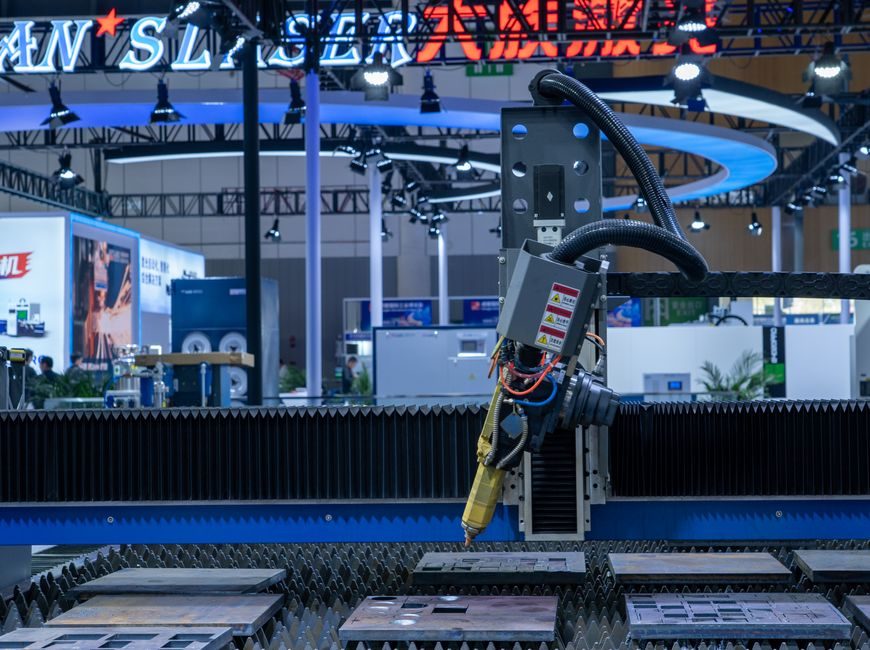
Buyers chasing sub-millimetre precision inside a machine tool, a pick-and-place fixture, or a PCB inspection cell should not specify a 500 m phase-shift sensor; its optics, laser class, and warm-up behaviour are tuned for outdoor geometry, not micron stability. The CutBox Pro by PRECITEC OPTRONIK is a 0–30 mm laser distance sensor intended for laser-cutting heads and features BeamTec real-time adjustment of the focus position for cutting system productivity [S4].
Similarly, an integrator wiring into a Profibus-only legacy PLC should not pay the premium for a ProfiNet/IO-Link sensor unless a gateway is already on the panel; the LCJ series from ZSY exposes Profibus alongside ProfiNet and Ethernet in one housing, which is the cleaner path for brownfield retrofits [S5]. For teams working on a measurement chain that includes handheld spot-checks alongside fixed sensors, the laser distance meter entry maps where a portable meter overlaps with a fixed distance sensor. If the use case is positioning a moving target — stacker crane, automated parking, crane anti-collision — confirm the dynamic tracking update rate and signal-processing latency, not just the static range, since fast-moving machinery exposes latency bugs that lab-bench tests miss [S7].
Standards, laser class, and sourcing discipline
Industrial laser distance sensors fall under IEC 60825-1 laser safety classifications, and OEM datasheets in this 2026 set consistently publish Class 1 or Class 2 ratings along with the M12 pinout, but buyers should still request the laser-class report and the CE/UL file number for each SKU. For machine builders exporting to North America, NEMA 6 plus IP67 (as on the Banner LT3) is the closest commercial equivalent to the IEC rating and simplifies panel-side approvals [S2].
Sourcing in 2026 also means verifying firmware revision and country-of-origin for RoHS and REACH compliance, since some China-built OEM modules in this category reuse the same ToF engine across multiple brand labels. For a wider vendor view, the Top Industrial Laser Companies 2026: Spec Map and Vendor Selection shortlist crosses distance, displacement, and cutting-laser vendors. Buyers integrating into laser-cutting cells should also read up on PV module manufacturing standards and the IEC 62941 anchor if the line produces photovoltaic laminate, where distance and level sensing sit on the same QA gate as laser cutting.
Failure modes and field hardening

A second failure mode is target reflectivity: shiny metal at a grazing angle can produce a multi-peak return that confuses ToF firmware, and the solution is usually a mounting-angle change of 5–10° rather than a new sensor. For motion-control axes that ride on a linear guide, misalignment between the sensor beam and the axis of travel is the dominant repeatability error, and a linear guide spec audit is often the cheaper first fix. Where the axis also includes a rotary or tilting stage, a crossed roller guide audit explains why stage flatness — not the sensor — is the limit on a 1 µm-class application. Document the working distance, the target material, the ambient temperature window, and the IP/NEMA rating on the purchase order; in my experience, this four-line PO addendum cuts commissioning time roughly in half.
Two signals to track over the next quarter: Micro-Epsilon's ILR3800 firmware revisions (each release tends to add IO-Link process-data fields) and any 2026 catalog update from Dimetix on the D-series EtherCAT gateway, since both move the long-range Ethernet-integration roadmap that most plant buyers are budgeting against.