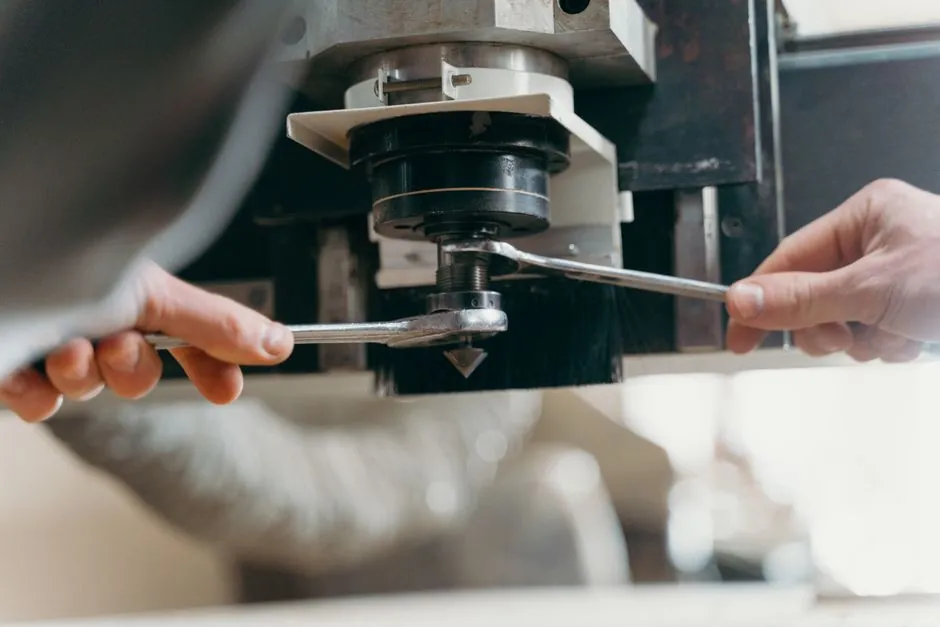
A servo positioning coupling on an RFQ should never be left as "flexible coupling, 8 mm to 12 mm." Specifying the wrong part inflates backlash, drops torsional stiffness, and forces a requote when the servo drive loop cannot hold its tuned bandwidth.
For positioning axes, the coupling has three jobs: transmit torque without hysteresis, hold torsional stiffness so the controller sees real shaft motion, and forgive the small parallel and angular misalignment left after assembly. The product families that come up most often on a positioning RFQ are jaw, Oldham, single-beam (helical), double-beam, disc, and bellows, with a clear split between general industrial use and true precision servo use [S2][S3][S5][S7][S9][S10].
Coupling Family Comparison for Servo Positioning
Jaw couplings with a polyurethane spider, for example the MMJ clamping series, are the cheapest option and accept the most parallel misalignment, but they carry measurable backlash and a soft torsional spring that drags down servo loop gain, so they belong on conveyors, not on a positioning axis that needs repeatable endpoint [S7].
Oldham designs with clamp hubs handle parallel offset cleanly but introduce a sliding interface that wears and adds a small dead band; they are common where two shafts are mounted on different planes and the offset is the dominant error, not the rotational accuracy [S4][S2]. Beam and double-beam couplings (helical or flat spiral) are the workhorse choice for stepper and small servo couplings, since one-piece metal construction gives zero backlash, high torsional stiffness, and small parallel plus angular compensation; MFS-C and MFSS-C in extra super duralumin and stainless steel respectively are typical beam-coupling references for clamping-hub servo drives [S1][S3].
Disc couplings in the SCPS/SCPW clamping series are the high-rigidity, high-torque choice when the axis sees reversing peak loads at speed, because the bolt-and-shim pack keeps backlash near zero while allowing measurable angular misalignment, which is the typical MISUMI/NBK specification route for positioning servomotors [S10][S9][S5]. Bellows couplings are reserved where torsional stiffness is the dominant requirement and misalignment is small, since the thin-wall metal bellows delivers the lowest compliance of any flexible family but the least forgiveness on side load [S3].
RFQ Line Items Buyers Should Write
An RFQ that leaves any of the following blank is the single most common cause of a requote cycle on a positioning axis, since each one changes the catalogue family the supplier quotes from.
1. Shaft diameter on the motor side and load side, with tolerance and keyway status (plain, D-cut, keyed), since bore size drives the catalogue code and the hub style. 2. Coupling family: beam, bellows, disc, jaw, or Oldham. 3. Rated torque in N·m and peak or reversing torque, with a service factor of at least 1.5 to 2.0 over the application's continuous torque, and at least 1.0 over the application's peak (so the coupling never yields under a fault stop). 4. Maximum continuous speed in rpm and balance grade, because flexible couplings above roughly 10,000 rpm need a balanced or high-speed variant. 5. Allowable parallel misalignment in mm and angular misalignment in degrees, and end-play in mm, since these are the three numbers the supplier uses to disqualify a family. 6. Backlash class, with "zero backlash" written explicitly if the axis does any point-to-point work, otherwise the default catalogue backlash for jaw or chain couplings will be quoted. 7. Hub fixation: clamp or set screw; clamping hubs (MFS-C, MMJ, MHW, SCPS, MCO/MCOC) avoid the keyway and the marring of the shaft, while set-screw hubs are cheaper and easier to field-service [S1][S7][S9][S10][S5]. 8. Hub material: extra super duralumin (A2017/A7075 class) for weight-sensitive axes, stainless steel for washdown or medical lines, or standard steel for general industrial cells [S1][S3]. 9. Ambient: temperature range, IP rating needed around the coupling, and chemical or washdown exposure, since polyurethane spiders in jaw couplings and the elastomer in Oldham designs both fail above roughly 80 to 100 °C and against most solvents [S1][S4]. 10. Compliance requirement, in deg/N·m, because servo tuners need a stiffness number, not just "high rigidity" on the catalogue page [S10].
Who This Spec Is For, and Where It Backs Out
This map is for engineers buying couplings into positioning servo loops: pick-and-place, indexing tables, ball-screw drives, gantries, AGV steering axes, and any closed-loop motion where the controller must "see" the load motion through the coupling. For non-positioning service (a fan, a long conveyor, a pump), a jaw or chain coupling is fine and the rest of this article is overkill; for a true feedback-driven axis, those choices will cost you bandwidth and endpoint accuracy [S3][S7].
The other cutoff is shaft speed. Disc and bellows couplings are usually fine to roughly 10,000 rpm, and one-piece beam couplings to roughly 5,000 to 6,000 rpm in the small sizes, but the supplier will want a balance grade and a balance verification above roughly 5,000 rpm, and the RFQ has to call for that explicitly. Below roughly 1,500 rpm the dominant concern is stiffness, not balance.
Stack-Up: Why the Coupling Choice Changes the Servo Loop
Torsional stiffness in a servo motor axis is not a footnote, it is a pole in the closed-loop transfer function. A flexible coupling sits between two inertias, and if its stiffness is too low, the controller cannot close a high enough bandwidth without hitting a resonance; the symptom is an audible squeal at a fixed frequency and a positioning axis that overshoots or rings at every move. [S1]
The three real failure modes to plan against are: (a) backlash, which kills repeatable endpoint accuracy and shows up as a small dead zone the controller has to cross each time direction reverses, common with worn jaw spiders; (b) compliance, which limits the achievable servo bandwidth and shows up as resonance or ringing, common when a soft elastomer coupling is used in a high-gain loop; and (c) fretting wear on the shaft from set-screw fixation, which is solved by moving to a clamp hub (MFS-C, MMJ, MHW, SCPS, MCO/MCOC) so the shaft is not marred [S1][S4][S7][S9][S10]. Specifying the failure mode you are designing against, not just the catalogue family, is the difference between a quote that fits and a quote that has to be redone.
Materials, Standards, and the Optional Fields That Trigger Repricing
Hub material: extra super duralamin (a high-strength aluminium alloy), standard carbon steel, or stainless steel (typically 304 or 316) for washdown. Spiders and elastomers on jaw and Oldham couplings are usually polyurethane in the 80 to 95 Shore A range, with nitrile or Hytrel variants for higher temperature; if the RFQ does not name the elastomer, expect the supplier to default to standard PU and then requote the moment you mention food grade, clean room, or a temperature above 80 °C [S1][S4].
Standards commonly referenced on precision coupling drawings include ISO 21940 for balance grade, AGMA 9006 for flexible coupling lubrication and inspection, and DIN 6885 for keyway geometry, and a CE-marked servo installation will need a Declaration of Conformity to the Machinery Directive for the assembly as a whole. None of these should be invented on the RFQ; the buyer should only name a standard if the engineering team has already applied it. For balance grade, the rule of thumb is G6.3 at roughly 1,500 to 5,000 rpm and G2.5 above that, with the exact threshold set by the servo drive supplier's manual.
Two optional fields reliably trigger a requote if left open: "balanced for high speed" and "food-grade / stainless / washdown elastomer." A third is "keyway per DIN 6885-1 P9," because plain bore, D-cut bore, and keyed bore are three different catalogue items in the same nominal size, and a missing keyway spec forces the supplier to call back before quoting. The same applies to clamping bore diameter and tolerance: a 12 mm clamp hub is a different SKU from a 12.7 mm (1/2 in) clamp hub, and from a 1/2 in keyed bore.
Acceptance Criteria, Lubrication, and What to Ask in the First Email
Before issuing the RFQ, lock down five things: the calculated peak torque at the coupling (fault stop included, not just running torque), the parallel and angular misalignment the assembly actually leaves after the bearings and the ball screw are torqued, the rotational speed at the coupling, the temperature and chemical environment, and the backlash the application can tolerate, with a number in arc-minutes if the axis is doing point-to-point work. With those in the RFQ, the supplier can match a family, a size, and a hub style on the first pass. [S3]
Acceptance at incoming inspection should include a static torque test (the coupling must hold rated torque with zero relative rotation), a dimensional check on bores and the OD, a backlash check on a fixture (zero for one-piece metal families, a small published number for jaw and Oldham), and a balance verification if the RFQ called for one. Lubrication: most modern precision flexible couplings from the families listed are maintenance-free, but disc couplings with a bolt pack, and gear couplings, need a periodic grease check, and the supplier should be asked to mark "L-typed maintenance-free" or "greaseable" on the datasheet [S1][S2][S3]. For process plants where the coupling sits between the shaft collar and the load, a maintenance-free beam or disc coupling removes a scheduled task and is the right default.
For a quick first pass on a new axis, a one-piece beam or double-disc coupling in the SCPS/SCPW clamping series is the safest general-purpose choice for a positioning servomotor, with a bore pair sized to the motor shaft and the ball-screw or pinion shaft, a torque rating at least double the application's peak, zero backlash, and a hub material chosen for the environment [S10][S9]. The next signal worth tracking is the supplier's published misalignment curve (parallel mm vs angular deg vs speed), since the catalogue headline number is usually the static limit, and the real limit at running speed is lower.
For related coverage, see OEM vs ODM for Display Panels: Spec-Driven Sourcing Map.