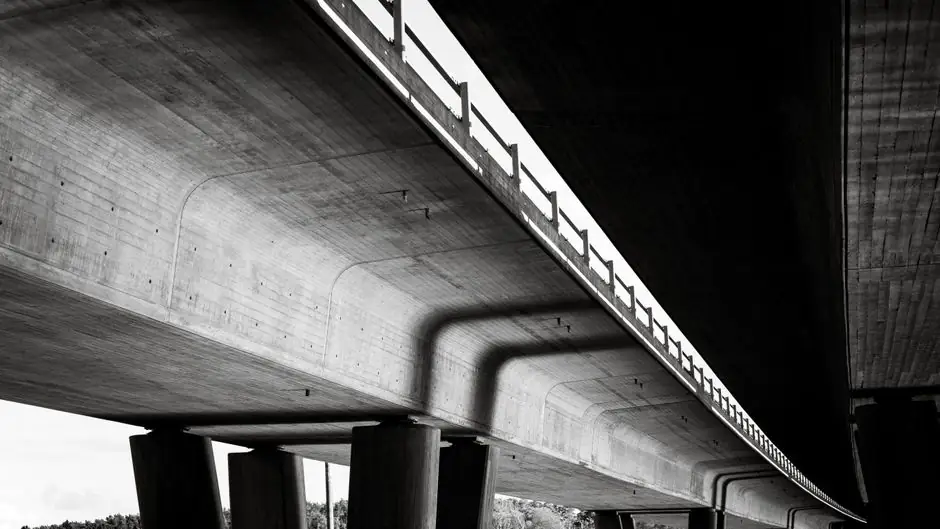
Bridge construction layout is dominated by rotary grade lasers with mm-tracking receivers, because pier cap elevations, deck screed rails, and abutment bearing seats must hold a slope of 0.1–2% across runs that routinely exceed 200 m [S6][S10].
For pier, abutment, and deck-slab work, the practical toolset splits into three classes: dual-grade rotary (both X and Y axes), single-grade rotary, and self-leveling cross-line or 3×360° units used inside formwork; beam color (green vs red), IP rating, and self-leveling range determine the fit on a live bridge site [S3][S8][S9].
Accuracy, Beam, and Self-Leveling Numbers That Decide the Pick
Construction-grade cross-line units are commonly specified at ±1/8 inch (≈3.2 mm) at 33 feet (10 m), with consumer units drifting to ±3/16 inch (≈4.8 mm) at 33 feet, a tolerance the source flags as unacceptable for structural or mechanical layout [S8]. Rotary grading work needs finer numbers: a working tolerance of ±1.5 mm at 30 m is a typical site benchmark for rebar and form rail, while high-precision 3D green-beam units are rated at ±3 mm at 10 m in the 4×360° class [S4][S7]. Green beams are reported at up to 4× the visible brightness of red, a meaningful difference on bright deck pours, at the cost of roughly 2–3× the battery draw for the same diode class [S3][S9].
Self-leveling range separates pendulum from electronic-servo instruments: pendulum units correct within ±3° to ±5° of tilt, while electronic-servo units reach ±5° to ±8°, the wider window matters when the laser is set on rough deck soffit formwork or battered rebar chairs [S8]. A reference laser level layout that covers beam class, working range, and self-leveling range is the cleanest way to keep the comparison fair across vendors.
Bridge Work Breaks Down Into Three Tool Profiles
For outdoor grade work, dual-grade rotary lasers are specified because pier approaches, deck drainage, and abutment backfill need compound slopes on both X and Y axes; a single-grade rotary handles one-axis runs such as drainage trenches and pipe crossings, with grade set as a fall/run percentage, for example (100 mm ÷ 6000 mm) × 100 = 1.667% [S6][S10]. Working radius with a tracking receiver reaches 1150 ft (≈350 m) on green rotary units in the consumer/prosumer tier, which is enough for full-span bridge decks without moving the instrument [S3].
For indoor formwork, rebar cage alignment, and bearing-seat layout, a 3×360° or 4×360° self-leveling cross-line laser is the right tool, since it gives full horizontal and vertical planes in one set-up; IP54 is the typical minimum rating cited for construction dust and water exposure, with some rotary and 3D units specified higher for rain-prone pours [S3][S4]. For masonry substructure (pier shafts, abutment walls), the selection logic overlaps with the masonry spec map, where the same ±1.5–3 mm at 10 m window and 3×360° coverage apply [news:laser-level-selection-for-masonry-2026-spec-map].
Comparison of the Three Classes Against Bridge Tasks

The decision hinges on four criteria: working range, slope capability, environment sealing, and beam visibility. Dual-grade rotary (e.g. EL614GM, EGL624GM) scores high on range (with receiver) and on compound slope, but is overkill for single-axis rebar cages; single-grade rotary fits trench and drainage runs cheaply but cannot hold a deck cross-fall; 3×360° self-leveling cross-line wins indoor formwork because every plane is visible without rotating the head, yet it cannot match rotary range outdoors without a pulse-mode receiver [S3][S6][S10].
For electrical and lighting runs inside bridge service galleries, a separate spec map narrows the choice to IP54+ cross-line units with pulse-mode receivers and stable green beams, a useful contrast that shows how the bridge-deck pick is driven by range and grade rather than by IP alone [news:laser-level-picks-for-electrical-installation-beam-accuracy-ip]. The reference page on construction tools frames where each of these classes sits in the broader layout-toolkit chain, alongside the heavier construction machinery and equipment used for pier and girder erection.
Who a Bridge Laser Level Is For, and Who Should Skip It
It is for the layout engineer, surveyor, or foreman who needs to set pier cap elevations, screed rails, bearing seats, parapet bases, and deck drainage grades to within a few millimetres across long runs, and who is willing to mount the laser on a heavy-duty tripod and walk the site with a tracking receiver [S6][S10]. It is not for small residential slab work (a 30 m cross-line is sufficient) and not for girder or segment erection, where total stations and GNSS-guided machine control carry the alignment instead.
If the bridge sits within a larger project that already runs total-station machine control on the same control network, a rotary grade laser is a low-cost redundancy for the wet-deck and finishing crews rather than the primary alignment tool, a role split that mirrors the way overhead bridge crane alignment on the precast yard still leans on laser and string-line checks even where total stations are available.
Failure Modes and Field Constraints to Plan Around
Three failure modes dominate site reports: (1) drift when the instrument is set up off-level beyond its self-leveling window, which in pendulum units can be as tight as ±3°, so a rough tripod base silently degrades the reading; (2) beam dropout in direct sun on long runs, mitigated only by green diodes plus a pulse-mode mm-tracking receiver, not by a red beam at the same power; (3) slurry, dust, and rain fouling the housing, which is why IP54 is the cited minimum and IP65 is the safer pick for pier and deck pours [S3][S4][S8]. Battery life is the quieter constraint: red-diode units run 2–3× longer than green-diode units of the same class, which on a long pour shifts the trade toward red if range and receiver sensitivity are equivalent [S9].
Two operational rules follow. First, walk the receiver along the full run before any concrete is placed, to confirm that the grade percentage set on the laser matches the design slope; a 1% error on a 300 m run is 3 m of vertical drift, which is enough to scrap a drainage run. Second, record beam color, diode class, working range with receiver, and IP rating in the calibration log; these four fields, plus last-check date, are the same fields used to compare units in published selection tables [S4][S10].
Selection Checklist, Standards, and Trackable Signals
A working selection checklist for a bridge package: dual-grade rotary with mm-tracking receiver for deck and approach slab; single-grade rotary for drainage, trench, and pipe runs; 3×360° or 4×360° self-leveling cross-line for formwork, rebar cages, and bearing seats; green beam where sun exposure is unavoidable, red beam where battery endurance and cost dominate; IP54 minimum, IP65 preferred for outdoor pours; working tolerance ±1.5–3 mm at 10 m; self-leveling range ±5° to ±8° for uneven deck formwork [S3][S4][S6][S8][S9][S10].
Trackable signals for the next cycle: published updates to IP and beam-color guidance on the major rotary-laser product lines (Leica, Topcon, Spectra, RedBack), and any revision of the slope-and-grade guidance that tightens the working tolerance for deck-screed rails below the current ±1.5 mm at 30 m benchmark.
See also our earlier report, Dynamic Compactor Selection for Pipeline Trench Backfill.