
Tunnel heading and invert work demands a laser level with a minimum 1,000 ft (305 m) working range, IP66 or higher sealing against dust and shotcrete mist, and dual-axis self-leveling rated to ±5 degrees, because the instrument has to stay live across long sight lines where re-setup adds hours per advance ring.
For shield-driven tunnels, the dominant failure mode is segment uplift caused by buoyant grout pressure exceeding engineering-code limits, so a laser-target guidance system surveyed at 10-20 m intervals along the lining is the practical mitigation that surveying crews actually run.
Why Tunnel Heading Work Stresses a Laser Level Differently
A tunnel heading is a confined, humid, dust-laden, dim space that punishes instruments on three axes at once: visibility, sealing, and stability. Green-beam diodes (515-532 nm) are perceived up to four times brighter than red (635-660 nm) under the low-light conditions typical of a heading face, which is why green rotary lasers dominate TBM and NATM guidance packages even though they cost more and drain batteries faster [S1].
Vibration from blasting, muck cars, and shotcrete robots makes a stable mount non-optional. Adjustable-leg tripods with fiberglass or hardened-aluminum legs are the common choice because each leg can be set independently to find level on rail-mounted or uneven invert surfaces, and fiberglass reduces temperature-induced drift on long shifts [S1]. Common tripod extension spans 3-6 ft, with elevating models reaching 6-8 ft or more for invert-to-crown control [S1].
Specification Criteria for a Tunnel-Grade Laser Level
The selection table below lines the four common beam formats against the criteria that actually drive a tunnel engineer's purchase decision. [S2]
Dot laser: shortest range (typically under 100 ft), best for plumb-down shaft transfer and pipe-invert referencing, low cost, poor visibility across a heading.
Line laser: 50-100 ft useful range in a heading, ideal for formwork and segment alignment at the immediate face, single-plane reference, limited for long-distance drive control.
Rotary laser (red, 635 nm): 1,500-2,000 ft range with a detector, mature battery ecosystem, harder to see in dim headings without a target plate.
Rotary laser (green, 515-532 nm): same 1,500-2,000 ft range, perceived 4x brighter in low light, higher battery draw, premium price tier, dominant in modern TBM guidance.
For tunnel cross-section control and invert grade setting, a rotary laser with an IP66-rated housing, a 5/8-11 thread mount, and a detector package is the workhorse choice [S1].
Tripod and Mount Pairing for Tunnel Geometry
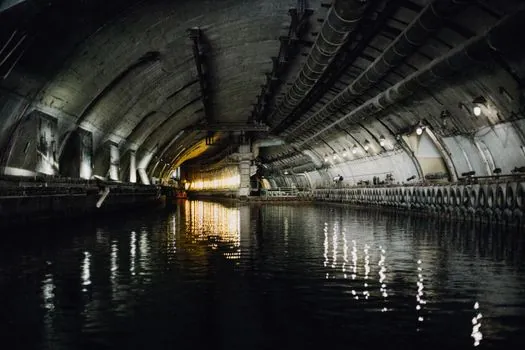
Tripod choice is not a footnote; it sets the working height and the vibration floor of the whole reference plane. Adjustable-leg aluminum or fiberglass tripods dominate because they can be leveled on rail ties, muck, and uneven invert without blocking, and elevating tripods with a crank allow fine height setting without re-shimming [S1].
Thread pattern matters in the field: most professional rotary lasers and automatic levels use a 5/8-11 thread, while smaller line and dot lasers use 1/4-20; mixing them without an adapter stops a job at midnight [S1]. For long tunnel drives, a heavy-duty elevating tripod with steel spike shoes and fiberglass legs is the pairing that holds calibration across a 10-hour shift.
Shield Tunnel Monitoring: Where Lasers Meet the Lining
Segment uplift during shield excavation is the deformation mode that laser monitoring is specifically tasked to catch. Grout injected into the tail void exerts a persistent upward buoyant force on the segment ring, and when grout setting is delayed, uplift can exceed engineering-code limits, causing segment misalignment, water ingress, and cracking [S4]. A laser-target-based tunnel guidance system surveyed longitudinally along the lining during excavation is the standard measurement approach for tracking this movement [S4].
The reference vertical datum for that monitoring chain is the lower ground level, the binding elevation line for excavation pit bottoms, foundation undersides, pipe inverts, and removal limits in rock and tunnel construction [S3]. In a tunnel context, the LGL defines the invert target and the toe of every bench; it is the elevation that the laser reference plane is locked to at every set-up.
Survey Method, Standards, and 3D Verification
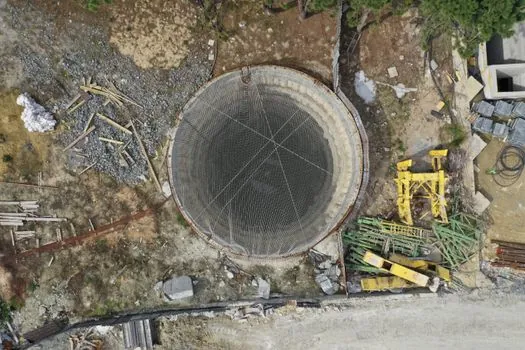
For existing tunnel conditions, determination of the lower ground level combines leveling, total station work, and GNSS where surface control allows; in complex break-edges and shored sections, 3D laser scanning at short station intervals is the reliable method for deriving a consistent terrain profile across sections and plan sheets [S3]. The same scanning workflow is documented in recent 2026 service-performance work on shield tunnels, where 3D laser scanning data feed analytical models of long-term lining behavior [S2].
Three concrete rules apply across both new-build and service-stage laser work: (1) traceable benchmarks with documented instrument accuracy and a named reference elevation; (2) distinct line styles or color coding in plans to separate existing versus target LGL; (3) explicit stationing and cross-section references so any point on the lining is reproducible from the log [S3].
Limitations and Failure Modes in Tunnel Service
Even a correctly specified rotary laser fails in three predictable tunnel scenarios. First, condensed water and shotcrete mist will defeat an IP54 housing in weeks; IP66 is the practical minimum, IP67 the safer pick for headings with active spraying. Second, beam occlusion by rebar, ventilation ducting, and moving equipment breaks the detector lock; planning detector positions at 10-20 m intervals avoids long stand-off gaps in the reference plane. Third, long-term segment movement is governed by grout buoyancy and groundwater pressure, not by initial set-out accuracy, which is why the laser guidance system is paired with longitudinal laser-target monitoring rather than used as a one-time set-out tool [S4].
For demolition adjacent to live tunnels, a separate spec map applies, and the demolition-focused laser level picks cover range, IP rating, and beam visibility in that context.
For HVAC shaft and plenum work that often runs off the same tunnel contract, the HVAC laser level trade map lines dot, line, and rotary formats against dot-count, self-leveling range, and mounting thread.
Trackable signals to watch: revision of the 5/8-11 versus 1/4-20 mount standard across mid-tier rotary lines, and wider adoption of green-beam diodes in IP67-rated rotary housings as battery density improves. The relevant encyclopedia references for adjacent specification work are construction tools and the broader construction machinery and equipment category.