
The most common 2026 mis-spec on a laser marker order is buying wattage before defining the part, the throughput, and the mark itself. Selection is a three-axis problem: laser source against material, mechanical configuration against daily volume, and galvo field against the largest marking area in the catalog [S1][S2].
Industrial fiber and CO2 markers ship in a working area band of roughly 110x110 mm to 300x300 mm per galvo field, with pulsed fiber sources running 20 W, 30 W, 50 W, 60 W, and 100 W steps; CO2 RF markers cluster at 30 W, 60 W, and 100-150 W [S3][S4][S7]. Galvo-side marking speed hits 10,000-12,000 mm/s, positioning speed up to 15,000 mm/s, and beam quality (M-squared) under 1.5 is the published norm for closed fiber benches [S4][S7][S8].
Step 1: Material Dictates the Laser Source
Material-to-wavelength pairing is the first hard filter: metals and most engineering plastics mark cleanly on a 1064 nm pulsed fiber source, while organics such as wood, leather, paper, acrylic, and coated cardboard absorb strongly at the 10.64 µm CO2 line [S2][S8]. For aluminum, which is more refractory than mild steel, fiber lasers at 30-50 W with short focal lengths are the published recommendation to keep DataMatrix codes readable after sandblasting [S2].
Plastics diverge further. UV (355 nm) and green (532 nm) sources are called out specifically for PMMA, ABS, and other polymers where fiber IR would carbonize or distort the surface; a MOPA fiber architecture covers the most common plastics and metals in a single bench and is the default for general workshops [S2]. On a CO2 platform, the published working wavelength is fixed at 10,640 nm, and a red-light preview is the standard aiming system on 30 W and 60 W RF models [S4].
Step 2: Volume Dictates the Mechanical Configuration
For 50-200 parts/day, a Z-axis-only station with manual repositioning is the published economical configuration; moving to an XZ two-axis system at 200-500 parts/day raises productivity by up to 25% on the same laser head [S2]. Above 500 parts/day, the mainstream options split into rotary-table (W-axis) systems that mark while the next part is being loaded, and XYZ gantry markers that run full pallets in one cycle [S2].
Volume also interacts with mark area. A desktop closed fiber bench typically covers a 110x110 mm to 200x200 mm field, handhelds expose roughly a 100x100 mm to 150x150 mm marking window at 0.01 mm positioning accuracy, and a 3D scan-head option (StellarMark 3DS-class) is required when the part is round, cylindrical, or otherwise non-flat [S3][S5][S6]. For wide-web or multi-zone production, multi-head CO2 systems string 3 or 6 galvos on a single beam path to extend the effective field to 1,800 mm or 3,600 mm [S4].
Step 3: Mark and Throughput Requirements
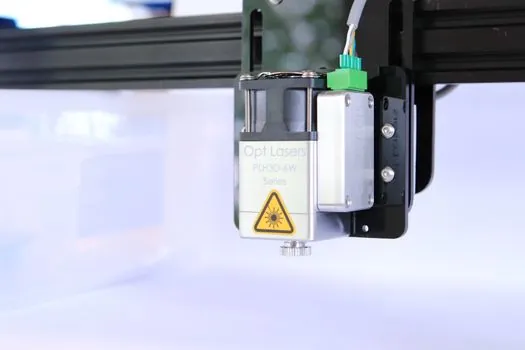
Mark requirements beat raw speed. A 0.01-0.20 mm engraving depth on metal or hard plastic is typical for a 20 W handheld, a 0-1.5 mm adjustable depth band is published for closed fiber benches running at or below 100 kHz pulse repetition, and spot quality around 0.23 mm at a 300x300 mm field is the standard published figure for mid-power CO2 RF markers [S4][S6][S7]. High-energy per-pulse operation (≤100 kHz) is what enables the deeper engraving range; once the pulse rate climbs, energy per pulse drops and so does achievable depth [S7].
Throughput is a function of three numbers, not one: galvo marking speed (10,000-12,000 mm/s typical), positioning speed (up to 15,000 mm/s), and content density per cycle. Higher wattage does not automatically mean higher throughput; content, fixturing, and motion strategy decide cycle time, with 20-100 W industrial fiber wattage widely available to cover most cases [S1][S4][S7]. Repeatability of under 8 µrad and 8-hour long-term drift below 0.2 mrad are the published alignment-stability thresholds for mid-power CO2 RF and fiber systems [S4].
Comparison: Four Realistic Options Against Four Criteria
Four common 2026 platforms line up as follows against the criteria a buyer actually weighs: desktop closed fiber (20-50 W, 110x110-200x200 mm field, air-cooled, 0.01-0.20 mm depth, low cost per mark); handheld 20 W fiber (portable, 0.01 mm accuracy, 0.01-0.20 mm depth, fits large or fixed parts); CO2 RF 30-60 W (10,640 nm, 300x300-500x500 mm field, 0.23 mm spot, water-chilled, organics and coated materials); 3D scan-head fiber (200x200-300x300 mm field, round/cylinder capable, 20-50 W) [S3][S4][S5][S6][S7][S8].
On a 1 to 4 ranking against cost, portability, deepest achievable mark, and round-part capability, the desktop fiber scores high on cost and deep marking, low on portability; the handheld inverts that with high portability and lower per-station cost; the CO2 RF wins on field size and organic-material throughput but is bulky and needs a chiller; the 3D fiber is the only practical option for non-flat parts [S3][S4][S5][S6][S7][S8].
Who Should Not Pick the Mainstream Option
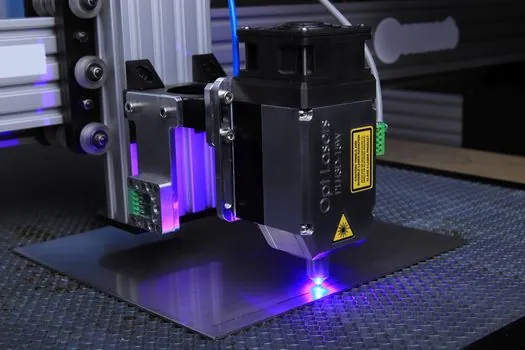
Buyers who mark only on round shafts, pipes, or contoured housings should skip flat-field galvo systems entirely, because a 2D fiber head cannot hold focus across curvature and the mark will distort at the edges. A W-axis rotary fixture, a 3D scan-head galvo, or a five-axis (XYZ + rotary) cell is the correct starting point, even at lower volume [S2][S3].
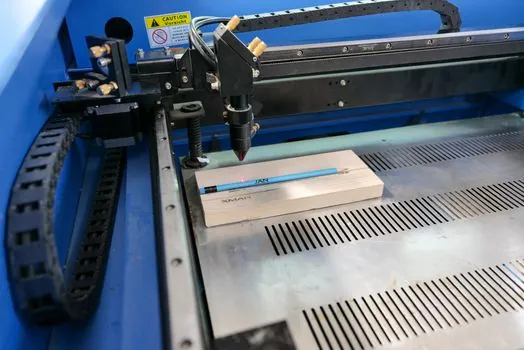
Buyers who run primarily organics (wood, leather, cardboard, acrylic) should not order a fiber marker as the primary station: a 1064 nm source is largely absorbed or reflected by these substrates and produces poor contrast or fire risk; a 30-150 W CO2 RF platform with industrial water chiller is the documented fit [S2][S4]. Conversely, a CO2 head is wasted on bare metal marking, where fiber delivers the contrast and depth at lower wattage [S2].
Spec Checklist and Failure Modes
Rocklin's published 2026 checklist pins seven items: part material and coating, largest part plus smallest marking area, required content (text, logo, 2D code, depth), target cycle time and daily volume, portability vs bench station, 3D-marking need for round or uneven parts, and integration scope (automation, fixtures, extraction, safety) [S1]. The common failure modes the same checklist calls out are fixture drift, neglected fume extraction on plastic and coated-metal jobs, and under-sized galvo fields that force multi-pass marking on what should be a single-cycle job [S1].
Cooling is a quiet constraint: air-cooled fiber units are standard on 20-50 W desktops and handhelds, while 30-150 W CO2 RF models require an industrial circulation water chiller, with 220 V or 380 V 50/60 Hz supply and roughly 130-180 cm cabinet footprints depending on power class [S4][S5][S6]. Under-rated extraction is the most common code-compliance gap on plastic and coated-metal cells and should be specified at the same time as the laser marker itself.
Adjacent Specs Worth Tracking
Two adjacent 2026 reference paths help close the loop: a Code Reader Sizing and Selection guide covers the verification side of the mark, since a fiber or CO2 station is only half of a closed-loop marking cell, and an Industrial Code Reader Suppliers map is the natural next step when DMC contrast after coating or passivation becomes the bottleneck. For buyers sourcing complete traceability cells, these reads should be sequenced before final PO, not after. [S1]
Trackable signals over the next sourcing cycle: published working-area extensions on multi-head CO2 systems (currently up to 3,600 mm on 6-head builds), beam-quality M-squared values under 1.5 on closed fiber benches, and pulse-repetition ceilings at or below 100 kHz for high-energy engraving [S4][S7][S8]. If a quote skips any of these four numbers (field, spot, repeatability, drift), treat it as an incomplete spec and request the data sheet before signing.
Spec-level background on the components involved: linear guide, and crossed roller guide.