
Industrial laser marker selection starts with substrate absorption at the laser's wavelength, not with brand or wattage: ferrous and non-ferrous metals absorb strongly at 1064 nm (fiber), organics and most polymers absorb at 10.6 micron (CO2), and precious metals plus heat-sensitive plastics need 355 nm UV or 532 nm green to avoid thermal damage [S3][S5].
A practical 2026 spec-first flow covers four decisions in order: substrate class, required mark contrast or depth, throughput/cycle time, and laser class plus enclosure. Buying on laser source first, or on lowest sticker price, is the most common way to end up with a marker that either cannot mark the part or fails the safety audit [S4][S6].
Step 1: Match Wavelength to Substrate Absorption
Substrate-wavelength pairing is the single highest-impact decision, because a laser only marks well when the material absorbs its output. Ferrous and non-ferrous metals (steel, aluminum, copper alloys) absorb fiber at 1064 nm efficiently, which is why fiber dominates metal marking [S3]. Organic substrates (wood, paper, leather, glass, acrylic, many rubbers) absorb CO2 at 10.6 micron and are commonly marked with CO2 galvo systems, often described as a non-contrast, surface-discoloration mark [S1][S5].
UV at 355 nm and green "Wave" at 532 nm are the only realistic options on heat-sensitive plastics, films, glass, and precious metals such as gold and silver, where the 1064 nm and 10.6 micron bands are reflected rather than absorbed and would scorch or fail to mark [S3]. For comparison, here is a quick decision matrix on three criteria:
Fiber 1064 nm: best for metals and many engineering plastics, high contrast annealed or etched marks, Class IV typically requiring an enclosure. CO2 10.6 micron: best for organics (wood, glass, paper, acrylic, rubber, cardboard), non-contrast surface marks, often usable behind acrylic shielding on an open floor [S5]. UV 355 nm / Green 532 nm: best for heat-sensitive plastics, glass, and precious metals, cold-marking with minimal HAZ, lower power and slower throughput.
Step 2: Define the Mark Type Before Sizing Power
Mark type, not just material, drives the next decision. A frosted background with dark foreground is the typical readable barcode configuration when downstream vision systems need reliable contrast; CO2 and fiber can both deliver that, but the appearance is set by wavelength and pulse profile, not by raw wattage [S5]. Deep engraving for tooling or aerospace traceability, often 0.1-0.5 mm into the part, calls for a fiber source with sufficient pulse energy and a MOPA architecture for flexible pulse width, rather than a higher-wattage Q-switched unit aimed at speed [S3].
Surface color marking on stainless or titanium, used for logos and aesthetic part numbers, is a MOPA fiber or picosecond fiber application: the mark is an oxide-layer color, not ablation, so peak power and pulse duration matter more than average wattage. Buyers who ask for "the highest wattage fiber" without naming the mark type usually end up over-powered for color marks and under-powered for deep engraving [S3].
Step 3: Throughput, Cycle Time, and Work Area
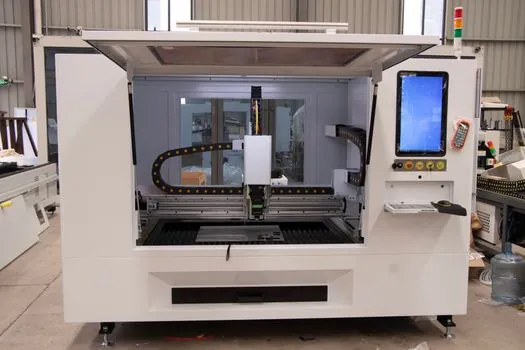
For stand-alone cells, throughput is best framed as cycle time, defined as the time from part introduction to the read of the 2D code (where vision verification is fitted), rather than raw characters-per-second [S3]. The work envelope (marking field, typically 110x110 mm, 150x150 mm, or 200x200 mm on galvo heads) must fit the largest face you need to mark; larger fields reduce throughput because the galvo acceleration has to stay within the focal budget, and you generally cannot "zoom" past the stated field without losing spot quality [S4][S6].
If your line runs mixed SKUs, plan for a 3-axis or rotary fixture so the marker reaches curved surfaces, cylinders, and tall features without re-fixturing. A flat-only 2-axis head is the budget choice, but it caps you on geometry, which is a hidden cost that shows up later as manual handling or rejected marks on tapered parts. For multi-station cells, budget for a fume extractor, a chiller sized to the laser source's heat load, and a vision system if the part carries a 2D code that must be validated inline [S3].
Step 4: Laser Class, Enclosure, and Shop-Floor Placement
Laser safety classification sets the room you need, not just the goggles you buy. Class I systems (fully enclosed, interlocked workstations) can sit on an open shop floor next to operators; Class IV open-beam systems, which include most un-enclosed fiber markers, must be in a dedicated room with area posting, interlocked doors, key switch, and CDRH-aligned controls, and operators must have the right wavelength-rated eyewear [S5]. CO2 at 10.6 micron is often usable on an open floor behind acrylic (Plexiglas) shielding because acrylic blocks the 10.6 micron beam, but fiber at 1 micron passes straight through common transparent guards, which surprises first-time buyers [S5].
If the marker will replace ink jet, dot peen, or labels, plan a Class I workstation as a drop-in: the cabinet, interlocks, extraction port, and laser source arrive as one tested unit, which shortens safety review and EHS sign-off. Open-frame Class IV installations are cheaper up front and more flexible, but they shift the integration cost and compliance burden onto the buyer, a trade worth pricing explicitly [S5].
Step 5: Lifetime Cost, Consumables, and Service

Diode- and fiber-pumped sources are commonly rated around 100,000 hours of operational autonomy with no consumables beyond optics cleaning and occasional filter changes, which is a real sustainability and operating-cost win over ink jet, dot peen, and label systems that consume paint, ribbons, or adhesive stock [S3]. Quote the lifetime number on a like-for-like basis: hours of marking beam-on time, not calendar years, because a 24/7 line and a single-shift job shop will get very different service intervals out of the same source.
Total cost of ownership also has to absorb the accessories: vision system for 2D code verification, fume extraction matched to substrate (plastics and some coated metals need different filtration than bare metal), chiller or air-cooled head, and any rotary or linear motion stage. Specifying these as options rather than as line items is the classic way a quoted "laser marker" doubles in price between RFQ and PO [S3][S6].
Who Should NOT Pick the Default Fiber Marker
Despite fiber's dominance on metal, it is the wrong default for several common cases. If the part is clear polycarbonate, PE/PP film, or thin-wall medical plastic, fiber 1064 nm will melt or stress-whiten the surface; step down to UV 355 nm or green 532 nm, or accept a CO2 mark where contrast allows. If the substrate is anodized aluminum and the mark must not breach the anodic layer, specify UV or MOPA fiber with controlled pulse width, not a generic high-power Q-switched unit. If the part is glass and the aesthetic must be a clean frosted etch without micro-cracks, CO2 with controlled pulse or a picosecond source outperforms a stock fiber marker [S1][S3].
Buyers who only need a Class I enclosed cell for a regulated line, such as medical device UDI or aerospace part traceability, should also resist open-frame fiber even when it is cheaper: the enclosure is not a luxury, it is the path of least resistance to FDA and AS9100 audit readiness. Compare the options on substrate, mark type, throughput, and laser class before any brand is named, because no single vendor beats physics on the wrong wavelength [S5][S6].
Shortlist Logic and Trackable Signals
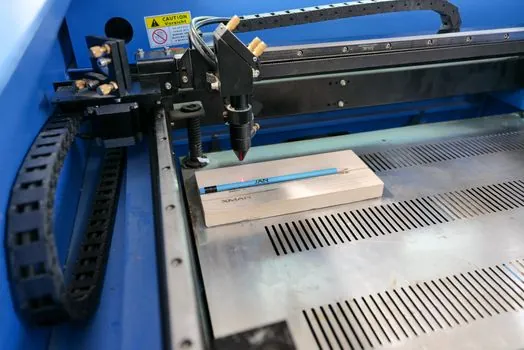
A workable shortlist follows the four steps in order: (1) write down the substrate and required mark type; (2) lock the wavelength family (fiber / CO2 / UV / green) and pulse class (Q-switched vs MOPA vs picosecond); (3) size work area to the largest part, not the average; (4) decide Class I workstation vs Class IV room based on floor plan and EHS posture. Only then compare brands on service network, controller ecosystem, and vision integration. Buyers who follow this order land on a marker that is fit for the part, the line, and the audit; the rest is negotiation [S4][S6].
Two trackable signals to watch over the next 6-12 months: MOPA fiber pricing continuing to fall as the picosecond source category matures, and tighter CDRH/IEC 60825 enforcement pushing more Class IV installs into Class I enclosures, both of which will shift the cost-per-station curve in favor of fully integrated workstations. For buyers sizing a line today, the safe move is to budget a Class I enclosed marker, hold the wavelength decision until sample marks exist on the actual production parts, and pilot a 2D code read-rate test before locking the cell layout.
Spec-level background on the components involved: laser marker, laser level, and laser profiler.
Background reading: Architectural hardware selection for industrial facilities: a spec-first playbook.